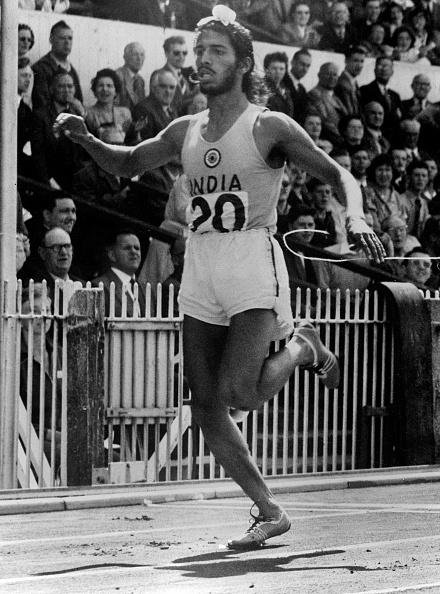
There are athletes who win medals.
There are athletes who break records.
And then there are athletes whose stories become part of a nation’s memory.
Milkha Singh was one of them.
Known around the world as the “Flying Sikh,” Milkha Singh became one of India’s greatest track-and-field athletes. His journey from a difficult childhood to international sporting fame remains one of the most inspiring stories in Indian sports.


👤 Milkha Singh — Personal Details
| Detail | Information |
|---|---|
| Full Name | Milkha Singh |
| Popular Name | The Flying Sikh |
| Born | 20 November 1929 |
| Birthplace | Govindpura, Punjab Province, British India |
| Sport | Athletics |
| Speciality | 400 metres / middle-distance running |
| Olympics | 1956, 1960, 1964 |
| Asian Games Gold Medals | 4 |
| Commonwealth Games Gold | 1 |
| Major Honour | Padma Shri, 1959 |
| Died | 18 June 2021 |
Milkha Singh was born on 20 November 1929 in Govindpura, which was then part of British India and is now in Pakistan. He died on 18 June 2021, aged 91. (olympics.com)
🌱 A Childhood Shaped by History
Milkha Singh’s childhood was deeply affected by the Partition of India in 1947.
He lost several members of his family during the violence surrounding Partition and eventually made his way to India.
The experience left a profound mark on his life.
But rather than allowing his difficult childhood to define his future, Milkha Singh eventually found a new direction through sport.


His journey from displacement and hardship to becoming an international athlete is one of the most remarkable aspects of his story.
🪖 Joining the Indian Army
Milkha Singh joined the Indian Army in the early 1950s.
It was there that his athletic potential began to receive serious attention.
Running became part of his military training, and he gradually discovered that he possessed extraordinary endurance and speed.


The Army provided him with the discipline and environment necessary to develop his abilities.
From this point, running was no longer simply exercise.
It became his life’s mission.
🏃 The Birth of a Champion
Milkha Singh trained with remarkable dedication.
His routine demanded enormous physical effort.
Long-distance training, speed work, strength exercises and strict discipline became part of his daily life.
He gradually developed into one of India’s finest runners.
His performances soon took him beyond domestic competitions and onto the international stage.
🇮🇳 Representing India at the Olympics
Milkha Singh competed at three Olympic Games:
🏟️ Melbourne — 1956
He made his Olympic debut at the 1956 Melbourne Games.
The experience was difficult, but it gave him valuable exposure to the world’s best athletes.
🏟️ Rome — 1960
The 1960 Rome Olympics became the most famous race of his career.
🏟️ Tokyo — 1964
He later represented India at the Tokyo Olympics as well.


🏟️ The Famous 1960 Rome Olympic Race
The 400-metre final at the 1960 Rome Olympics became one of the defining moments of Milkha Singh’s career.
He finished fourth.
A medal was incredibly close.
His recorded time was 45.6 seconds, which was then an Indian national record. (olympics.com)
Although he did not win an Olympic medal, his performance made him one of India’s most celebrated athletes.
For decades, the race remained one of the most talked-about moments in Indian athletics.
🥇 Asian Games Glory
While an Olympic medal remained just out of reach, Milkha Singh dominated the Asian Games.
He won four gold medals during his Asian Games career.
His victories came in:
- 🥇 200 metres
- 🥇 400 metres
- 🥇 400 metres
- 🥇 400 metres
His success helped establish him as one of the leading athletes in Asian track and field.


🥇 The 1958 Commonwealth Games
Another historic achievement came in 1958.
Milkha Singh won the 400-metre gold medal at the Commonwealth Games in Cardiff.
He became the first Indian male athlete to win an individual Commonwealth Games athletics gold medal. (olympics.com)
This victory made him an international sporting star.
It also demonstrated that an Indian athlete could compete successfully against some of the world’s strongest runners.
🇵🇰 The Race That Created the “Flying Sikh”
One of the most famous chapters of Milkha Singh’s story took place in Pakistan.
In 1960, he competed against Pakistan’s leading sprinter Abdul Khaliq.
Milkha Singh won the race.
After watching his performance, Pakistan’s President Ayub Khan reportedly gave him the famous title:
“The Flying Sikh.”

The nickname stayed with him for the rest of his life.
🏆 Why the Nickname Became So Famous
“The Flying Sikh” perfectly captured the image people had of Milkha Singh.
He was known for his:
- ⚡ Speed
- 💪 Strength
- 🏃 Endurance
- 🎯 Focus
- 🧠 Mental toughness
- 🇮🇳 Determination
His running style and competitive spirit made him instantly recognizable.
📊 Milkha Singh’s Major Sporting Achievements
Milkha Singh’s career included numerous international victories.
🥇 1958 Asian Games
Gold in 200 metres.
🥇 1958 Commonwealth Games
Gold in 400 metres.
🥇 1962 Asian Games
Gold in 400 metres and 4×400-metre relay.
🏟️ 1960 Rome Olympics
Fourth place in the 400-metre final.
🏟️ 1956 Melbourne Olympics
Olympic debut.
🏟️ 1964 Tokyo Olympics
Third Olympic appearance.
His record made him one of India’s most successful athletes of the 20th century. (olympics.com)
🏅 Padma Shri
The Government of India honored Milkha Singh with the Padma Shri in 1959.
It was recognition of his extraordinary contribution to Indian sport.
🌍 More Than a Runner
Milkha Singh’s influence extended beyond athletics.
After retiring from competitive running, he continued to promote sport and fitness.
He encouraged young Indians to take athletics seriously and pursue their dreams through discipline.
His story became particularly powerful because he had started with so little.
❤️ Milkha Singh and His Family
Milkha Singh married Nirmal Kaur, a former captain of the Indian women’s volleyball team.
The couple had three daughters and a son, Jeev Milkha Singh, who became a professional golfer.


Sport therefore remained an important part of the family’s life.
🏌️ His Son Also Became a Champion
Milkha Singh’s son, Jeev Milkha Singh, went on to become a successful professional golfer.
He represented India internationally and established himself on the professional golf circuit.
This created a fascinating sporting legacy across two different generations.
🎬 The Story Reached the Big Screen
Milkha Singh’s extraordinary life later became the subject of the Hindi film Bhaag Milkha Bhaag, released in 2013.
The film introduced his story to a new generation of viewers.


The movie helped bring renewed attention to his childhood, athletic career and Olympic journey.
🕯️ His Final Years
Milkha Singh continued to be associated with athletics and Indian sport long after his competitive career ended.
He remained an inspiration to athletes and young people across India.
He died on 18 June 2021 in Chandigarh after complications related to COVID-19.
His wife Nirmal Kaur had died a few days earlier. (olympics.com)
His death marked the end of an extraordinary chapter in Indian athletics.
🤯 Interesting Facts About Milkha Singh
1. 🏃 He competed at three Olympics
Melbourne 1956, Rome 1960 and Tokyo 1964.
2. 🥇 He won four Asian Games gold medals
His Asian Games record was exceptional.
3. 🥇 He won Commonwealth Games gold
His 1958 victory was historic for Indian athletics.
4. ⚡ He became the “Flying Sikh”
The nickname came after his famous race in Pakistan.
5. 🏅 He received the Padma Shri
India honored him in 1959.
6. 🏌️ His son became a professional golfer
Jeev Milkha Singh built his own international sporting career.
7. 🎬 His life inspired a major film
Bhaag Milkha Bhaag introduced his story to millions of people.
8. 🏟️ His Rome performance became legendary
He narrowly missed an Olympic medal in the 400 metres.
💡 What Can We Learn From Milkha Singh?
Milkha Singh’s life teaches lessons far beyond athletics.
1. Your beginning does not determine your ending.
His childhood was filled with hardship, but he built an extraordinary future.
2. Discipline can transform talent.
Natural ability becomes powerful when combined with consistent training.
3. Failure does not have to be the end.
His fourth-place finish in Rome could have broken his confidence, but instead it became part of his legacy.
4. Representing your country is a privilege.
Milkha Singh always carried enormous pride in running for India.
5. Success can inspire generations.
His greatest legacy may be the young athletes who were inspired to run because of his story.
🇮🇳 The Legacy of the Flying Sikh
Milkha Singh’s story is extraordinary because it contains almost everything an inspiring sports story needs:
A difficult childhood.
A new beginning.
Hard training.
International competition.
Victories.
Heartbreaking defeats.
And an unforgettable legacy.
He may not have won an Olympic medal, but his achievements helped place Indian athletics on the international stage.


🏁 Final Thoughts
Milkha Singh once ran races that lasted less than a minute.
But the impact of those races lasted for generations.
From the difficult circumstances of his childhood to the world’s biggest sporting arenas, his journey demonstrated what determination can accomplish.
He became India’s Flying Sikh not simply because he ran fast, but because he showed millions of Indians how far determination could take a person.
🏃 Milkha Singh didn’t just run for medals. He ran for a dream, for India, and for generations that came after him. 🇮🇳
🇮🇳 MANA BHARATHAM
Stories, Facts & Wonders From India
🌐 Website: allpincodes.online
📖 Blog: MANA BHARATHAM
Know India. Explore India. Celebrate India. 🇮🇳
Leave a Reply