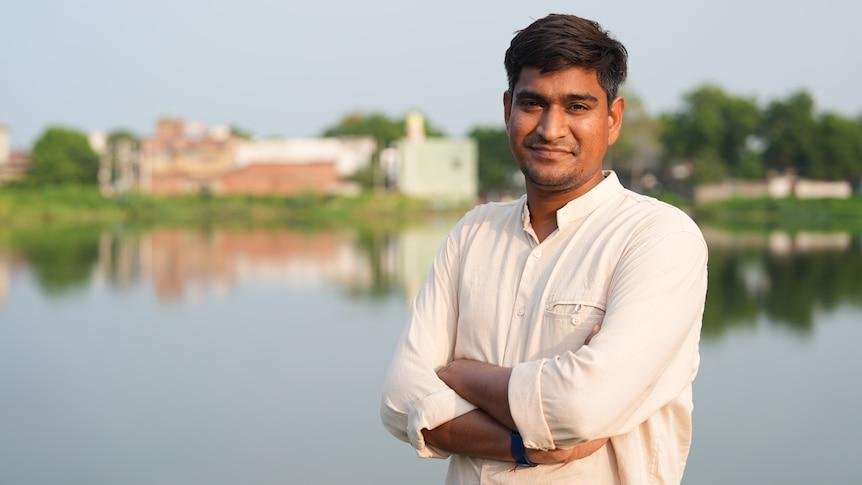
From Polluted Ponds to Living Ecosystems — The Unsung Water Warriors of India
India has thousands of ponds, lakes, tanks, wetlands and rivers that have supported communities for generations. But pollution, plastic waste, sewage, encroachment, siltation and neglect have damaged many of these water bodies.
While governments run large programmes for water conservation, several individuals, environmentalists, volunteers and social organisations have also taken matters into their own hands.
Some left comfortable careers.
Some started with a handful of volunteers.
Some work with villages.
Some use social media to inspire people.
And some simply began cleaning the water body near their own home.
Their stories show that water conservation is not only a government responsibility—it can also become a people’s movement.
1. 💧 Ramveer Tanwar — The “Pond Man of India”


Among India’s best-known pond-restoration activists is Ramveer Tanwar, popularly called the “Pond Man of India.”
Growing up in Uttar Pradesh, Tanwar developed a strong connection with village ponds. As the ponds around him became polluted and neglected, he decided to work on their restoration.
He eventually left his corporate career and devoted himself to water conservation. Through his organisation Say Earth, he has worked with communities to restore ponds and water bodies.
Reports describe his work across several Indian states, with more than 80 water bodies revived through his efforts and community participation.
His approach includes:
- Removing garbage and plastic
- Removing excess silt where necessary
- Improving water filtration
- Planting trees around ponds
- Protecting restored water bodies
- Involving local residents
- Creating awareness through Jal Chaupal
His central message is simple:
“A revived pond is a revived community.”
His work has also been featured in TEDx talks on pond restoration.
2. 🌊 Arun Krishnamurthy — From Google to Lake Restoration


Arun Krishnamurthy is another remarkable name in India’s water-restoration movement.
He worked at Google before deciding to dedicate himself to environmental conservation. His concern about polluted water bodies eventually led to the creation of the Environmentalist Foundation of India (EFI).
EFI has worked on cleaning and restoring lakes and ponds across India, combining:
- Scientific restoration
- Volunteer participation
- Waste removal
- Biodiversity protection
- Community awareness
A 2019 India Today report said EFI had cleaned and restored at least 93 freshwater bodies across 14 Indian states at that time.
His story is particularly inspiring because he demonstrated that a successful corporate career does not have to be the end goal for everyone.
3. 🌳 Rajendra Singh — The “Waterman of India”


Rajendra Singh, widely known as the “Waterman of India,” is one of India’s most influential water-conservation activists.
His work in Rajasthan focused heavily on traditional water-harvesting structures known as johads.
Rather than simply cleaning polluted water bodies, his approach focused on restoring traditional systems that capture rainwater and recharge groundwater.
His work demonstrated an important principle:
Sometimes the best water technology is traditional knowledge combined with community participation.
Through years of work with villages, water conservation helped transform areas that had suffered from severe water scarcity.
His work has made him one of India’s internationally recognised environmental activists.
4. 🌱 S. Vishwanath — Making Traditional Water Wisdom Relevant Again


S. Vishwanath, popularly associated with the water-conservation movement in Bengaluru, has spent decades promoting rainwater harvesting, groundwater recharge and sustainable water management.
His work is slightly different from someone who physically cleans ponds every day.
He focuses on:
- Rainwater harvesting
- Groundwater recharge
- Traditional water systems
- Urban water management
- Lake conservation
- Public awareness
His work demonstrates that protecting water is not only about cleaning a polluted lake.
It is also about preventing water from being wasted in the first place.
5. 🌊 Art of Living Volunteers — Reviving Rivers Through Communities


The Art of Living Foundation has also undertaken community-based river and water-conservation projects.
Its reported projects include the rejuvenation of rivers such as:
- Naganadhi
- Kumudvathi
- Vedavathi
The organisation says its volunteers have worked on 41 rivers and tributaries, with projects involving thousands of villages and millions of people.
The important part of this model is community participation.
Instead of treating water conservation as a one-time cleaning campaign, volunteers work with local communities on:
- Water harvesting
- Check dams
- Soil conservation
- Desilting
- Plantation
- Groundwater recharge
- Awareness
6. 🧹 Surendra Singh Choudhary — “Bittu Tabahi”


A much newer example comes from Madhya Pradesh.
Surendra Singh Choudhary, a young B.Sc. student from Biaora in Rajgarh district, became known online as “Bittu Tabahi.”
In 2026, he began cleaning the polluted Ajnar River near his hometown.
Reports say he personally removed plastic, bottles, algae and other waste, initially working without external funding. He reportedly spent around ₹30,000 of his own money on the effort.
His story became popular because it showed something powerful:
You do not always need a large organisation to start an environmental movement.
Sometimes one young person simply decides:
“If nobody is doing it, I will start.”
7. 🌿 Kalpana Ramesh — Restoring Hyderabad’s Water Heritage


Kalpana Ramesh has worked extensively on water conservation and heritage water systems in Hyderabad.
One of the best-known examples is the restoration of the historic Bansilalpet stepwell.
The restoration involved removing enormous quantities of accumulated garbage and reviving the historic water structure. Her broader work connects:
water conservation + architecture + heritage + community participation.
This is important because India’s traditional water systems were often designed according to local geography and rainfall.
Saving them can mean saving both history and water infrastructure.
8. 🌾 Community Water Warriors — The People Nobody Knows


Perhaps the most important group is not made up of famous personalities at all.
Across India, villagers, farmers, students, women’s groups and local volunteers participate in shramdaan—voluntary physical labour—to clean and restore water bodies.
For example, government-reported community mobilisation projects have involved women as “Neer Nayikas” and youth as “Jal Doots.” In one such initiative, collective shramdaan helped revive more than 440 traditional ponds.
These people rarely become famous on television.
But their work can directly affect:
- Groundwater
- Agriculture
- Drinking water
- Livestock
- Local biodiversity
- Village livelihoods
9. 🐦 Environmentalist Foundation of India — Beyond Cleaning
EFI deserves special mention because its approach goes beyond simply removing garbage.
The organisation works on wildlife conservation and habitat restoration as well as lakes and ponds.
Its restoration model considers the ecological role of a water body.
That means asking:
What species live here?
Where does the water come from?
Where does sewage enter?
How can the water body survive after volunteers leave?
This is an important distinction.
Cleaning a lake is temporary.
Restoring a lake’s ecosystem is long-term.
EFI’s work has therefore become an important example of community-based ecological restoration.
10. 🌍 Ramveer Tanwar’s Community Model
One of the most interesting things about Ramveer Tanwar’s work is that he doesn’t treat restoration as simply:
“Bring machines → remove garbage → leave.”
Instead, the local community is involved.
His restoration process can include:
Survey
⬇️
Waste removal
⬇️
Silt removal
⬇️
Water treatment
⬇️
Plantation
⬇️
Fencing/protection
⬇️
Community awareness
⬇️
Long-term maintenance
Tanwar has explained that different ponds require different restoration techniques depending on whether the major problem is garbage, sewage, weeds or excessive silt.
💧 Why These People Matter
A pond may look like a small geographical feature.
But a healthy pond can support an entire local ecosystem.
One restored pond can potentially mean:
💧 Better groundwater recharge
🌾 Better agricultural resilience
🐦 More habitat for birds
🐟 Better conditions for aquatic life
🌳 More vegetation
🌧️ Better rainwater storage
🏘️ A healthier community environment
That is why these individuals are not merely “cleaning garbage.”
They are working on the relationship between:
Water + People + Agriculture + Wildlife + Future Generations
🇮🇳 What Makes Their Stories Special?
These people come from very different backgrounds.
| Person / Group | Main contribution |
|---|---|
| Ramveer Tanwar | Pond restoration & community water conservation |
| Arun Krishnamurthy / EFI | Lake and habitat restoration |
| Rajendra Singh | Traditional water harvesting & groundwater recharge |
| S. Vishwanath | Rainwater harvesting & sustainable urban water management |
| Kalpana Ramesh | Hyderabad water systems, lakes & heritage water structures |
| Art of Living volunteers | River rejuvenation & community water conservation |
| Surendra “Bittu Tabahi” | Grassroots river cleaning |
| Village volunteers | Shramdaan and local pond restoration |
Their methods are different, but their goal is similar:
Save water before it disappears.
🌊 The Biggest Lesson
India does not have a shortage of people who care about water.
The real challenge is connecting those people with:
technology + government support + scientific planning + funding + community participation.
A person with a smartphone can make a polluted pond visible to thousands of people.
A group of volunteers can remove tonnes of waste.
A village can revive a traditional tank.
An engineer can design a filtration system.
A government can provide funding.
And together, these actions can turn a neglected water body into a living ecosystem again.
🇮🇳 Conclusion
From Ramveer Tanwar’s ponds to Arun Krishnamurthy’s lakes, from Rajendra Singh’s traditional water systems to Kalpana Ramesh’s urban water heritage work, and from organised volunteer movements to young people like Bittu Tabahi, India has a growing network of people fighting for its water resources.
They may use different methods.
They may live in different states.
They may have completely different backgrounds.
But they all prove one thing:
A dirty pond is not necessarily a dead pond.
With science, patience, community participation and determination, a neglected water body can come alive again.
💧 Save a pond. Save a village. Save an ecosystem. Save India’s future. 🇮🇳
Written by Pasupuleti Saida Rao
Leave a Reply