Stories of Individuals and Organisations Giving Food, Care and Hope
India is home to millions of children, and for some of them, getting a nutritious meal every day can be a challenge. Across the country, however, individuals, NGOs, temples, community kitchens, social workers and volunteers are working to ensure that children do not go to bed hungry.
Some distribute meals on the streets.
Some run shelters.
Some rescue abandoned children and provide food and education.
Some collect surplus food from restaurants and weddings.
Others have built large organisations that serve meals to thousands of children every day.
Their work is a reminder that a meal can be more than food—it can be dignity, health, education and hope.
🍚 1. The Akshaya Patra Foundation — Meals That Help Children Stay in School


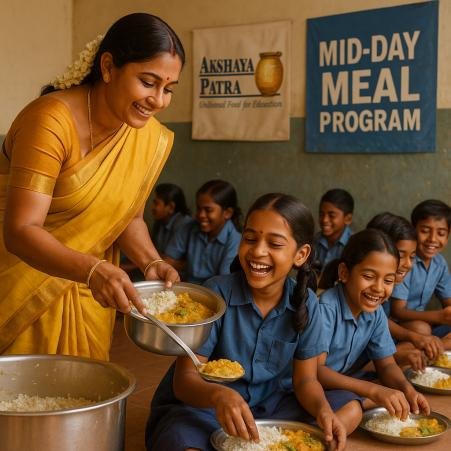
One of India’s best-known organisations working to provide meals to schoolchildren is The Akshaya Patra Foundation.
Its school-meal programme provides freshly cooked meals to children, particularly those attending government and government-aided schools.
The organisation operates large centralised and decentralised kitchens and has served billions of meals since its establishment, according to its official information.
The idea behind the programme is powerful:
A hungry child finds it harder to concentrate in the classroom.
Providing a nutritious school meal can therefore support both nutrition and education.
The organisation’s work has expanded across multiple Indian states and Union Territories.
🍲 2. The Mid-Day Meal Movement


Not all large-scale food programmes are run by private organisations.
The Government of India operates the school-meal programme now known as PM POSHAN, building on India’s long-running Mid-Day Meal programme.
The programme aims to provide hot cooked meals to eligible children in government and government-aided schools.
This is one of the country’s most significant efforts to address classroom hunger.
It also demonstrates an important principle:
Food security and education are deeply connected.
❤️ 3. Robin Hood Army — Food From Those Who Have to Those Who Need


The Robin Hood Army is a volunteer-driven organisation that works to redistribute surplus food to people who need it.
Volunteers collect excess food from restaurants, weddings, events and other sources and distribute it among underserved communities.
Children are among the beneficiaries of these efforts.
The model is simple:
Food that might otherwise be wasted → people who need food
It turns food waste into an opportunity to help someone.
🍛 4. Feeding India — Fighting Hunger Through Food Rescue


Feeding India, an initiative associated with Zomato, has worked on hunger and food-waste issues through food donation and community programmes.
Its work has included food redistribution and partnerships aimed at improving food security.
One of the most important ideas behind food-rescue organisations is that:
Surplus food does not have to become waste.
Food that is safe to eat can potentially be redirected towards people facing hunger.
🥘 5. Roti Bank Movements Across India


Across different Indian cities, Roti Banks and similar community initiatives collect surplus food and distribute it to people in need.
Many of these initiatives work with:
- Restaurants
- Hotels
- Wedding halls
- Caterers
- Volunteers
- Local donors
The concept is particularly effective because India has a huge number of celebrations and social events where excess food can remain after guests have eaten.
Instead of throwing it away, volunteers can collect and redistribute safe surplus food.
🧒 6. Salaam Baalak Trust — Food, Shelter and a Future


For children living without stable family support, food is only one part of the problem.
The Salaam Baalak Trust works with street-connected and vulnerable children, providing support that includes shelter, education, healthcare, counselling and other services.
Organisations like this demonstrate why simply giving a meal is sometimes not enough.
A child may also need:
🏠 A safe place to stay
🍚 Regular nutritious food
📚 Education
🩺 Healthcare
❤️ Emotional support
🎓 Skills for the future
The goal is therefore not simply to feed a child for one day, but to help create a safer future.
🛕 7. Temple Kitchens and Community Feeding


India has a long tradition of Annadanam—offering food to people without expecting payment.
Temples, religious institutions and community groups across the country operate free-meal programmes.
Some serve thousands of people on particular days.
Children, elderly people, pilgrims and economically disadvantaged families can all benefit.
The tradition is based on a simple belief:
Food should never be denied to someone who is hungry.
This cultural tradition has existed in many forms across India’s regions and communities for generations.
🌾 8. Gurudwaras — Langar for Everyone


The Sikh tradition of Langar is one of the world’s most powerful examples of community feeding.
At Gurudwaras, people from different backgrounds can sit together and share a meal.
Volunteers prepare, cook, serve and clean.
There is no requirement to prove wealth, status or social position.
Everyone sits together. Everyone eats together.
The Golden Temple in Amritsar is particularly famous for its enormous community kitchen, where volunteers help prepare and serve meals to very large numbers of people.
👩🍳 9. Community Kitchens Run by Women


In many parts of India, women’s self-help groups have become involved in preparing meals for schools, communities and vulnerable populations.
This creates a double benefit:
🍲 Food support
and
👩💼 Economic opportunities for women.
When local women are trained and employed in community kitchens, the programme can strengthen both nutrition and livelihoods.
🚑 10. Street Volunteers Feeding Homeless Children


Across India’s cities, many small NGOs and independent volunteers work quietly to provide meals to children living on the streets or in vulnerable communities.
Unlike large organisations, they may not have huge budgets.
Sometimes their operation is simply:
A few volunteers + donated food + a vehicle + a neighbourhood
They visit places where vulnerable families live and distribute meals.
These individuals may never appear in newspapers.
But for the child receiving the meal, their arrival can mean everything.
♻️ 11. Food Rescue — Fighting Hunger and Food Waste Together
India faces an interesting contradiction.
At the same time that some people struggle to obtain enough food, enormous quantities of food can be wasted.
Food-rescue organisations attempt to connect these two problems.
Their basic process is:
Surplus food
⬇️
Safety check
⬇️
Collection
⬇️
Packing
⬇️
Transportation
⬇️
Distribution
⬇️
A meal reaches someone who needs it
This approach can reduce food waste while helping vulnerable communities.
❤️ 12. Why Feeding a Child Matters
A meal may seem like a small thing.
But regular nutritious food can support:
- Healthy growth
- Concentration
- School attendance
- Physical development
- Immunity
- Energy
- Overall wellbeing
For a child, a meal can therefore be the first step towards a better life.
That is why these organisations are not merely “feeding people.”
They are contributing to a larger chain:
Food → Health → Education → Opportunity → Independence
🇮🇳 The Real Heroes Are Often Invisible
We know the names of some large organisations.
But thousands of people working at the local level remain unknown.
A grandmother cooking extra food for neighbourhood children.
A restaurant owner donating unsold meals.
A student collecting food donations.
A driver transporting meals.
A volunteer washing dishes in a community kitchen.
A social worker spending evenings with street children.
A farmer donating vegetables.
A shopkeeper providing rice.
All of them can become part of the same movement.
The fight against hunger does not belong to one organisation. It belongs to society.
🌟 What We Can Learn From Them
We do not need to start a giant NGO to make a difference.
Even simple actions can help:
🍚 Donate safe surplus food
🥕 Support community kitchens
💰 Contribute to credible organisations
🤝 Volunteer locally
♻️ Reduce food waste
👧 Support children’s education
❤️ Treat vulnerable children with dignity
The most important thing is consistency.
One meal helps today.
Education and long-term support can change tomorrow.
🇮🇳 Conclusion
From large school-meal programmes to small groups serving children on the streets, India has many people working to ensure that hunger does not decide a child’s future.
Akshaya Patra demonstrates the power of large-scale school meals.
Robin Hood Army demonstrates how volunteers can rescue and redistribute surplus food.
Salaam Baalak Trust shows that vulnerable children need much more than food—they need safety, education and care.
Gurudwara Langar demonstrates the power of equality and community service.
And countless unnamed volunteers demonstrate something even more important:
Humanity does not always need a big platform. Sometimes it only needs a willing heart and a plate of food.
A child who receives a meal today may have the strength to attend school tomorrow.
And the child who gets an opportunity tomorrow may one day help thousands of others.
🍚 Feed a child. Support a family. Strengthen a community. Build a better India. 🇮🇳
🇮🇳 MANA BHARATHAM
Stories, Facts & Wonders From India
✍️ Written by Pasupuleti Saida Rao
Leave a Reply