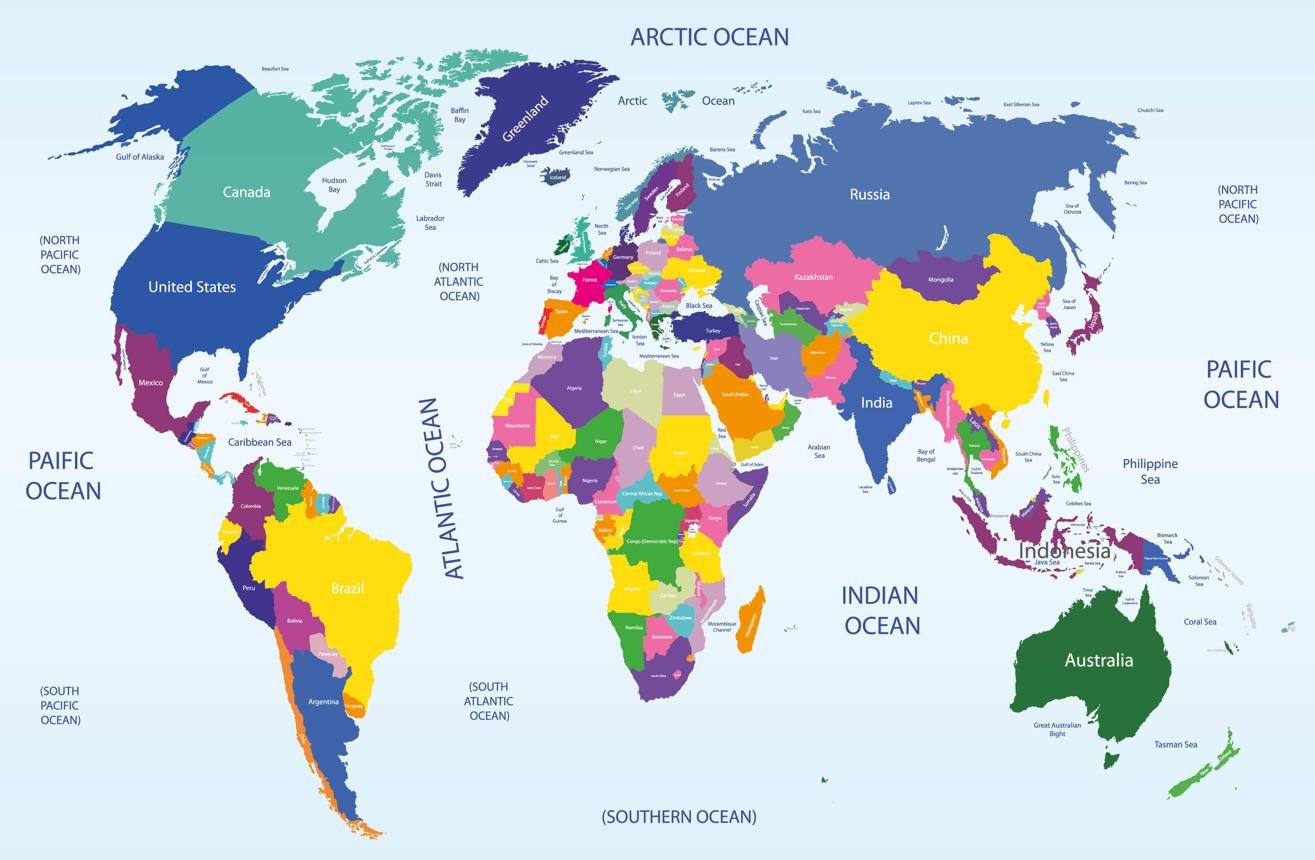
The world is a vast and fascinating place, made up of countries with different landscapes, cultures, languages, traditions, histories, and ways of life. From the snowy mountains of Europe and Asia to the tropical islands of the Pacific, every part of the world has something unique to discover.
Learning about the countries of the world helps us understand not only geography, but also the people, cultures, natural environments, economies, and histories that make our planet so diverse.


🌎 How Many Countries Are There in the World?
The commonly used count is 195 countries: 193 member states of the United Nations, plus the two observer states, the Holy See and the State of Palestine.
However, the exact number can vary depending on how a source defines and recognizes a country. Some territories and regions have limited or disputed international recognition.
This makes the idea of a “country” more complicated than simply counting places on a map.
🗺️ The Seven Continents
The world’s countries are generally grouped across seven continents:
1. Asia
Asia is the largest continent by both land area and population.
It includes countries such as India, China, Japan, Indonesia, Saudi Arabia, South Korea and Thailand.
Asia is known for its enormous geographical and cultural diversity. The continent contains some of the world’s highest mountains, vast deserts, tropical forests and major rivers.


2. Africa
Africa is the second-largest continent and is home to a remarkable variety of landscapes and cultures.
Countries such as Egypt, Kenya, Nigeria, South Africa, Morocco and Ethiopia are located here.
Africa is famous for the Sahara Desert, the Nile River, savannas, tropical forests and extraordinary wildlife.


3. Europe
Europe is relatively small in land area but has played a major role in world history, politics, science, art and culture.
Countries such as France, Germany, Italy, Spain, the United Kingdom, Greece and Norway are part of Europe.
The continent contains historic cities, castles, mountains, forests and coastlines.


4. North America
North America includes countries such as Canada, the United States, Mexico and many nations of Central America and the Caribbean.
The continent contains Arctic landscapes, forests, deserts, mountains, beaches and large plains.


5. South America
South America is known for its extraordinary natural beauty.
Countries such as Brazil, Argentina, Peru, Chile, Colombia and Ecuador are located here.
The continent is home to the Amazon rainforest, the Andes Mountains and many unique ecosystems.


6. Australia and Oceania
This region includes Australia, New Zealand and numerous Pacific island nations.
It is known for unique wildlife, coral reefs, beaches, volcanic islands and diverse indigenous cultures.
Australia itself is both a country and a continent.


7. Antarctica
Antarctica is different from the other continents because it has no sovereign countries.
It is almost entirely covered by ice and is mainly used for scientific research.
Several countries have research stations there, but Antarctica is governed through an international treaty system rather than being divided into ordinary countries.


🏛️ What Makes One Country Different From Another?
Every country has its own combination of characteristics.
Government
Countries can have different political systems, including republics, constitutional monarchies and other forms of government.
Language
Thousands of languages are spoken around the world.
Some countries have one widely spoken national language, while others have many languages used by different communities.
Culture
Food, clothing, music, festivals, architecture, traditions and social customs can vary enormously from one country to another.
Geography
A country’s location strongly influences its climate, landscape, agriculture and lifestyle.
Some countries are surrounded by oceans, while others are landlocked.
Economy
Countries also differ in their major industries.
Agriculture, manufacturing, technology, tourism, energy, mining and financial services are important to different economies.
🌐 Countries With Unique Geography
The world contains many remarkable geographical examples.
Russia is the world’s largest country by land area.
Canada is the second-largest country by land area.
Vatican City is the world’s smallest independent state by area.
Nepal is home to Mount Everest, the highest mountain above sea level.
Indonesia is one of the world’s largest archipelagic countries, consisting of thousands of islands.


🌍 Why Is Learning About Different Countries Important?
Understanding different countries can help us develop a broader view of the world.
It teaches us that people may have different languages, traditions and lifestyles while sharing many common human experiences.
Geographical knowledge can also help students understand international events, travel, world history, global trade and environmental issues.
Most importantly, learning about other cultures can encourage curiosity, respect and understanding.
🌎 Interesting Facts About the World
- The Earth has seven commonly recognized continents.
- Asia is the largest continent by population and land area.
- Africa contains the Sahara, the world’s largest hot desert.
- South America contains the Amazon rainforest.
- Antarctica is the coldest continent.
- Australia is both a country and a continent.
- The Pacific Ocean is the largest ocean on Earth.
- Mount Everest is the highest mountain above sea level.
- Countries around the world use hundreds of different languages.
- Each country has its own combination of geography, history and culture.


🌟 Final Thoughts
Our world is incredibly diverse.
Every country has its own story, from ancient civilizations and historic kingdoms to modern cities and technological achievements.
Exploring the countries of the world is a great way to understand geography, history, culture, nature and humanity.
There is always something new to discover—from the world’s biggest countries to its smallest states, from enormous mountains to tiny islands, and from ancient traditions to modern innovations.
This World Information collection will explore these places and subjects in greater detail, one topic at a time.
❓ Frequently Asked Questions
How many countries are there in the world?
A commonly used count is 195 countries, consisting of 193 UN member states and two UN observer states.
Which is the largest country in the world?
Russia is the largest country in the world by land area.
Which is the smallest country in the world?
Vatican City is the smallest independent state by area.
How many continents are there?
The commonly taught model recognizes seven continents: Asia, Africa, Europe, North America, South America, Australia/Oceania and Antarctica.
Which is the largest continent?
Asia is the largest continent by both land area and population.
Does Antarctica have countries?
No. Antarctica does not have sovereign countries like the other continents.