India’s history is much older than many people imagine.
Thousands of years ago, when many parts of the world were still developing their early settlements, the Harappan Civilization had already developed carefully planned cities, streets, drainage systems, houses, workshops and sophisticated methods of managing water.
One of the most fascinating examples of this ancient civilization is Dholavira, located on the arid island of Khadir in Gujarat’s Kutch region.
Dholavira is not famous because of a huge palace or a massive temple. It is famous because of something much more interesting — the intelligence with which an ancient city survived in a difficult, water-scarce environment.


📍 Where Is Dholavira Located?
Dholavira is located on Khadir Island in the Kutch region of Gujarat.
The surrounding landscape is dry and receives limited rainfall. This made water one of the most important challenges for people living there.
Instead of depending on a large permanent river, the inhabitants developed systems to collect and store seasonal water.
This difficult environment is one of the reasons Dholavira is so important to archaeologists.
UNESCO describes Dholavira as one of the best-preserved urban settlements of the Harappan period in South Asia.
🏺 What Was Dholavira?
Dholavira was a large urban settlement of the Harappan Civilization, also known as the Indus Valley Civilization.
Archaeological evidence shows that the settlement was occupied from approximately 3000 BCE to 1500 BCE.
That means people lived and developed the settlement for roughly 1,500 years.
During this long period, the city changed and developed through different stages.
UNESCO identifies evidence from the Early, Mature and Late Harappan phases at the site.


🧭 How Was Dholavira Discovered?
The archaeological site of Dholavira was discovered in 1968.
Later, systematic archaeological excavations revealed the remains of the ancient settlement.
UNESCO records that the site was excavated over 13 field seasons between 1989 and 2005.
Archaeologists uncovered:
- Fortifications
- Gateways
- Streets
- Houses
- Reservoirs
- Drainage systems
- Workshops
- Ceremonial areas
- A cemetery
- Stone structures
- Artefacts
These discoveries helped researchers understand how the people of Dholavira lived.
🏙️ A Surprisingly Well-Planned Ancient City
One of the most impressive things about Dholavira is its urban planning.
The city was not simply a collection of houses built randomly.
It had clearly organized areas with different functions.
UNESCO describes the settlement as consisting of a fortified Castle, Bailey, Ceremonial Ground, Middle Town and Lower Town.
This suggests that the inhabitants had a strong understanding of planning and organization.


🏰 The Fortified City
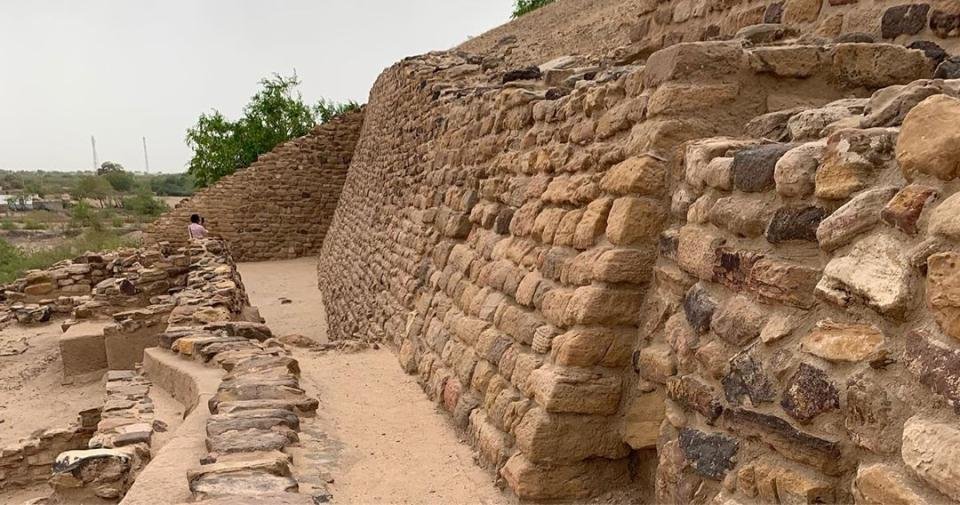
Dholavira had strong defensive structures.
The central fortified area was known as the Castle, with a connected Bailey.
Other sections of the city were also carefully planned and separated.
The extensive walls demonstrate that security and controlled access were important considerations in the city’s design.
But Dholavira was not only about defence.
Its planners had to solve another much bigger problem:
💧 Water.
💧 The Amazing Water Management System
This is probably the most fascinating part of Dholavira.
The city was located in a dry region where water was scarce.
Instead of treating water as something to be collected only when needed, the people created a large network of reservoirs, channels, drains and collection systems.
UNESCO describes Dholavira’s water-management system as a sophisticated achievement involving water harvesting, reservoirs and drainage.


🌧️ How Did They Collect Rainwater?
Two seasonal streams, Mansar and Manhar, were located near the settlement.
During periods of rainfall, water from these seasonal streams could be harnessed.
The city planners constructed reservoirs and channels so that precious water could be collected and stored rather than simply disappearing into the surrounding dry landscape.
UNESCO’s documentation identifies the seasonal streams and extensive water-harvesting infrastructure as important features of the site.
This is particularly impressive because the system was developed thousands of years ago.
🏞️ The Large Reservoirs of Dholavira
Archaeologists discovered a series of large reservoirs around the city.
Some reservoirs were positioned near the fortified areas, while others were located around the eastern and southern portions of the settlement.
The reservoirs were carefully constructed using stone and were connected with channels designed to manage water.
UNESCO identifies the reservoirs as one of the defining characteristics of Dholavira’s urban planning.

🚰 Ancient Drainage System
Dholavira’s engineers did not only think about collecting water.
They also had to think about where excess water would go.
Archaeological evidence shows a sophisticated system for drainage and diversion of surface water.
Channels helped direct rainwater and runoff toward collection areas and away from important parts of the settlement.
UNESCO describes both water-harvesting and drainage systems as major technological achievements of Dholavira.
This means the city’s water system had two important goals:
Save water when it was scarce.
Control water when there was too much.
That is an impressive concept even from a modern engineering perspective.
🧱 Why Did Dholavira Use So Much Stone?
Many Harappan cities are known for their use of baked bricks.
Dholavira is interesting because stone was extensively used in construction.
The surrounding region provided useful stone resources, including banded limestone.
The builders used locally available materials for walls and other structures.
UNESCO specifically highlights Dholavira’s extensive use of stone as an important feature distinguishing its urban architecture.


🏠 Houses and Residential Areas
Dholavira was not only a city of large public structures.
People lived in residential areas of different sizes.
The differences in the size and organization of houses suggest that the city had different social and occupational groups.
UNESCO notes that the planned residential areas provide evidence of a stratified society and different occupational activities.
This gives historians an opportunity to study not just buildings, but also the social organization of the people who lived there.
🛠️ Workshops and Ancient Industries
Dholavira was also an important centre of manufacturing.
Archaeologists found evidence of bead-making workshops.
The people worked with materials such as:
- Copper
- Shell
- Stone
- Semi-precious stones
- Terracotta
- Gold
- Ivory
These objects demonstrate that Dholavira was not an isolated settlement.
It was connected to wider networks of production and trade.


💎 Dholavira and Ancient Trade
One of the most fascinating discoveries is evidence of long-distance trade.
Archaeological findings suggest that Dholavira had connections with other Harappan settlements as well as regions associated with Mesopotamia and the Oman Peninsula.
This tells us that the people living in Dholavira were part of a much larger trading world.
Goods, raw materials and manufactured objects could travel long distances across ancient trade networks.
🐚 What Did People Make at Dholavira?
The archaeological discoveries indicate a wide range of manufacturing activities.
Among the materials found at the site are:
- Shell
- Copper
- Stone
- Gold
- Ivory
- Terracotta
- Semi-precious stones
Bead production appears to have been particularly important.
The discovery of workshops provides evidence that Dholavira was not just a residential settlement but also an industrial and commercial centre.
🔤 The Famous Dholavira Signboard
One of the most intriguing discoveries associated with Dholavira is a large arrangement of signs discovered at the site.
It is commonly referred to as the Dholavira signboard.
The signs belong to the undeciphered writing system associated with the Harappan Civilization.
The discovery is particularly fascinating because the large scale of the signs suggests that written symbols had an important role in the city’s public environment.


❓ What Does the Dholavira Writing Say?
This is one of the great unanswered questions of ancient Indian history.
The Harappan script has not yet been conclusively deciphered.
Therefore, we cannot confidently say exactly what the Dholavira signs meant.
Researchers continue to study Harappan symbols and inscriptions, but there is no universally accepted decipherment.
That mystery makes Dholavira even more fascinating.
⚰️ The Cemetery of Dholavira
Dholavira also had a large cemetery outside the main walled city.
The burial structures provide information about the beliefs and social practices of the people who lived there.
UNESCO notes that the cemetery contains six types of cenotaphs, with many of the burials being memorial in nature.


🧑🤝🧑 What Was Life Like in Dholavira?
We obviously cannot know every detail about daily life thousands of years ago.
But archaeological evidence gives us some clues.
People lived in planned neighbourhoods, produced goods, worked with different materials, traded with distant regions and depended on carefully managed water resources.
The city also had public spaces and ceremonial areas.
All of this suggests a society with organized systems of work, trade, administration and resource management.
🌵 How Did Dholavira Survive in a Harsh Environment?
This is perhaps the biggest lesson from Dholavira.
The city was not built beside a large permanent river.
Instead, the people adapted to their environment.
They:
Collected seasonal water → stored it in reservoirs → controlled runoff → used drainage systems → protected their water supply.
Their survival depended on understanding the landscape.
UNESCO specifically identifies Dholavira’s water management as evidence of the ingenuity of its inhabitants in a harsh environment.
🏛️ What Happened to Dholavira?
Dholavira was occupied for approximately 1,500 years.
Over time, the city changed.
Different phases of construction, modification and settlement are visible in the archaeological remains.
Eventually, the urban settlement declined.
The exact reasons for the decline are complex and should not be reduced to one simple explanation. Changes in climate, water availability, economic networks and broader transformations within the Harappan world are among the issues researchers study.
The archaeological record shows a gradual transformation rather than a single dramatic event.
🌍 Dholavira Becomes a UNESCO World Heritage Site
Dholavira was added to the UNESCO World Heritage List in 2021.
UNESCO recognized it under criteria related to its exceptional testimony to the Harappan Civilization and its outstanding example of ancient urban planning.
The site is protected and managed by the Archaeological Survey of India under India’s heritage protection laws.


🇮🇳 Why Is Dholavira Important to India?
Dholavira is important because it changes the way we think about ancient India.
It shows that thousands of years ago, people in the Indian subcontinent had developed:
- 🏙️ Planned urban settlements
- 💧 Advanced water management
- 🚰 Drainage systems
- 🧱 Large-scale stone construction
- 🛠️ Specialized manufacturing
- 💎 Long-distance trade
- 🏰 Fortified urban areas
- 📜 A writing system
- ⚰️ Organized burial traditions
Dholavira therefore represents much more than an archaeological ruin.
It is evidence of an ancient society capable of solving difficult environmental and urban problems.
💡 Interesting Facts About Dholavira
- 🏺 Dholavira belonged to the Harappan Civilization.
- 📍 It is located on Khadir Island in Gujarat.
- 📅 The settlement was occupied approximately from 3000 to 1500 BCE.
- ⏳ People lived there for around 1,500 years.
- 💧 The city had an elaborate system of reservoirs and water management.
- 🚰 Archaeologists found sophisticated drainage arrangements.
- 🏰 The settlement contained fortified areas.
- 💎 Bead-making and other manufacturing activities took place there.
- 🌍 Evidence indicates trade connections reaching regions associated with Mesopotamia and Oman.
- 🔤 The Harappan writing system found at the site remains undeciphered.
- ⚰️ Dholavira contains a large cemetery.
- 🌏 It became a UNESCO World Heritage Site in 2021.
- 🇮🇳 The site is protected and managed by the Archaeological Survey of India.
❓ Frequently Asked Questions
What is Dholavira famous for?
Dholavira is especially famous for its planned urban layout, sophisticated water-management system, reservoirs, fortifications, manufacturing activities and Harappan archaeological remains.
How old is Dholavira?
The earliest evidence at Dholavira dates to around 3000 BCE, and the settlement continued for roughly 1,500 years.
Where is Dholavira located?
Dholavira is located on Khadir Island in the Kutch region of Gujarat.
Why was water management important at Dholavira?
The settlement was located in an arid environment where water was scarce. Its inhabitants therefore developed reservoirs, channels and drainage systems to collect and control seasonal water.
Is Dholavira a UNESCO World Heritage Site?
Yes. Dholavira: a Harappan City was inscribed on the UNESCO World Heritage List in 2021.
Can we read the writing found at Dholavira?
No. The Harappan script remains undeciphered, so the exact meaning of the signs cannot currently be stated with certainty.
🌸 Conclusion
Dholavira is one of the most remarkable archaeological discoveries in India.
More than four thousand years ago, people built a carefully planned city in one of the most challenging environments of the region.
They created reservoirs to conserve water, drainage systems to control runoff, fortified areas for protection, workshops for manufacturing and trade connections extending far beyond their immediate surroundings.
The greatest lesson from Dholavira is not simply that ancient people could build large cities.
It is that they understood their environment and designed their city around it.
Their knowledge of water, planning, construction and resource management continues to fascinate historians and archaeologists today.
Dholavira is a powerful reminder that India’s history is filled with extraordinary stories of innovation, engineering and human intelligence. 🇮🇳

🇮🇳 MANA BHARATHAM
This article is published by MANA BHARATHAM on ALL INDIA PIN CODE SEARCH.
For more interesting stories about Indian history, ancient civilizations, monuments, culture and fascinating discoveries, stay connected with MANA BHARATHAM.
Know India. Explore India. Celebrate India. 🇮🇳