For thousands of years, the ancient Egyptian civilisation has fascinated the world.
The pyramids, mysterious tombs, enormous temples and golden treasures have inspired countless stories.
But in 2021, archaeologists announced a discovery that created worldwide excitement: the remains of a major ancient city near Luxor, Egypt.
The city was buried beneath the desert for centuries.
Archaeologists called it one of the most important ancient Egyptian discoveries in decades.
Its official archaeological name is the city of Aten, while it became widely known in the media as the “Lost Golden City.”
What makes the discovery extraordinary is not just its age.
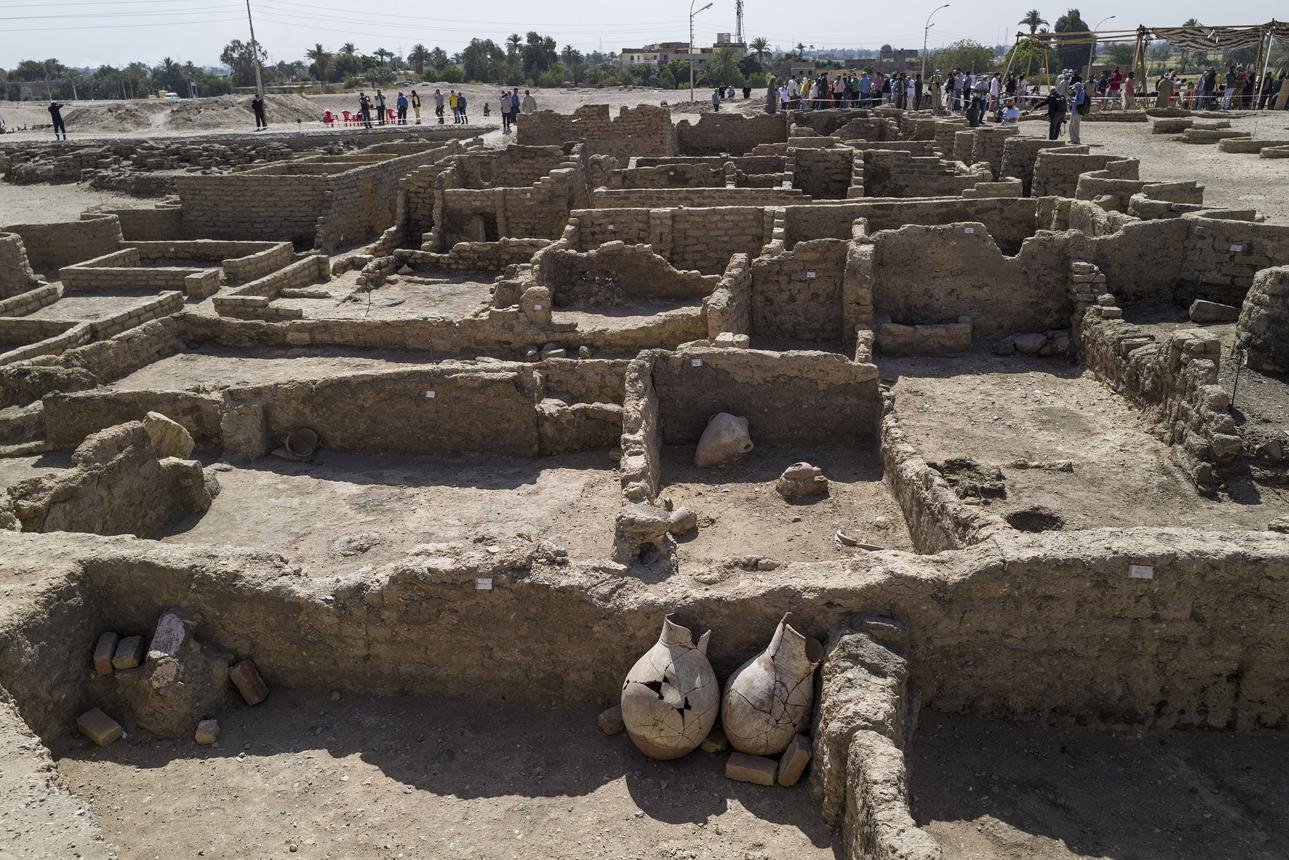
The city contains evidence of houses, workshops, streets, administrative areas and everyday life — giving researchers a rare opportunity to understand how ordinary people lived during one of ancient Egypt’s most powerful periods.


1 — The Lost City of Aten
Ancient Egyptian archaeological excavation showing mud-brick walls and the remains of the Lost City of Aten near Luxor.
🏺 1. Where Was the Lost City Discovered?
The ancient city was discovered on the west bank of the Nile near Luxor, close to several famous archaeological sites.
The location is particularly important because Luxor was once the heart of ancient Egyptian power.
The area contains some of Egypt’s most famous monuments, including the remains of ancient temples and royal burial sites.
Archaeologists began excavating the site in search of evidence connected with ancient Egyptian royal activity.
Instead, they uncovered something much bigger:
An entire ancient settlement.
⏳ 2. How Old Is the City?
Researchers believe the city dates to the period of Amenhotep III, who ruled Egypt during the 14th century BCE.
The settlement continued to be used during the reign of his successor, Akhenaten.
That means the city is more than 3,000 years old.
Think about that for a moment.
Modern cities have changed dramatically over the last few centuries.
But here, archaeologists found the physical remains of streets, walls, buildings and objects belonging to people who lived more than three millennia ago.


2 — Ancient Egyptian Royal Era
An authentic museum photograph of an ancient Egyptian statue representing the royal period associated with the city.
🧱 3. What Did Archaeologists Find?
The discovery became particularly important because researchers did not find just a few isolated objects.
They uncovered the remains of a large settlement.
Among the discoveries were:
- Mud-brick walls
- Streets
- Houses
- Workshops
- Storage areas
- Administrative spaces
- Everyday objects
- Tools
- Jewellery
- Pottery
These discoveries help researchers reconstruct what life may have looked like in ancient Egypt.
Instead of looking only at royal tombs and monuments, archaeologists can study evidence of the people who actually worked and lived in the city.
👷 4. This Was Not Just a City of Kings
Ancient Egypt is often represented by images of pharaohs, pyramids and enormous temples.
But a civilisation cannot function through kings alone.
Someone had to:
- Build monuments
- Produce food
- Make pottery
- Manufacture tools
- Create jewellery
- Manage supplies
- Organise workers
- Produce clothing
- Maintain buildings
The Lost City provides evidence of this less-visible side of ancient Egyptian civilisation.
It gives archaeology a glimpse into everyday life.
💍 5. Jewellery and Everyday Objects Reveal Personal Stories
Among the discoveries were objects that show how people used and decorated their possessions.
Jewellery and small personal objects may seem insignificant compared with a giant temple.
But archaeologists can learn a great deal from them.
A small object can reveal:
Who made it?
What materials were available?
What did people value?
How skilled were craftsmen?
How wealthy was the settlement?
This is why archaeology is not only about finding spectacular treasures.
Sometimes the smallest objects tell the most interesting stories.


3 — Objects Found at the Ancient City
Ancient Egyptian pottery, jewellery or other archaeological objects associated with the excavation.
🍞 6. What Can a City Tell Us About Ancient Egyptians?
A city is like a giant historical document.
Its buildings can tell researchers about architecture.
Its tools can reveal occupations.
Its pottery can provide clues about food and daily life.
Its workshops can reveal manufacturing techniques.
Its streets can reveal how the settlement was organised.
By combining thousands of small pieces of evidence, archaeologists can reconstruct a picture of an ancient society.
The Lost City is valuable for exactly this reason.
👑 7. Why Was the City Important During Amenhotep III’s Reign?
Amenhotep III ruled Egypt during a period when the kingdom was powerful and wealthy.
His reign is associated with major building projects, international contacts and artistic achievements.
The discovery of a large settlement from this period provides additional information about the economic and administrative systems supporting the royal court.
It shows that behind monumental temples and royal ceremonies there was a complex network of workers, craftsmen, administrators and suppliers.
☀️ 8. The City Was Connected With Aten
The settlement’s archaeological name is associated with Aten, the sun disk that became especially important during the religious reforms of Akhenaten.
Akhenaten is famous for promoting Aten worship and establishing a new royal capital at Akhetaten, modern-day Amarna.
The religious changes of this period were unusual in ancient Egyptian history.
The Lost City therefore provides another important piece of evidence from a fascinating period of political, religious and cultural change.
🏜️ 9. How Could Such a Large City Remain Hidden?
This is one of the questions that makes the discovery so fascinating.
The city was not necessarily hidden like a secret underground kingdom.
Over thousands of years, sand and sediment covered the remains.
Ancient settlements can disappear from the visible landscape as buildings collapse, natural processes reshape the area and later layers accumulate.
Archaeologists therefore sometimes discover ancient cities beneath landscapes that look completely ordinary.
That is one of the magical things about archaeology:
A place can disappear from human memory without disappearing from the Earth.


4 — Archaeological Landscape Near Luxor
A wide aerial or landscape photograph showing the desert and archaeological area around Luxor.
🔎 10. Why Is This Discovery So Important?
The importance of the Lost City goes beyond its size.
For many years, historians have learned about ancient Egypt through:
- Tombs
- Temples
- Statues
- Royal inscriptions
- Papyri
- Burial objects
But settlements can provide something different.
They show how people actually lived.
A royal tomb may tell us how a king was buried.
A city can tell us how thousands of people worked, ate, produced goods and organised their lives.
That makes the discovery extremely valuable.
🧠 11. Archaeology Is Like Solving a Giant Puzzle
Archaeologists rarely discover a complete story written down for them.
Instead, they collect clues.
One piece may be a wall.
Another may be a pottery fragment.
Another may be a tool.
Another may be a seal.
Another may be a piece of jewellery.
Individually, these objects may not tell us much.
Together, they can reveal an entire civilisation.
The Lost City is a perfect example of this process.
🏛️ 12. Egypt Still Has Many Secrets
Egypt has been studied by archaeologists for centuries.
Yet discoveries like the Lost City show that the country still has enormous archaeological potential.
Beneath deserts, fields and ancient settlements, there may still be evidence waiting to be discovered.
That means the story of ancient Egypt is far from finished.
Every new excavation can change what we thought we knew.
🤯 10 Amazing Facts About Egypt’s Lost City
1️⃣ The city was discovered near Luxor in 2021.
2️⃣ It is more than 3,000 years old.
3️⃣ Archaeologists associate the city with the reign of Amenhotep III.
4️⃣ The settlement is also known as the “Lost Golden City.”
5️⃣ Researchers found extensive mud-brick structures.
6️⃣ Workshops and administrative areas were discovered.
7️⃣ Archaeologists found objects that provide clues about everyday life.
8️⃣ The discovery helps researchers understand the society behind Egypt’s famous monuments.
9️⃣ The city was located near some of ancient Egypt’s most important archaeological sites.
🔟 The discovery demonstrates that important archaeological secrets can remain hidden for thousands of years.
🌟 The Most Amazing Part of the Discovery
The most fascinating thing about the Lost City may not be any single object.
It is the idea that an entire community once existed there.
People woke up in the morning.
Workers went to workshops.
Craftsmen made objects.
Administrators managed supplies.
Families lived in houses.
People walked along streets.
Children probably played.
Life continued day after day.
Then, over centuries, the settlement disappeared beneath layers of earth.
Thousands of years later, archaeologists found it again.
That is what makes this discovery more than an archaeological story.
It is a story about ordinary human lives surviving through time.
🇪🇬 Final Thoughts
Egypt’s pyramids and temples show us the extraordinary achievements of ancient kings and engineers.
But the Lost City of Aten tells another story.
It brings us closer to the people who built and supported that civilisation.
Its walls, workshops, tools and everyday objects provide a rare glimpse into a world that existed more than 3,000 years ago.
And perhaps the greatest lesson from the discovery is this:
History does not always disappear. Sometimes, it simply waits beneath the ground for someone to find it.
The sands of Egypt still hold countless stories.
And somewhere beneath those ancient landscapes, there may be another discovery waiting to change what we know about the past.