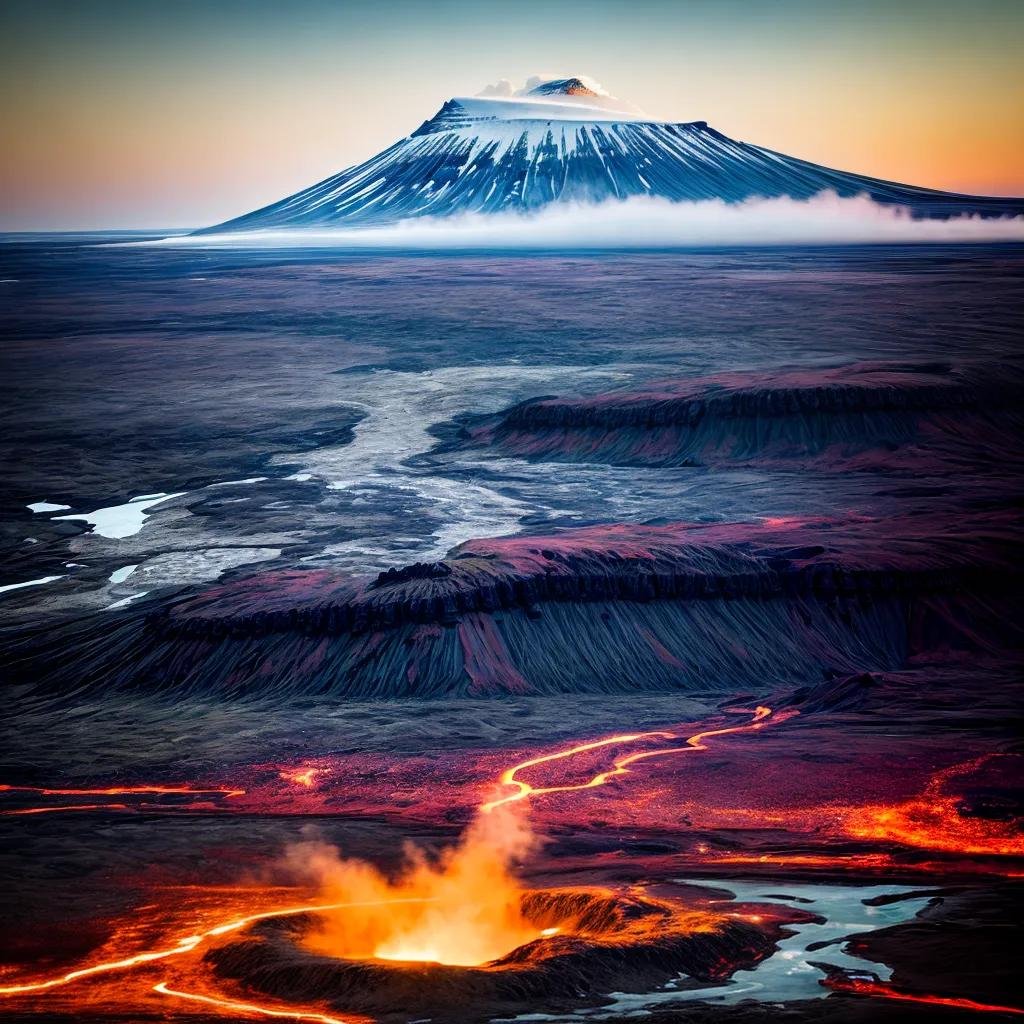
Imagine a country where massive glaciers cover the land, while powerful volcanoes are still active beneath the Earth’s surface.
In one direction, you can see frozen landscapes.
In another, you may find boiling hot springs, geysers and volcanic rocks.
This extraordinary combination has given Iceland one of the most fascinating nicknames in the world:
The Land of Fire and Ice
Iceland is a small island nation in the North Atlantic, but its landscape is anything but ordinary.
From glaciers and volcanoes to waterfalls, black-sand beaches and the Northern Lights, Iceland looks like several different worlds combined into one country.


Iceland’s Fire and Ice Landscape
Place this photo below the introduction:
A dramatic Icelandic landscape showing a glacier or snowy mountain with volcanic terrain in the surrounding area.
🌋 1. Why Is Iceland Called the Land of Fire and Ice?
The nickname is not just a poetic description.
Iceland genuinely contains both:
🔥 Fire — Volcanoes and geothermal activity
and
🧊 Ice — Glaciers and enormous frozen landscapes
The country sits in a geologically active region where tectonic plates are moving apart.
This geological activity helps produce volcanic eruptions, geothermal heat and hot springs.
At the same time, Iceland’s northern location allows enormous glaciers to exist across parts of the country.
That unusual combination is what makes Iceland so special.
🧊 2. Iceland Has Enormous Glaciers
Iceland is home to several major glaciers.
The most famous is Vatnajökull, one of Europe’s largest glaciers by area.
The glacier covers a huge part of southeastern Iceland.
Under and around the ice are mountains, valleys and volcanic landscapes.
This creates a fascinating environment where ice and volcanic geology exist side by side.


Vatnajökull Glacier
Place this photo here:
A wide photograph of Vatnajökull showing the enormous glacier, surrounding mountains and icy landscape.
🌋 3. Volcanoes Are Part of Iceland’s Identity
Iceland has many volcanic systems, and volcanic activity has played a major role in shaping the country.
Over thousands of years, lava flows have created mountains, valleys and unusual rock formations.
Some Icelandic volcanoes are located beneath glaciers.
This creates a spectacular geological combination.
Imagine an enormous sheet of ice covering a landscape shaped by volcanic activity.
That is Iceland.
🔥 4. What Happens When a Volcano Erupts Beneath Ice?
This is one of the most fascinating aspects of Icelandic geology.
When volcanic activity occurs beneath a glacier, the intense heat can melt large amounts of ice.
This can produce sudden floods known as jökulhlaups.
These glacial outburst floods can be extremely powerful.
They demonstrate just how dramatically Iceland’s fire-and-ice environment can interact.
♨️ 5. Iceland Uses Heat From Beneath the Earth
Iceland has abundant geothermal resources.
Hot water and steam from underground are used for several purposes, including:
- Heating buildings
- Producing electricity
- Heating swimming pools
- Greenhouse agriculture
- Bathing and recreation
Geothermal energy has become an important part of Iceland’s energy system.
In other words, the same geological forces that create volcanoes and hot springs can also provide useful energy.


Iceland’s Geothermal Landscape
Place this photo here:
A photograph showing steam rising from a geothermal area, hot springs or volcanic landscape.
💨 6. The Famous Geysers of Iceland
The word “geyser” itself is connected with Iceland.
The famous Geysir geothermal area helped give the English language the word “geyser.”
Although the original Great Geysir is not constantly active, another nearby geyser called Strokkur regularly erupts.
Every few minutes, hot water can shoot dramatically into the air.
Visitors often gather around the area waiting for the next eruption.
Then suddenly:
💦 BOOM!
A column of hot water rises from the ground.


Strokkur Geyser
Place this photo here:
A photograph capturing Strokkur erupting with a tall column of water and steam.
🌌 7. Iceland Is Famous for the Northern Lights
One of Iceland’s most magical natural phenomena is the Aurora Borealis, commonly called the Northern Lights.
During suitable conditions, colourful lights can appear across the night sky.
They may look:
💚 Green
💜 Purple
💙 Blue
🌸 Pink
The lights are created when charged particles from the Sun interact with Earth’s upper atmosphere.
For visitors, however, the scientific explanation almost disappears when the sky suddenly begins glowing above a dark Icelandic landscape.


Northern Lights Over Iceland
Place this photo here:
A night photograph showing colourful aurora lights above an Icelandic mountain, waterfall or remote landscape.
🏖️ 8. Iceland Has Black-Sand Beaches
Most people imagine beaches covered with golden or white sand.
Iceland offers something completely different.
Some beaches are covered with black volcanic sand.
One of the most famous is Reynisfjara, on Iceland’s southern coast.
The dark sand, powerful Atlantic Ocean, cliffs and unusual basalt formations create a dramatic landscape.
It looks almost like a movie set.
But the waves around these beaches can be dangerous, so visitors need to follow local safety warnings.


Reynisfjara Black-Sand Beach
Place this photo here:
A wide photograph showing the black volcanic sand, ocean, cliffs and basalt rock formations.
💧 9. Iceland Has Incredible Waterfalls
Iceland is also famous for spectacular waterfalls.
Some waterfalls are surrounded by cliffs and green landscapes.
Others are located in remote areas surrounded by mountains.
One of the most famous is Seljalandsfoss.
What makes it particularly unusual is that visitors can, under safe conditions, walk behind the falling water.
Another famous waterfall is Skógafoss, known for its powerful curtain of water.


Icelandic Waterfall
Place this photo here:
A photograph of Seljalandsfoss or Skógafoss showing the waterfall and surrounding landscape.
🐴 10. Iceland Has a Unique Horse Breed
Iceland is home to the Icelandic horse, a small and hardy breed that has been developed in relative isolation for centuries.
These horses are famous for their strength, endurance and distinctive gaits.
They are an important part of Icelandic culture and history.
Despite their relatively small size, Icelandic horses are well adapted to the country’s challenging environment.
🐋 11. Iceland’s Waters Are Full of Marine Life
The ocean around Iceland is also biologically rich.
Whales can be seen in Icelandic waters, and whale-watching has become a popular activity.
Depending on the location and season, visitors may encounter species such as:
- Humpback whales
- Minke whales
- Orcas
- Dolphins
This means Iceland’s natural wonders are not limited to its land.
The surrounding ocean is another important part of the country’s ecosystem.
🏙️ 12. Reykjavík: The World’s Northernmost Capital City
Iceland’s capital is Reykjavík.
It is known for its colourful buildings, modern architecture, coastal setting and vibrant cultural life.
Despite being the capital of an entire country, Reykjavík is much smaller than many major world capitals.
The city provides a fascinating contrast to Iceland’s vast wilderness.
You can have a modern urban experience and, within a relatively short journey, reach glaciers, waterfalls, volcanoes and geothermal landscapes.


Reykjavík
Place this photo here:
A panoramic photograph showing Reykjavík with Hallgrímskirkja, colourful buildings and the surrounding landscape.
🧬 13. Iceland Is Geologically Young
Iceland’s landscape is relatively young compared with many ancient continental regions.
Volcanic activity continues to reshape parts of the country.
New lava fields can form during eruptions, while glaciers, rivers, wind and waves constantly reshape existing landscapes.
This makes Iceland almost like a natural laboratory for studying how geological landscapes develop.
🌍 14. Iceland Sits Between Two Tectonic Plates
One of the most interesting geological facts about Iceland is its position on the Mid-Atlantic Ridge.
The North American and Eurasian tectonic plates are moving apart in this region.
The ridge is mostly underwater, but Iceland is one of the rare places where visitors can see parts of this geological system above sea level.
At Þingvellir, the landscape provides a remarkable opportunity to see geological features associated with the movement of the plates.


Þingvellir National Park
Place this photo here:
A photograph showing the dramatic rift landscape at Þingvellir National Park.
🌱 15. Iceland Is Also a Country of Green Landscapes
The name “Land of Fire and Ice” might make you imagine only volcanoes and glaciers.
But Iceland can also become remarkably green during the warmer months.
Moss-covered lava fields, grasslands and valleys can create vivid landscapes.
This creates another fascinating contrast:
Black volcanic rock
Bright green moss
White glaciers
Blue ocean
All can appear within the same landscape.
🤯 10 Amazing Facts About Iceland
1️⃣ Iceland is famous for its combination of volcanoes and glaciers.
2️⃣ Vatnajökull is one of Europe’s largest glaciers by area.
3️⃣ Iceland has abundant geothermal energy.
4️⃣ The English word “geyser” is connected to Iceland’s Geysir.
5️⃣ Strokkur is one of Iceland’s best-known active geysers.
6️⃣ Iceland has spectacular black-sand beaches created from volcanic material.
7️⃣ The Northern Lights can sometimes be seen across Iceland’s night sky.
8️⃣ Iceland has numerous waterfalls, including Seljalandsfoss and Skógafoss.
9️⃣ The country lies on the Mid-Atlantic Ridge.
🔟 Iceland’s landscape continues to be shaped by volcanic and glacial processes.
🔥🧊 Why Is Iceland So Different From Other Countries?
Iceland’s uniqueness comes from the combination of several powerful natural forces.
🌋 Volcanoes create new land.
🧊 Glaciers carve existing landscapes.
🌊 The Atlantic Ocean shapes the coastline.
💨 Wind and rain reshape mountains and valleys.
♨️ Geothermal heat rises from deep underground.
🌌 The Sun creates the possibility of spectacular auroras.
All these forces work together to create a country that looks dramatically different from many places on Earth.
🌟 The Real Meaning Behind “Land of Fire and Ice”
Iceland’s nickname is more than a catchy phrase.
It describes the extraordinary meeting of two seemingly opposite forces.
Fire represents the Earth’s powerful interior.
Ice represents the cold environment of the far North.
And between them lies a landscape filled with waterfalls, rivers, black beaches, mountains, green valleys and geothermal springs.
That is why Iceland feels almost unreal.
🇮🇸 Final Thoughts
Iceland may be a relatively small country, but its natural story is enormous.
It is a place where glaciers can sit above volcanic landscapes, where hot water rises from beneath the ground, where black beaches meet the Atlantic Ocean and where the Northern Lights can transform the night sky.
Few places on Earth combine so many dramatic natural features in one location.
And perhaps that is the greatest reason Iceland fascinates people around the world.


