In the next article, we’ll explore how artists across India transformed the Ramayana into paintings, sculptures, murals, miniature art and temple carvings, how Rama, Sita, Hanuman and Ravana were visually represented, and why Ramayana art remains an important part of India’s cultural heritage.


The Ramayana as a Visual Story
Long before modern cinema and television, artists used images to tell stories.
The Ramayana provided artists with countless scenes to portray:
👶 Rama’s childhood
🏹 Rama and Sita’s marriage
🌳 The forest exile
🦌 The golden deer
🐒 Hanuman’s journey
🌊 The bridge to Lanka
⚔️ The battle with Ravana
👑 Rama’s return
These images allowed people to experience the epic visually.
Ramayana Sculptures in Temples
Indian temples contain many sculptures depicting stories from Hindu traditions.
Ramayana scenes can appear on:
🛕 Temple walls
🚪 Pillars
🏛️ Mandapas
🪨 Stone panels
🎨 Temple interiors
Sculptors used stone to create detailed scenes involving Rama, Sita, Lakshmana, Hanuman and other characters.


Hampi and Ramayana Art
The monuments around Hampi in Karnataka contain numerous connections with the Ramayana tradition.
The region is traditionally associated with Kishkindha, the kingdom of Sugriva.
Local landscapes, temples and traditional narratives connect places around Hampi and Anegundi with episodes involving:
🐒 Hanuman
👑 Sugriva
⚔️ Vali
🏹 Rama
This combination of landscape, architecture and storytelling makes the region particularly interesting for Ramayana enthusiasts.
Ramayana Murals
Murals are another important artistic form.
Artists painted stories directly onto walls and ceilings.
Instead of reading a long narrative, visitors could encounter an entire sequence through a series of images.
A mural might show:
➡️ Rama’s journey
➡️ Sita’s abduction
➡️ Hanuman meeting Rama
➡️ The search for Sita
➡️ The battle in Lanka
The wall itself becomes a visual storybook.


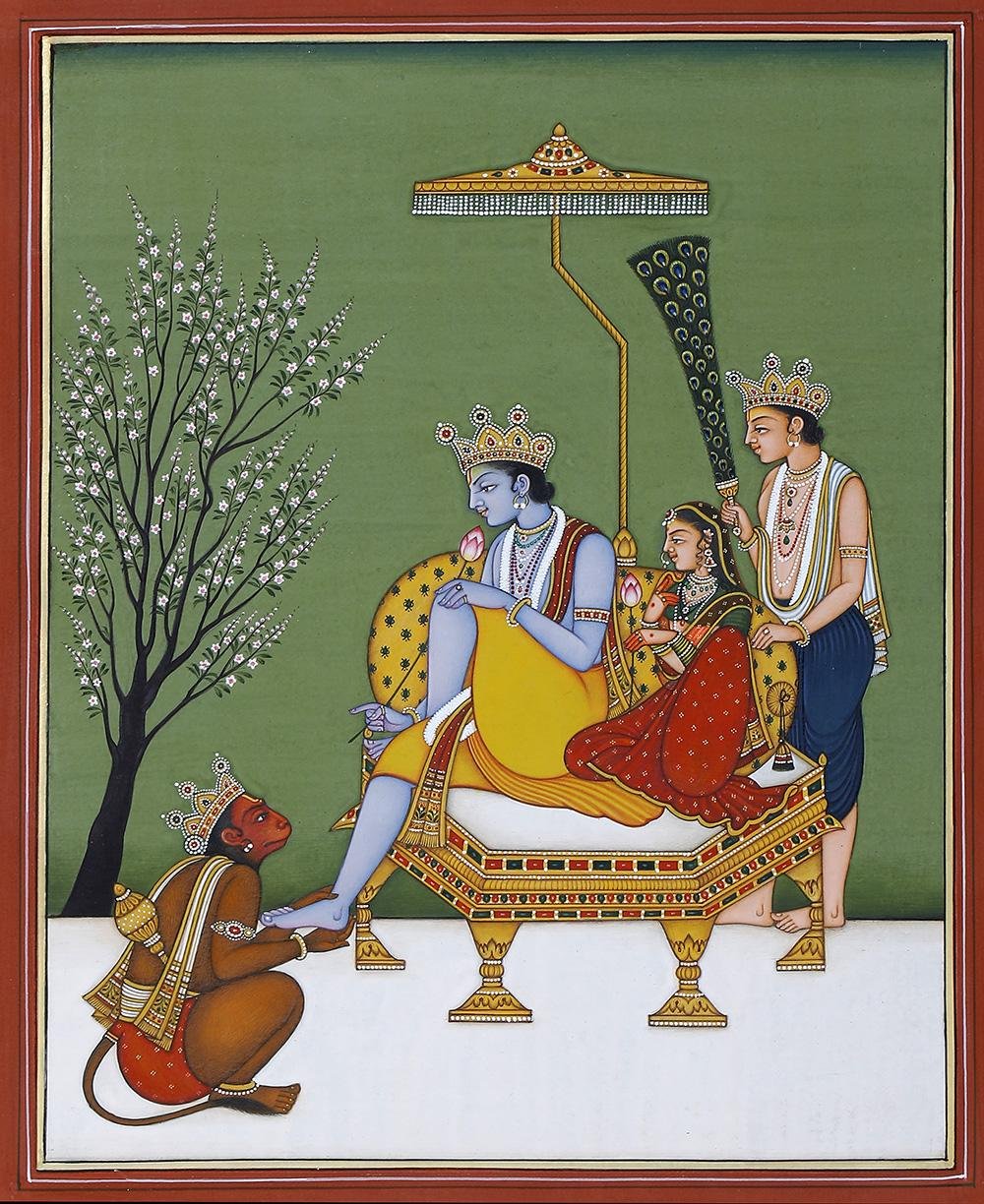
Miniature Paintings
Another fascinating tradition is Indian miniature painting.
Artists created detailed scenes on relatively small surfaces.
Ramayana manuscripts and illustrated collections could contain multiple paintings showing different episodes.
These artworks often feature:
🎨 Detailed landscapes
👑 Elaborate costumes
🏰 Palaces
🌳 Forests
⚔️ Battle scenes
The small scale did not prevent artists from creating highly detailed compositions.
Rama and Sita in Art
Artists have represented Rama and Sita in many different ways.
Rama may be shown:
🏹 Holding his bow
👑 As a king
🙏 In a devotional setting
❤️ Together with Sita
Sita may be shown:
🌸 With Rama
🌳 In the forest
🏰 In Lanka
🙏 In devotional compositions
The artistic style changes from region to region.
Hanuman in Indian Art
Hanuman is perhaps one of the most visually recognizable figures from the Ramayana.
Artists portray him in many forms.
He may be shown:
💪 Carrying the Sanjeevani mountain
🏹 Serving Rama
🙏 Kneeling in devotion
🐒 Leaping across the ocean
❤️ Showing Rama in his heart
🛡️ Holding his gada
Each representation highlights a different quality.


Ravana in Indian Art
Ravana is another character who gives artists enormous creative possibilities.
His traditional ten-headed form creates a powerful visual image.
Artists may portray him as:
👑 A powerful king
⚔️ A warrior
🔥 A dramatic antagonist
📖 A learned figure within traditional narratives
His elaborate crown, weapons and multiple heads make him immediately recognizable.
Regional Artistic Styles
The Ramayana appears differently in different artistic traditions.
A painting from Rajasthan may look very different from a mural in Kerala.
A South Indian temple sculpture may differ greatly from a miniature painting from North India.
Yet the characters remain recognizable.
This is one of the most interesting features of Ramayana art.


The Battle of Lanka
Artists have often been drawn to the dramatic battle between Rama and Ravana.
Paintings may include:
⚔️ Rama’s army
🐒 Vanara warriors
🏹 Rama and Lakshmana
👑 Ravana
🔥 The battlefield
These compositions allow artists to show movement, emotion and enormous scale.
The Golden Deer
The golden deer episode is another popular subject.
Artists can create a striking visual contrast between:
🌳 The forest
🦌 The unusual golden deer
🏹 Rama pursuing it
❤️ Sita watching
The episode is particularly suitable for visual storytelling because of its dramatic imagery.
Hanuman’s Leap
One of the most dynamic scenes in Ramayana art is Hanuman’s leap across the ocean.
Artists may show him:
🌊 Flying over the sea
🏔️ Passing mountains
🐒 Surrounded by clouds
💪 Carrying extraordinary strength
The scene visually represents courage and determination.


Ramayana Art and Storytelling
Visual art can communicate a story even to people who cannot read.
A temple visitor might recognize:
🏹 Rama through his bow
🐒 Hanuman through his form
👑 Ravana through his multiple heads
🌸 Sita through her appearance
The image becomes a form of storytelling.
Art Preserves Cultural Memory
Paintings and sculptures do more than decorate buildings.
They preserve ideas about:
👑 Kingship
🙏 Devotion
⚖️ Dharma
❤️ Relationships
💪 Courage
🌟 Good and evil
When people encounter these artworks centuries later, they can still see how earlier generations imagined the Ramayana.
From Temple Walls to Modern Art
Ramayana-inspired art did not stop with traditional temple sculpture.
Modern artists have continued to reinterpret the epic.
Today, Ramayana themes can appear in:
🖼️ Contemporary paintings
🎨 Digital artwork
📚 Graphic novels
🎬 Film design
🧑🎨 Modern illustrations
The visual language continues to evolve.


Why Ramayana Art Still Matters
A written story tells us what happened.
A painting can show us how a generation imagined it.
A sculpture can show us which characters were considered important.
A mural can reveal how an entire community experienced the story.
That makes Ramayana art valuable not only as religious expression, but also as a record of India’s artistic history.
A Story Written in Stone and Color
Across India’s temples, manuscripts and paintings, the Ramayana has been preserved through visual art.
Some works are centuries old.
Others are being created today.
The materials may change from stone and natural pigments to modern digital tools, but the inspiration remains remarkably enduring.
Conclusion
The Ramayana has inspired generations of Indian artists.
From temple sculptures and murals to miniature paintings and contemporary artwork, Rama’s story has been transformed into countless visual forms.
Artists have portrayed:
🏹 Rama’s courage
🌸 Sita’s strength
🐒 Hanuman’s devotion
👑 Ravana’s power
⚔️ The battle of Lanka
👑 Rama’s return
🕉️ The Ramayana is not only an epic that people read or hear — it is also an epic that generations of artists have painted, carved and brought to life through images.
In the next part, we will explore the Ramayana in Indian cinema and television — how filmmakers transformed the ancient epic for the screen and introduced Rama’s story to modern audiences.