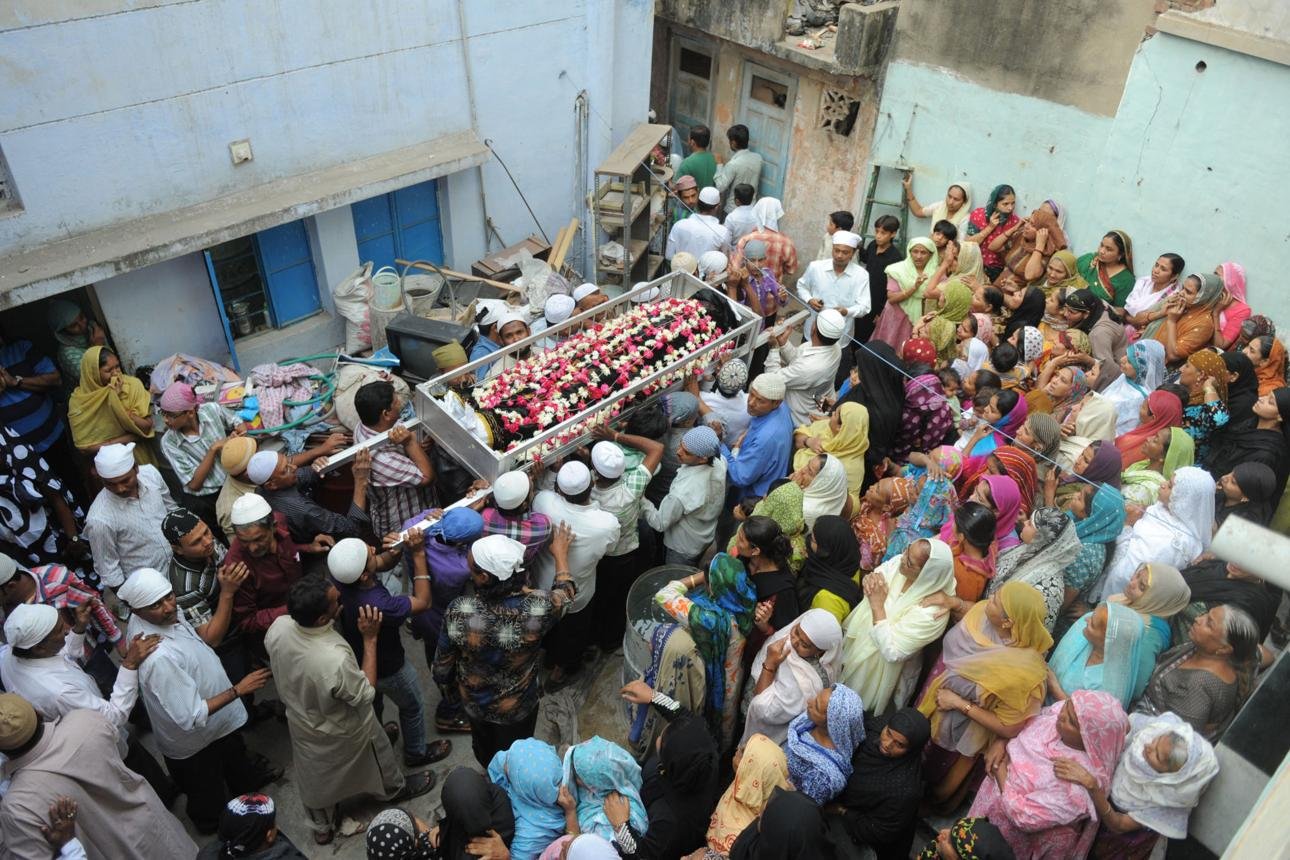


Death rituals among India’s Hijra/Kinnar communities are surrounded by curiosity, stories and many myths. There is no single funeral practice followed by every Hijra across India. Customs can differ according to religion, region, gharana, guru-chela tradition and local community practices. Academic research documents both burial and cremation traditions among different Hijra/Kinnar groups.
Some traditions are Hindu-influenced, some are Islamic, and some combine elements from different religious and community traditions. This reflects the diverse cultural history of the Hijra community in South Asia.
🕯️ What Happens When a Hijra/Kinnar Person Dies?
When a community member dies, the guru, chelas and other members of the Hijra household or gharana may become closely involved in the funeral arrangements.
The Hijra community traditionally has a guru-chela social structure, in which a guru acts as a senior figure and chelas form a close community network. Researchers have documented the importance of these relationships in everyday life as well as rituals.
The exact funeral process, however, is not identical everywhere.
⚰️ Burial or Cremation — Which One Is Used?


This is one of the biggest misconceptions about Hijra funerals.
There is no single nationwide rule.
Some Hijra groups traditionally practice burial, particularly groups with strong Islamic cultural traditions.
Other Hindu Kinnar/Hijra communities practice cremation.
Academic studies have documented both practices.
Therefore, the statement:
“Every Hijra is buried after death.”
is not correct.
Likewise, saying:
“Every Hijra is cremated.”
would also be incorrect.
🕌 Muslim Hijra Funeral Traditions
Research on Hijra communities in eastern India has documented Muslim Hijras following Islamic burial traditions.
In some communities, the deceased is:
- Washed according to Islamic funeral customs
- Wrapped in a white shroud
- Taken for burial
- Buried in a Muslim cemetery
One ethnographic study from eastern India describes Muslim Hijras following Islamic burial practices and notes that some aspects of the funeral are kept within the community or are not openly witnessed by all members.
The details can vary significantly between communities.
🔥 Hindu Kinnar/Hijra Cremation


Academic research has also documented Hindu Kinnar funeral practices involving cremation.
One study describes a process in which the body is ceremonially bathed, dressed in clean clothing and then taken for cremation. It also records the involvement of a male blood relative where available or a senior community member in lighting the funeral pyre.
However, this should be understood as a documented cultural practice, not a universal rule for every Hindu transgender person or every Kinnar/Hijra community.
👗 Why Do Some Accounts Mention Different Clothing?
Some ethnographic accounts describe community members changing the deceased person’s clothing during funeral preparations.
In one documented tradition, when a body is taken toward a cremation or burial ground, community members may use clothing associated with the deceased’s assigned sex or religious funeral tradition rather than the clothing normally used during Hijra community life.
This should not be interpreted as meaning that every Hijra funeral follows the same practice.
🌙 Are Hijra Funerals Held at Night?


This is one of the most widely circulated stories about Hijra funerals.
Some accounts and community narratives describe private or nighttime funeral practices.
But researchers have also warned against treating these stories as a universal rule.
A recent academic discussion of Kinnar funeral traditions specifically records a myth or belief that Hijra funerals are conducted at night and involve degrading treatment of the deceased. The study distinguishes such claims from documented funeral practices.
Therefore:
❌ “All Hijras must be buried at midnight.”
is not an established nationwide rule.
❗ What About the Story That Hijras Beat the Dead Body?
This is another extremely sensational claim found online.
There are stories that members of the community allegedly beat or abuse the body during the funeral so that the person will not be reborn as a Hijra.
However, this should not be presented as a universal Hijra funeral ritual.
Academic research records such claims as myths or narratives, rather than establishing them as a practice followed by the entire community.
This distinction is important because sensational stories can create unnecessary hatred toward an already marginalised community.
🕯️ Mourning and Community
The death of a senior Hijra—particularly a guru—can have special significance for the community.
The guru-chela system creates relationships that resemble family relationships, with terms such as mother, sister, daughter and grandmother used within some Hijra households.
Therefore, the death of a guru can affect an entire household or lineage.
🍽️ What Is “Roti-Chatai”?
Some Hijra communities have additional mourning or remembrance ceremonies after the burial.
One ethnographic study from eastern India describes a ceremony called “roti-chatai”, associated with remembrance and the idea of mukti or liberation. In the communities studied, the ceremony could involve Hijras travelling from different places and participating in remembrance after the death of a community member.
The timing and form of such ceremonies vary by community.
It should therefore not be described as a compulsory ceremony for every Hijra in India.
🏳️⚧️ Why Are These Funeral Traditions So Different?


The Hijra tradition is not a single religion.
Hijra communities have historically included people influenced by:
- Hindu traditions
- Islamic traditions
- Regional customs
- Local religious practices
- Syncretic traditions combining elements from different cultures
Researchers describe the Hijra tradition as having a religiously syncretic character in many contexts.
That is why funeral practices can differ from one region to another.
🏙️ A Serious Problem: Discrimination After Death
Perhaps the most disturbing issue is not the ritual itself, but whether transgender people are allowed equal access to funeral and burial facilities.


A 2019 report from Hyderabad documented cases in which transgender people faced difficulties obtaining access to burial or cremation grounds. Activists reported having to find alternative arrangements because of discrimination.
This demonstrates that discrimination can continue even after death.
Every person deserves dignity in death, regardless of gender identity.
👨👩👧 What About the Biological Family?
The role of the biological family can vary.
Some transgender people remain closely connected to their families.
Others become separated from their birth families and develop strong relationships within a Hijra household.
In such cases, the guru and chela network may become the person’s primary social family. Researchers have documented these non-biological kinship structures extensively.
Consequently, the community may take significant responsibility for funeral arrangements.
🧠 Why Are There So Many Myths?
Hijra communities have historically been relatively private about certain internal rituals.
Researchers describe Hijra communities as having their own social structures, rituals and forms of belonging.
When outsiders do not see a ritual directly, rumours can fill the gap.
This has produced stories such as:
- “They always bury people at midnight.”
- “Nobody is allowed to see the funeral.”
- “They beat the body.”
- “They don’t follow any religion.”
- “Every Hijra is buried.”
These claims should be examined individually rather than accepted as facts.
📜 Hijra Funeral Traditions: Fact vs Myth
| Claim | What research indicates |
|---|---|
| Every Hijra is buried | ❌ Not true |
| Every Hijra is cremated | ❌ Not true |
| Some communities practise burial | ✅ Documented |
| Some Hindu Kinnar communities practise cremation | ✅ Documented |
| All funerals happen at night | ❌ Not established |
| Every Hijra funeral involves beating the body | ❌ No evidence for a universal practice |
| Guru/chela relationships influence community life | ✅ Well documented |
| Muslim Hijra communities may follow Islamic burial customs | ✅ Documented |
| Funeral practices vary by region and community | ✅ Yes |
🇮🇳 The Bigger Story
Hijra funeral traditions are ultimately part of a much larger story about identity, religion, family, community and social acceptance.
The community has existed in South Asia for centuries and has developed its own forms of social organisation and belonging. Modern research continues to document how these traditions are changing as transgender people gain greater legal recognition and visibility.
India’s transgender community today is not limited to traditional Hijra occupations or social structures. Transgender Indians work in many professions and participate in education, politics, business, healthcare, arts and activism.
❤️ Respecting the Dead
Whatever funeral tradition a person follows—burial, cremation, Islamic rites, Hindu rites or a community-specific practice—the fundamental principle should be the same:
Every person deserves dignity after death.
The most responsible way to discuss Hijra funeral traditions is therefore to separate documented cultural practices from rumours and sensational stories.
🇮🇳 Conclusion
Hijra/Kinnar funeral traditions in India are diverse rather than uniform.
Some communities practise burial, particularly within Islamic cultural traditions. Some Hindu Kinnar/Hijra communities practise cremation. Mourning ceremonies and community rituals can also vary according to region and gharana.
Stories about secret nighttime funerals or abuse of the deceased should not be presented as universal facts. Some such claims appear in community narratives or secondary accounts, but research does not establish them as a practice followed by all Hijras.
The more important issue is ensuring that transgender people receive equal dignity, access to funeral grounds and freedom to follow their own religious and cultural traditions.
🕊️ In death, as in life, every human being deserves dignity and respect. 🇮🇳
🇮🇳 MANA BHARATHAM
Stories, Facts & Wonders From India
✍️ Written by Pasupuleti Saida Rao