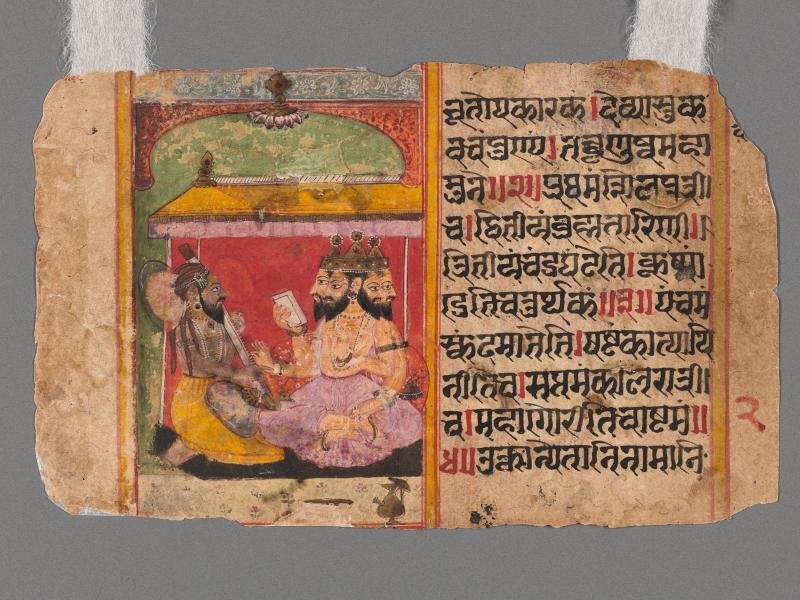
The Brahma Purana is traditionally regarded as the first of the 18 Mahapuranas. It is an important Sanskrit Purana containing stories about creation, gods, sages, dynasties, sacred places, dharma, pilgrimage and devotion.
It is also notable for its extensive descriptions of sacred places in Odisha, including Puri, Konark, Bhubaneswar and Jajpur.


Image ALT: Ancient Indian Sanskrit manuscript depicting Brahma and a sage, representing the Brahma Purana tradition.
What Is the Brahma Purana?
The Brahma Purana is one of the 18 Mahapuranas of Hindu tradition.
According to the traditional narrative, the Purana is presented as knowledge associated with Lord Brahma. The text begins in the setting of Naimisharanya, where sages gather and Suta Lomaharshana narrates the Purana.
The text covers a wide variety of subjects, including:
- Creation of the universe
- Manvantaras
- Genealogies of kings and sages
- Stories of gods and divine figures
- Dharma
- Pilgrimage
- Sacred places
- Worship of Surya
- Krishna-related narratives
- Yoga and spiritual teachings
A modern study of the text describes it as rich in social, religious, philosophical, mythological, geographical and literary material.
The Beginning of the Brahma Purana
The Brahma Purana begins with a description of Naimisharanya, a sacred forest where sages have gathered.
Suta Lomaharshana begins narrating the Purana after being requested by the sages.
The early portion discusses the creation of the world. It describes the primordial waters and the manifestation of the cosmic egg from which Brahma emerges. Brahma then begins the process of creation.


Image ALT: Lord Brahma representing the creation of the universe in traditional Indian art.
Brahma and the Creation of the Universe
Lord Brahma occupies an important place in the creation narratives of the Brahma Purana.
The early chapters discuss the creation of different beings and the development of cosmic order.
The text also introduces figures such as Manu, Rudra and other divine and ancestral beings.
The idea of creation in the Puranas is not simply a single historical event. It is connected with the traditional Indian understanding of cycles of creation, preservation and dissolution.
Manu and the Early Dynasties
The Brahma Purana also discusses Manu and his descendants.
The early narrative includes Manu’s marriage to Shatarupa and accounts of his children and descendants.
The Purana later discusses solar and lunar dynasties, along with important kings and legendary figures.


Image ALT: Traditional Indian artistic representation of Manu and the ancient royal dynasties.
Stories of Krishna
The Brahma Purana also contains a section dealing with Krishna and the Vrishni family.
Its contents include chapters concerning Krishna’s birth, the Vrishnis and the famous Syamantaka jewel episode.


Image ALT: Traditional Indian depiction of Lord Krishna representing the Krishna narratives of the Brahma Purana.
The Krishna-related material shows that the Brahma Purana is not limited to stories about Brahma. Like many Puranas, it brings together traditions connected with several major Hindu deities and sacred traditions.
Brahma Purana and Odisha
One of the most distinctive features of the Brahma Purana is its detailed treatment of sacred places in Odisha.
A substantial portion of the text discusses places including:
- Puri
- Konark
- Bhubaneswar
- Jajpur
The text connects these places with Vishnu, Surya, Shiva and Devi traditions.
Image ALT: Konark Sun Temple in Odisha, a sacred site associated with the Sun worship traditions described in the Brahma Purana.
Brahma Purana and Konark
The Brahma Purana contains important material concerning Konark and the worship of Surya, the Sun God.
The text describes Konaditya, a Sun deity associated with the Sun temple in Utkala. Its chapters on this subject discuss Surya worship and sacred practices.
This connection makes the Brahma Purana particularly interesting when studying the religious history and sacred geography of Odisha.


Image ALT: Konark Sun Temple and its geometric architectural layout representing the ancient Surya worship tradition.
Brahma Purana and Surya Worship
The Purana contains several chapters dedicated to the glory of Surya worship.
The text discusses the importance of worshipping the Sun and mentions particular occasions and rituals associated with Surya.
The Sun has an important place in Indian religious traditions because sunlight is associated with life, energy, health and cosmic order.
The Brahma Purana preserves part of this ancient tradition through its descriptions of Surya worship.
Puri and Lord Jagannath
Another important part of the Brahma Purana concerns Purusottama Kshetra, identified with Puri.
The text contains extensive material about the sacred region of Puri and its connection with Lord Jagannath.


Image ALT: Jagannath Temple in Puri, Odisha, representing the sacred Puri tradition described in the Brahma Purana.
The connection between the Purana and Puri is especially important for understanding how sacred geography and religious storytelling developed together in India.
Bhubaneswar and Shiva Tradition
The Brahma Purana also discusses Ekamra Kshetra, identified with Bhubaneswar.
This section is associated with Lord Shiva and sacred places in the region.


Image ALT: Lingaraj Temple in Bhubaneswar representing the Shiva tradition of Ekamra Kshetra.
This shows how the Brahma Purana connects different sacred traditions and different geographical regions.
Jajpur and Goddess Tradition
The Purana also describes Viraja Kshetra, associated with Jajpur and the worship of Devi.


Image ALT: Biraja Temple in Jajpur representing the Devi tradition associated with Viraja Kshetra.
Thus, within its sacred geography, the Brahma Purana brings together important traditions associated with:
Vishnu → Puri
Surya → Konark
Shiva → Bhubaneswar
Devi → Jajpur
The Brahma Purana and Pilgrimage
The Brahma Purana gives great importance to Tirthas, or sacred pilgrimage places.
A pilgrimage is not presented merely as a journey from one location to another.
Traditionally, visiting a sacred place is connected with:
- Devotion
- Purification
- Worship
- Remembering sacred stories
- Performing religious practices
- Understanding the spiritual significance of a place
The detailed descriptions of Odisha’s sacred places make the Brahma Purana particularly valuable for studying Indian sacred geography.
Brahma Purana and Dharma
The Brahma Purana also contains discussions related to Dharma, or righteous living.
Dharma in the Puranic tradition can involve:
- Duties
- Religious practices
- Charity
- Pilgrimage
- Worship
- Respect for teachers and elders
- Ethical conduct
These teachings are often communicated through stories rather than through abstract philosophical explanations alone.
Brahma Purana and Yoga
The text also contains material concerning Yoga and spiritual practice.
The Brahma Purana’s later material includes discussion of Yoga and contemplative devotion directed toward Vishnu.


Image ALT: Indian sage practicing meditation and representing the spiritual teachings associated with Yoga.
Yoga in this context is connected with self-discipline, concentration and spiritual realization.
Why Is the Brahma Purana Important?
The Brahma Purana is important for several reasons.
1. Religious Heritage
It preserves stories and teachings belonging to the Puranic tradition.
2. Sacred Geography
Its descriptions of Odisha provide valuable material about sacred places and pilgrimage traditions.
3. Mythology
It contains stories concerning gods, sages, kings and divine events.
4. Cultural Heritage
Its stories have connections with temples, festivals, pilgrimage and regional traditions.
5. Spiritual Teachings
It discusses dharma, devotion and spiritual practices.
What Makes the Brahma Purana Different?
Every Purana has its own emphasis.
The Brahma Purana is particularly interesting for its extensive sacred geography of Odisha.
Its descriptions of Puri, Konark, Bhubaneswar and Jajpur show how religious traditions became connected with particular landscapes and pilgrimage centres.
This makes the Brahma Purana valuable not only for religious study but also for understanding Indian culture, geography and temple traditions.
Brahma Purana – Quick Facts
Series: 18 Mahapuranas – Part 1
Name: Brahma Purana
Traditional Association: Brahma
Language: Sanskrit
Major Themes: Creation, genealogy, mythology, dharma, pilgrimage, sacred geography and devotion
Important Regions: Odisha and other sacred places
Important Sacred Places: Puri, Konark, Bhubaneswar and Jajpur
Important Traditions: Vishnu, Surya, Shiva and Devi
Notable Feature: Extensive descriptions of sacred places in Odisha
What Can We Learn From the Brahma Purana?
The Brahma Purana teaches us that India’s ancient literature was not limited to stories about gods.
It also preserved ideas about:
Dharma
Pilgrimage
Sacred geography
Devotion
Cosmic cycles
Royal traditions
Spiritual practice
It connects stories with places, temples and traditions that continue to be important today.
Frequently Asked Questions
What is the Brahma Purana?
The Brahma Purana is one of the traditional 18 Mahapuranas of Hindu literature.
Why is it called the Brahma Purana?
It is traditionally associated with Lord Brahma and contains creation-related narratives connected with Brahma.
What does the Brahma Purana contain?
It contains material on creation, genealogies, mythology, dharma, sacred places, pilgrimage, Surya worship, Krishna and spiritual practices.
Which places in Odisha are described in the Brahma Purana?
Important sacred regions described include Puri, Konark, Bhubaneswar and Jajpur.
Does the Brahma Purana discuss Lord Krishna?
Yes. Its contents include narratives concerning Krishna, his birth, the Vrishni family and the Syamantaka jewel.
Does the Brahma Purana discuss Surya worship?
Yes. Several chapters discuss Surya worship and the sacred Sun centre at Konark/Konaditya.
Why is the Brahma Purana important?
It is important for understanding Puranic mythology, dharma, pilgrimage, sacred geography and Indian cultural traditions.
Conclusion
The Brahma Purana is a fascinating beginning to our journey through the 18 Mahapuranas.
It begins with creation and cosmic narratives, continues through stories of Manu, sages, kings and divine personalities, and later takes us into the sacred geography of India.
Its detailed descriptions of Puri, Konark, Bhubaneswar and Jajpur make it especially important for understanding the religious and cultural heritage of Odisha.
The Brahma Purana shows us how stories, temples, sacred places, devotion and spiritual teachings became connected in India’s ancient tradition.
And this is only Part 1.
In our next article, we will continue with: