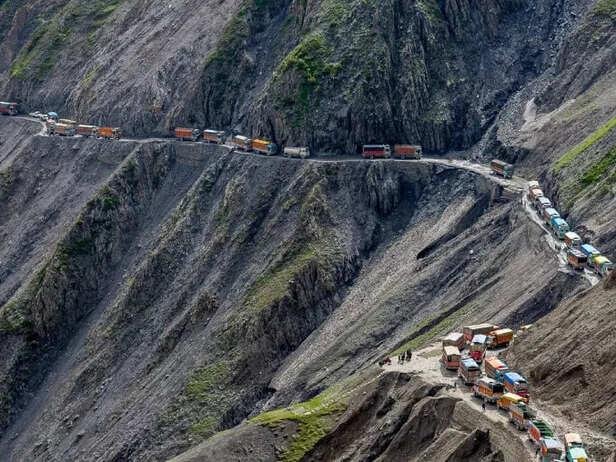
India has some of the most spectacular roads in the world. From Himalayan mountain passes to narrow coastal routes and winding roads through the Western Ghats, these highways offer breathtaking views—but some are also extremely challenging and dangerous.
Here are some of the roads and routes known for extreme terrain, sharp bends, landslides, snow, narrow passages, heavy traffic or difficult weather conditions.


🏔️ 1. Zoji La — Ladakh Route


Zoji La is a high mountain pass connecting the Kashmir Valley with the Ladakh region.
The road can be extremely difficult because of:
- ❄️ Heavy snowfall
- 🌧️ Landslides
- 🪨 Falling rocks
- 🌫️ Poor visibility
- 🏔️ Steep mountain terrain
- 🛣️ Narrow sections
During winter and periods of severe weather, travel can become particularly challenging.
🏔️ 2. Srinagar–Leh Highway


The Srinagar–Leh route crosses some of the most dramatic terrain in northern India.
Drivers encounter:
🏔️ High-altitude mountains
🌨️ Snow
🪨 Rockfalls
🌊 Mountain streams
🌫️ Sudden weather changes
The road is spectacular, but drivers must remain extremely alert.
🏔️ 3. Manali–Leh Highway


The Manali–Leh Highway is one of India’s most famous high-altitude road journeys.
It crosses several mountain passes and reaches extremely high elevations.
Some of its challenges include:
- Extreme altitude
- Snow
- Landslides
- Water crossings
- Narrow mountain roads
- Lack of immediate medical assistance
The road is particularly popular among adventure travellers and motorcyclists.
🏔️ 4. Kishtwar–Killar Road


The Kishtwar–Killar route in the Jammu and Kashmir/Himachal Pradesh region is famous among adventure travellers for its extremely narrow mountain sections.
In some places, the road runs alongside steep cliffs and deep valleys.
The combination of:
narrow roads + cliffs + rockfall + difficult weather
makes this route demanding even for experienced drivers.
🏔️ 5. Killar–Pangi Valley Road


The roads through Pangi Valley in Himachal Pradesh are known for rugged mountain terrain.
The route contains sections where there is very little room for vehicles to pass.
During bad weather, travel becomes considerably more difficult.
🌧️ 6. Mumbai–Pune Old Highway / Khandala Ghat


The ghat sections around Khandala and Lonavala can become hazardous during the monsoon.
Heavy rainfall can lead to:
🌧️ Reduced visibility
💧 Water accumulation
🪨 Landslides and rockfalls
🚗 Slippery roads
🚦 Traffic congestion
The modern Mumbai–Pune Expressway has significantly improved connectivity, but monsoon conditions remain a concern across the surrounding hill region.
🌧️ 7. Western Ghats Mountain Roads


Several roads through the Western Ghats become challenging during India’s monsoon season.
Routes around:
- Agumbe
- Charmadi
- Shiradi
- Kolli Hills
- Nilgiris
can experience heavy rainfall, slippery surfaces and landslides.
The danger is not necessarily the road itself—it is often the combination of steep terrain and extreme weather.
🌊 8. Kolli Hills Hairpin Roads — Tamil Nadu


Kolli Hills is famous for its 70 hairpin bends.
The winding road climbs through the hills and offers spectacular views.
For inexperienced drivers, however, repeated sharp bends can be challenging.
Drivers should maintain low speeds and avoid overtaking unnecessarily.
🏔️ 9. Nathu La Route — Sikkim


The roads leading toward Nathu La in Sikkim pass through high-altitude Himalayan terrain.
Snow, fog, steep gradients and unpredictable weather can make driving difficult.
Because the area is strategically sensitive, access to certain roads and areas is also regulated.
🏔️ 10. Old Silk Route — Sikkim


The historic Old Silk Route in Sikkim includes steep mountain roads and numerous bends.
The route near Zuluk is especially famous for its winding roads.
Fog and rain can dramatically reduce visibility.
🌊 11. Munnar–Kodaikanal Mountain Roads


The mountain roads around Munnar and Kodaikanal are beautiful but can become challenging because of:
🌫️ Fog
🌧️ Rain
🦌 Animals crossing
🛣️ Narrow bends
⛰️ Steep gradients
Drivers should be particularly careful at night and during heavy rain.
🏔️ 12. Leh–Khardung La Road


The road toward Khardung La is associated with extreme altitude and difficult Himalayan conditions.
However, one popular claim needs correcting:
❗ Khardung La is often advertised as one of the world’s highest motorable passes, but modern measurements and competing definitions make such rankings controversial.
The important point for travellers is not the record.
It is the altitude and environment.
🏔️ 13. Sela Pass — Arunachal Pradesh


Sela Pass is one of the most spectacular high-altitude routes in Arunachal Pradesh.
Winter conditions can bring:
❄️ Snow
🌫️ Fog
🧊 Ice
💨 Strong winds
The opening of the Sela Tunnel has improved all-weather connectivity on the strategic route, reducing dependence on the exposed pass during adverse conditions.
🛣️ 14. National Highway 5 — Himachal Pradesh


The highway through Kinnaur is famous for spectacular mountain scenery.
But parts of the route have historically been vulnerable to:
- Landslides
- Rockfalls
- Narrow sections
- Snow
- Heavy rainfall
Mountain roads can change rapidly after natural events, so current local conditions matter more than a road’s reputation.
🏔️ 15. Spiti Valley Roads


The roads through Spiti Valley are among India’s most dramatic adventure routes.
Some sections pass beside enormous cliffs and deep valleys.
There can be:
🏔️ High altitude
🪨 Loose rocks
🌊 Stream crossings
🌨️ Snow
🌫️ Poor visibility
The remoteness itself is an important factor: if something goes wrong, help may not arrive immediately.
⚠️ Why Are Mountain Roads So Dangerous?
There is rarely one single reason.
Several factors can combine:
🌧️ 1. Heavy Rain
Rain can reduce visibility and make roads slippery.
🪨 2. Landslides
Rock and soil can suddenly fall onto the road.
❄️ 3. Snow and Ice
Snow can cover road markings and reduce tyre grip.
🌫️ 4. Fog
Drivers may have only a few metres of visibility.
🏔️ 5. Steep Drops
A small driving mistake can have serious consequences near a cliff.
🚛 6. Heavy Vehicles
Large trucks can make narrow roads difficult to navigate.
🚗 7. Speeding
High speed dramatically reduces reaction time on sharp bends.
🛡️ How to Drive Safely on India’s Dangerous Roads
If you’re travelling on a difficult mountain route:
✅ Check the weather before leaving
Especially during monsoon and winter.
✅ Drive slowly
Do not treat mountain roads like race tracks.
✅ Avoid unnecessary overtaking
Wait for a safe and visible section.
✅ Use the horn appropriately
On blind mountain bends, warning other vehicles can be important.
✅ Keep your vehicle maintained
Brakes, tyres, lights and coolant should be checked before a long mountain journey.
✅ Don’t drive when exhausted
Fatigue can be particularly dangerous on winding roads.
✅ Follow local restrictions
Some high-altitude roads may be closed because of weather or security conditions.
📊 India’s Dangerous Roads — Quick Comparison
| Road / Route | State / Region | Main Challenge |
|---|---|---|
| Zoji La | J&K–Ladakh | Snow, rockfall, altitude |
| Srinagar–Leh | Ladakh | High altitude, weather |
| Manali–Leh | Himachal–Ladakh | Altitude, snow, remoteness |
| Kishtwar–Killar | J&K–Himachal | Narrow cliffs |
| Pangi Valley | Himachal Pradesh | Narrow mountain roads |
| Kinnaur NH-5 | Himachal Pradesh | Landslides, rockfall |
| Spiti Valley | Himachal Pradesh | Remoteness, altitude |
| Kolli Hills | Tamil Nadu | Hairpin bends |
| Western Ghats routes | Multiple states | Rain, landslides |
| Nathu La route | Sikkim | Snow, altitude |
| Sela Pass | Arunachal Pradesh | Snow, extreme weather |
| Old Silk Route | Sikkim | Fog, steep bends |
🌍 Beauty and Danger Together


The most dangerous roads are often also among the most beautiful roads in India.
They take travellers through:
🏔️ Snow-covered mountains
🌲 Dense forests
🌊 Deep valleys
☁️ Clouds
🌅 Incredible viewpoints
But the scenery should never distract drivers from the road.
A beautiful road can still be a dangerous road.
🇮🇳 Conclusion
India’s dangerous roads are not necessarily dangerous because they are poorly constructed. Many are challenging because they pass through extreme natural environments.
High mountains, heavy snowfall, monsoon rain, landslides, rockfalls, fog, steep cliffs and remoteness can all create serious risks.
Routes such as Zoji La, Manali–Leh, Kinnaur, Spiti, Pangi Valley, Sela Pass and several Western Ghats roads demonstrate the incredible variety of India’s terrain.
The safest approach is simple:
Respect the mountain. Respect the weather. Respect the road.
A journey should be remembered for its views and experiences—not for taking unnecessary risks. 🇮🇳
🇮🇳 MANA BHARATHAM
Stories, Facts & Wonders From India
✍️ Written by Pasupuleti Saida Rao