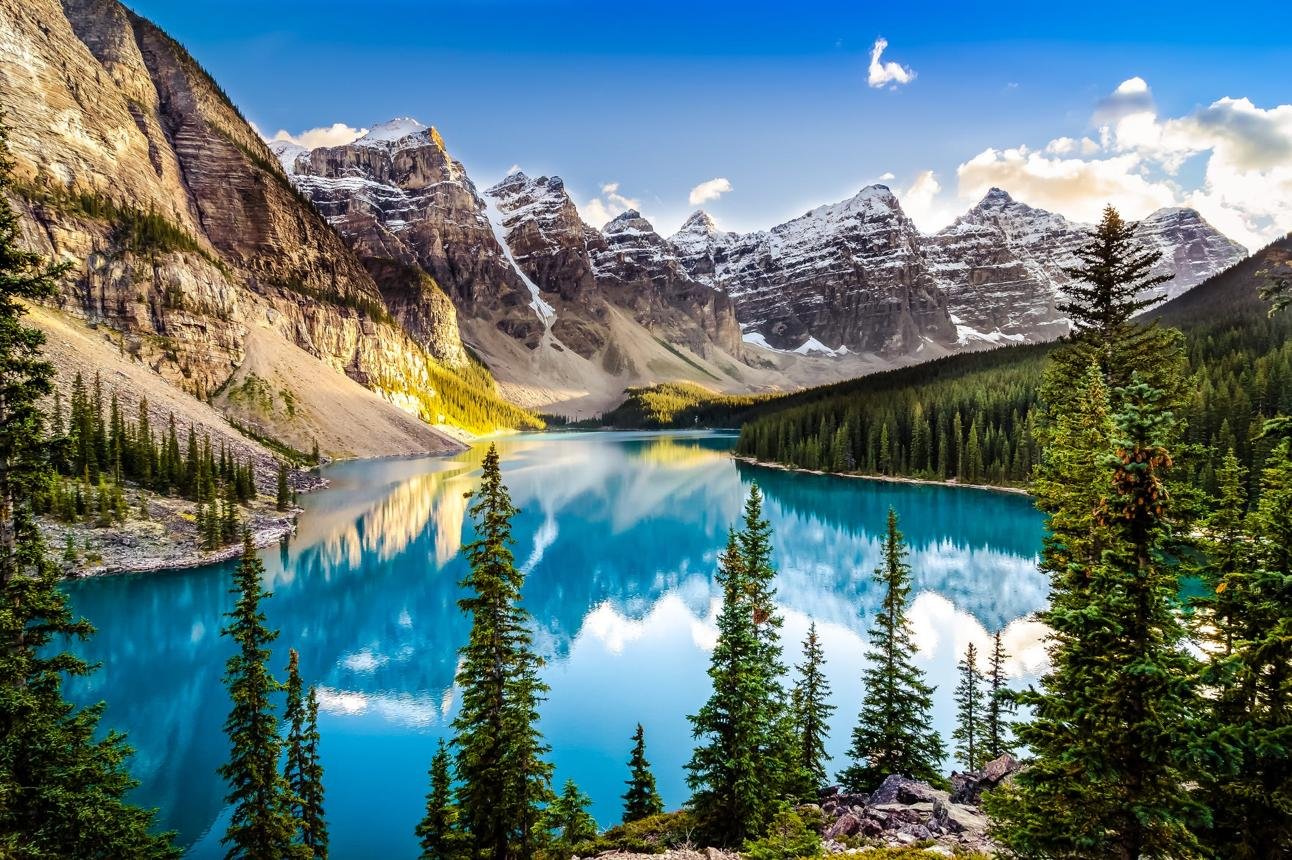
Canada is one of the most fascinating countries in the world.
It is famous for its vast forests, beautiful lakes, Rocky Mountains, Niagara Falls, Arctic landscapes, multicultural cities and spectacular Northern Lights.
Canada is enormous. In fact, it is the second-largest country in the world by total area. Despite its huge size, much of the country is covered by forests, lakes, mountains and wilderness.
Let’s explore this amazing country. 🇨🇦🌎


The Beauty of Canada
Canada is famous for its enormous wilderness, mountain ranges, forests and beautiful freshwater lakes.
🌎 Where Is Canada?
Canada is located in North America.
It stretches from the Atlantic Ocean in the east to the Pacific Ocean in the west, while its northern regions extend into the Arctic.
Canada shares its longest international land border with the United States.
The capital city is Ottawa.
Other famous cities include:
- Toronto
- Vancouver
- Montreal
- Calgary
- Edmonton
- Quebec City
🏔️ The Canadian Rocky Mountains
The Canadian Rockies are among the country’s most spectacular natural attractions.
They pass through parts of Alberta and British Columbia.
The region is famous for:
🏔️ Snow-covered peaks
💙 Turquoise lakes
🌲 Dense forests
🦌 Wildlife
🥾 Hiking trails
The mountains attract visitors throughout the year.


Canadian Rockies
💙 Lake Louise
Lake Louise in Alberta is one of Canada’s most photographed natural attractions.
The lake is surrounded by mountains and forests.
Its striking blue-green color comes partly from fine particles of glacial rock carried into the lake by meltwater.
During summer, visitors enjoy hiking and sightseeing.
In winter, the area becomes popular for snow and winter sports.
🏞️ Banff National Park
Banff National Park is Canada’s oldest national park.
It is located in the Rocky Mountains and is famous for spectacular scenery.
Visitors can experience:
🥾 Hiking
🏔️ Mountain views
🚣 Canoeing
❄️ Winter sports
🦌 Wildlife watching
The park is part of a larger protected mountain ecosystem.
💦 Niagara Falls
One of Canada’s most famous natural attractions is Niagara Falls, located on the border between Canada and the United States.
Niagara Falls is actually a group of three waterfalls:
💦 Horseshoe Falls
💦 American Falls
💦 Bridal Veil Falls
The enormous volume of water and powerful sound make the falls an unforgettable sight.


Niagara Falls
🌊 Canada – A Country of Lakes
Canada has an enormous number of lakes.
The country contains some of the world’s largest freshwater lakes, including:
💧 Lake Superior
💧 Lake Huron
💧 Lake Erie
💧 Lake Ontario
💧 Great Bear Lake
💧 Great Slave Lake
These lakes are important for ecosystems, transportation, recreation and freshwater resources.
🌌 The Northern Lights
Canada is one of the world’s excellent places to experience the Aurora Borealis, or Northern Lights.
In northern regions, the night sky can sometimes glow with spectacular colors.
The lights are produced when charged particles from the Sun interact with Earth’s upper atmosphere.
They may appear as:
💚 Green
💜 Purple
💙 Blue
❤️ Red
The exact appearance depends on atmospheric and solar conditions.


Northern Lights in Canada
🐻 Canada’s Amazing Wildlife
Canada has vast wilderness areas that support many species.
Some well-known Canadian animals include:
🐻 Polar bear
🐻 Grizzly bear
🫎 Moose
🦫 Beaver
🐺 Wolf
🦌 Caribou
🦅 Bald eagle
The beaver is Canada’s national animal and appears on the Canadian five-cent coin.


Canadian Wildlife
🐻❄️ Polar Bears of the Arctic
Northern Canada contains important habitat for polar bears.
The town of Churchill, in Manitoba, is internationally known for opportunities to observe polar bears in the wild.
Polar bears depend heavily on sea ice for hunting seals.
Climate change and the loss of Arctic sea ice are major concerns for their future.
🌲 Canada’s Vast Forests
Forests cover a large part of Canada’s landscape.
The country’s boreal forest stretches across huge areas.
These forests provide habitat for:
🦌 Caribou
🐺 Wolves
🐻 Bears
🦉 Birds
🐿️ Small mammals
Forests also play an important role in Canada’s climate and freshwater systems.
🧊 The Canadian Arctic
Northern Canada extends deep into the Arctic region.
The Arctic contains:
🧊 Sea ice
🏔️ Tundra
🐻❄️ Polar bears
🦭 Seals
🐋 Whales
🌌 Long winter nights
The region is also home to Inuit communities whose cultures and traditions are closely connected with the Arctic environment.
🧑🤝🧑 Indigenous Peoples of Canada
Canada is home to diverse Indigenous peoples, including:
- First Nations
- Inuit
- Métis
Each group includes many distinct communities, languages and traditions.
Indigenous peoples have deep and longstanding connections to Canada’s lands and waters.
Their histories and cultures are an important part of Canada’s identity.
🏙️ Toronto – Canada’s Largest City
Toronto is Canada’s largest city and an important economic and cultural center.
It is famous for:
🏙️ Skyscrapers
🌎 Multicultural communities
🎨 Arts
🍽️ International cuisine
🏀 Sports
One of its most recognizable landmarks is the CN Tower.


Toronto
🗼 The CN Tower
The CN Tower is one of Canada’s most recognizable landmarks.
It rises high above Toronto’s skyline and offers spectacular views of the city and Lake Ontario.
For many years, it was one of the world’s tallest freestanding structures.
Today it remains a major tourist attraction.
🏛️ Ottawa – Canada’s Capital
Ottawa is Canada’s capital city.
The city is located in the province of Ontario along the Ottawa River.
Important landmarks include:
🏛️ Parliament Hill
🌊 Rideau Canal
🏛️ National museums
🌳 Parks and gardens
The Rideau Canal is a UNESCO World Heritage Site.
🏰 Quebec City – A Taste of European History
Quebec City is famous for its historic architecture and French-speaking culture.
The city’s old district, Old Quebec, contains historic streets, stone buildings and fortifications.
It is one of the most distinctive historic urban areas in North America.


Quebec City
🗣️ Canada’s Two Official Languages
Canada has two official languages at the federal level:
🇬🇧 English
🇫🇷 French
French is particularly dominant in Quebec, while English is widely spoken throughout most of the country.
This bilingual heritage is an important part of Canada’s identity.
🍁 The Maple Leaf
The maple leaf is one of Canada’s most recognizable symbols.
It appears prominently on the Canadian flag.
Maple trees are also connected with the production of maple syrup, another famous Canadian product.
🍁 Canadian Maple Syrup
Canada is one of the world’s major producers of maple syrup.
Maple sap is collected from certain species of maple trees during a short season in late winter and early spring.
The sap is then processed into the sweet syrup enjoyed around the world.
Maple syrup is especially associated with Quebec and eastern Canada.


Canadian Maple Syrup
🏒 Canada and Ice Hockey
Ice hockey is deeply connected with Canadian culture.
Canada has produced many famous players and successful teams.
Hockey is played at professional, amateur and youth levels throughout the country.
For many Canadians, the sport is an important part of winter life.
❄️ Canada’s Long Winters
Many parts of Canada experience very cold winters.
Snow and ice can transform the landscape into a winter wonderland.
Popular winter activities include:
⛷️ Skiing
🏂 Snowboarding
⛸️ Ice skating
🏒 Ice hockey
🛷 Sledding
The cold climate has influenced Canadian architecture, transportation and everyday life.
🌆 Vancouver – City Between Mountains and Ocean
Vancouver is located in British Columbia on Canada’s Pacific coast.
It is famous for its combination of:
🌊 Ocean
🏔️ Mountains
🌲 Forests
🏙️ Modern city life
The surrounding natural scenery makes Vancouver one of Canada’s most visually impressive cities.


Vancouver
🌟 10 Amazing Facts About Canada
1. Canada is the second-largest country in the world by total area.
2. Ottawa is the capital city.
3. Toronto is Canada’s largest city.
4. Canada has an enormous number of lakes and freshwater resources.
5. The Canadian Rockies contain spectacular mountain landscapes.
6. Niagara Falls is one of Canada’s most famous natural attractions.
7. Canada is home to animals such as polar bears, moose, beavers and grizzly bears.
8. English and French are Canada’s two official languages at the federal level.
9. Maple syrup is one of Canada’s best-known products.
10. Canada has extensive Arctic territory and is an excellent place to experience the Northern Lights.
💡 What Can We Learn From Canada?
1️⃣ Protect Natural Resources
Canada’s forests, lakes and wildlife demonstrate the importance of protecting natural ecosystems.
2️⃣ Respect Indigenous Cultures
First Nations, Inuit and Métis peoples have deep histories and important cultural traditions.
3️⃣ Live With Nature
Canada shows how communities can exist alongside enormous wilderness areas.
4️⃣ Celebrate Cultural Diversity
People from many backgrounds have contributed to Canada’s modern society.
5️⃣ Protect the Arctic
The Arctic environment is fragile and important to wildlife, Indigenous communities and the global climate.
📝 Conclusion
Canada is a country of enormous scale and extraordinary beauty.
From the Rocky Mountains and Niagara Falls to the Arctic wilderness and Northern Lights, its landscapes are incredibly diverse.
Its cities are modern and multicultural, while Indigenous cultures and traditions connect the country with much older histories.
Canada’s wildlife, lakes, forests and mountains make it one of the world’s great natural destinations.