Continuing our 18 Mahapuranas series, Part 16 is the Matsya Purana.
The Matsya Purana is traditionally counted among the 18 Mahapuranas. It takes its name from Matsya, the fish incarnation of Lord Vishnu, and contains traditions concerning creation, Manu, the great flood, Vishnu, Shiva, Devi, Dharma, pilgrimage, temples, architecture and religious practices.


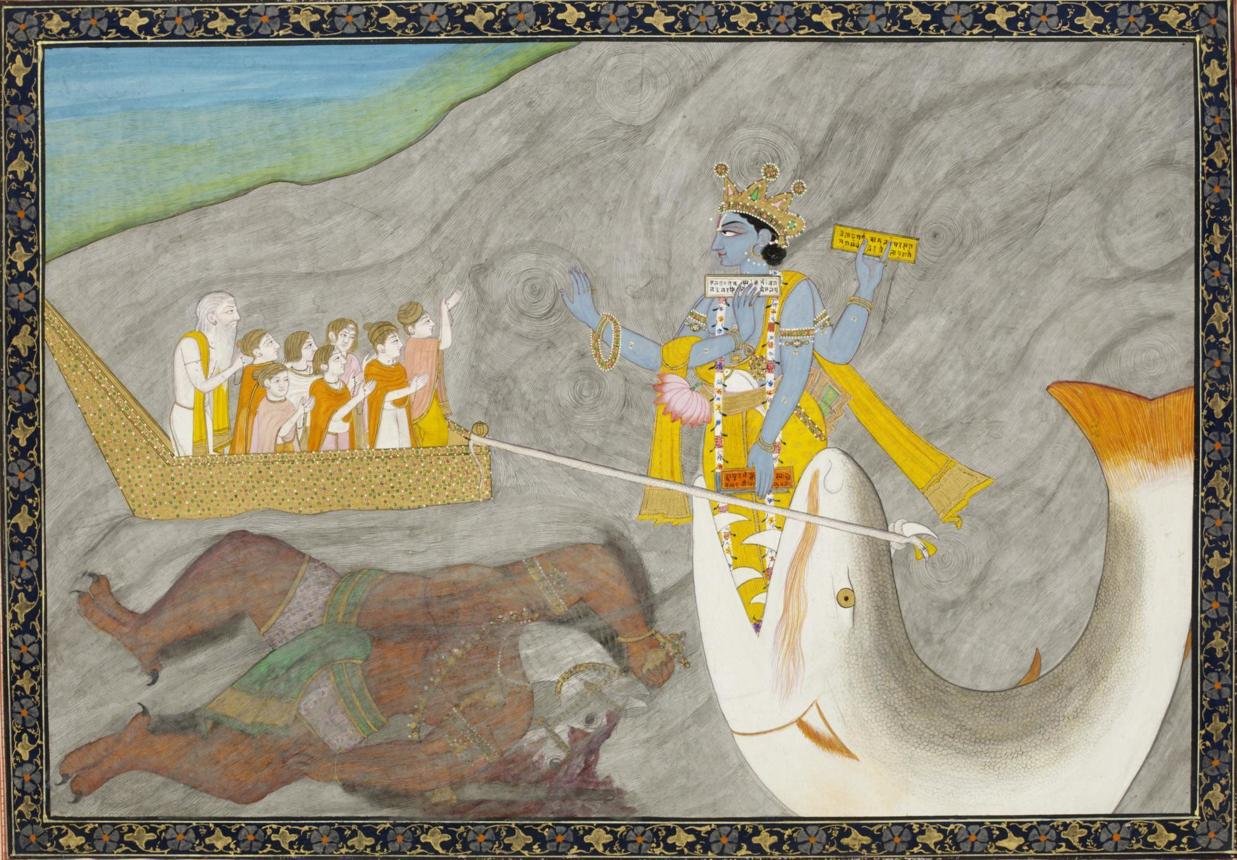
Image ALT: Lord Vishnu as Matsya guiding Manu’s boat during the great flood, representing the Matsya Purana
What Is the Matsya Purana?
The Matsya Purana gets its name from Matsya, the fish incarnation of Lord Vishnu.


Image ALT: Lord Vishnu appearing as the Matsya fish Avatar in traditional Hindu art
It is one of the traditional 18 Mahapuranas and covers a wide range of subjects.
Major themes include:
- Matsya Avatar
- Manu
- The great flood
- Creation
- Cosmic cycles
- Dharma
- Vishnu
- Shiva
- Devi
- Pilgrimage
- Temples
- Architecture
- Religious observances
Who Is Matsya?
Matsya means fish.


Image ALT: Matsya, the fish incarnation of Lord Vishnu, in traditional Indian art
Matsya is traditionally regarded as the first avatar of Vishnu in the commonly known Dashavatara sequence.
The Story of Manu
The Matsya story is closely connected with Manu, the primordial human and lawgiver figure in Hindu tradition.


Image ALT: Manu meeting the divine Matsya fish in traditional Hindu mythology
The story begins when Manu encounters a small fish.
The Little Fish
According to the famous tradition, the small fish asks Manu for protection.


Image ALT: Manu protecting the small divine fish that later reveals itself as Matsya
Manu protects the fish and moves it into larger and larger containers as it grows.
Eventually, the fish becomes enormous.
The Divine Revelation
The fish reveals that it is Lord Vishnu.
Image ALT: Lord Vishnu revealing himself as Matsya to Manu
Matsya then warns Manu about an approaching great flood.
The Great Flood
The flood is one of the central themes associated with the Matsya story.


Image ALT: Matsya guiding Manu’s boat through the great flood
Manu is instructed to prepare for the coming catastrophe.
Manu’s Boat
Manu builds a boat to survive the flood.

Image ALT: Matsya guiding Manu’s boat safely through the cosmic flood
The boat becomes a symbol of preservation and survival.
Matsya Guides the Boat
Matsya guides Manu’s boat through the flood.
Image ALT: Matsya guiding Manu’s boat through the flood using a divine rope
In traditional depictions, the boat is connected to Matsya while the divine fish guides it through the waters.
The Seven Sages
The flood story is also associated with the Seven Sages, or Saptarishis.


Image ALT: Manu and the Seven Sages traveling in the boat guided by Matsya
The sages represent the preservation of knowledge and spiritual tradition.
Preservation of Life
The story is not only about surviving a flood.
Image ALT: Manu preserving life and knowledge during the great flood with the help of Matsya
It represents the preservation of life, knowledge and Dharma through a cosmic catastrophe.
The Meaning of the Flood
The great flood can be understood as a story of destruction followed by renewal.
Image ALT: Matsya flood representing destruction followed by renewal in Hindu cosmology
The old order is destroyed, while the seeds of a new order are preserved.
Matsya as Protector
Matsya represents Vishnu’s role as the preserver and protector.


Image ALT: Matsya Avatar protecting Manu and preserving Dharma
The avatar appears when preservation becomes necessary.
Dashavatara
Matsya is traditionally the first avatar in the commonly known Dashavatara sequence:
- Matsya
- Kurma
- Varaha
- Narasimha
- Vamana
- Parashurama
- Rama
- Krishna
- Buddha or Balarama in different traditions
- Kalki


Image ALT: Dashavatara of Lord Vishnu beginning with Matsya Avatar
Matsya and Cosmic Cycles
The Matsya Purana contains traditions concerning cosmic time and cycles of creation.


Image ALT: Puranic representation of cosmic cycles of creation and dissolution
Hindu cosmology traditionally describes creation as a process involving recurring cycles rather than a single permanent beginning.
Creation
The Purana discusses traditions concerning creation and the structure of the universe.


Image ALT: Puranic depiction of cosmic creation and the universe
Creation, preservation and dissolution form an important framework in Puranic thought.
Pralaya
The concept of Pralaya, or cosmic dissolution, is important in Hindu cosmology.


Image ALT: Cosmic dissolution and flood representing Pralaya in Hindu cosmology
The Matsya story connects a great flood with the preservation of life and the beginning of a new cycle.
Manu and Humanity
Manu occupies an important position in Hindu traditions concerning humanity and Dharma.


Image ALT: Manu representing the ancient progenitor and lawgiver in Hindu tradition
Manu is associated with the continuation of human civilization after the flood.
Dharma
The Matsya Purana also contains teachings concerning Dharma.


Image ALT: Ancient sage teaching Dharma and righteous conduct in traditional Indian art
Dharma involves living according to righteousness, duty and ethical principles.
Charity
Dana, or charitable giving, is an important religious practice in Puranic traditions.


Image ALT: Traditional Hindu practice of Dana or charitable giving
Giving is associated with generosity, compassion and religious merit.
Vratas and Religious Observances
The Matsya Purana also discusses religious observances and vows.


Image ALT: Hindu devotee observing a religious vrata through fasting and prayer
Such observances can include:
- Fasting
- Puja
- Prayer
- Charity
- Sacred bathing
- Mantra recitation
Pilgrimage
Pilgrimage, or visiting sacred places, is another important theme.


Image ALT: Hindu devotees undertaking pilgrimage to a sacred temple
Sacred journeys are traditionally understood as opportunities for devotion and spiritual purification.
Tirthas
A Tirtha is a sacred place associated with religious significance.


Image ALT: Hindu pilgrims visiting a sacred Tirtha and river
Tirthas may include:
- Rivers
- Temples
- Mountains
- Lakes
- Sacred cities
Temple Traditions
One of the interesting features of the Matsya Purana is its material concerning temples and religious architecture.


Image ALT: Traditional Hindu temple architecture representing temple-building traditions
The text is therefore valuable not only for mythology but also for understanding traditional ideas about sacred architecture.
Temple Construction
Traditional temple construction involves careful consideration of:
- Location
- Measurements
- Design
- Proportions
- Sacred spaces
- Images of deities
- Ritual requirements


Image ALT: Traditional Hindu temple architecture and planning based on sacred proportions
Deity Images
The Purana also belongs to a broader tradition that discusses the proper representation of divine forms.


Image ALT: Traditional Hindu deity sculpture representing sacred image-making traditions
Sacred images are connected with temple worship and religious practice.
Architecture and Indian Heritage
The architectural traditions preserved in Puranic literature have influenced the development of Hindu temple culture.


Image ALT: Traditional Indian Hindu temple architecture representing India’s cultural heritage
This makes the Matsya Purana interesting from both a religious and cultural perspective.
Shiva Traditions
Although the Purana is named after Vishnu’s Matsya incarnation, it also contains traditions concerning Lord Shiva.


Image ALT: Lord Shiva representing Shaiva traditions within the Matsya Purana
This reflects the broad nature of Puranic literature.
Devi and Shakti
The Matsya Purana also includes traditions connected with Devi and Shakti.


Image ALT: Goddess Devi representing Shakti traditions in Puranic Hinduism
The Goddess is worshipped through numerous forms throughout Hindu traditions.
Vishnu Worship
Vishnu remains an important figure because of the Matsya incarnation.


Image ALT: Lord Vishnu holding the conch and discus in traditional Indian art
The Matsya Avatar demonstrates Vishnu’s role as the preserver of cosmic order.
The Boat as a Symbol
The boat in the Matsya story carries a powerful symbolic meaning.

Image ALT: Manu’s boat guided by Matsya as a symbol of preservation during the great flood
It can be understood as representing:
- Protection
- Preservation
- Hope
- Faith
- Continuity
The Flood as a Spiritual Lesson
The flood story can also be interpreted as a reminder that worldly conditions can change dramatically.
Image ALT: Matsya protecting Manu during the flood as a spiritual lesson about faith and preservation
The story emphasizes the importance of wisdom, preparation and trust in the Divine.
Preservation of Knowledge
The presence of sages in the flood story has another important meaning.


Image ALT: Saptarishis representing preservation of ancient spiritual knowledge
The sages symbolize the continuity of knowledge and spiritual tradition even after catastrophe.
Why Is the Matsya Purana Important?
1. Matsya Avatar
It preserves the famous story of Vishnu’s fish incarnation.
2. Manu and the Flood
It is closely associated with the great flood and Manu’s survival.
3. Cosmic Cycles
It contains traditions concerning creation, dissolution and cosmic time.
4. Temple Architecture
It includes important material related to temples and sacred architecture.
5. Dharma
It discusses religious duties and righteous living.
6. Pilgrimage
It preserves traditions concerning sacred places and religious journeys.
What Can We Learn From the Matsya Purana?
Preparation
Manu prepares for the coming flood rather than ignoring the warning.
Preservation
The story emphasizes protecting life and knowledge.
Faith
Manu trusts the divine guidance of Matsya.
Wisdom
Knowledge becomes essential for surviving great changes.
Renewal
Destruction can be followed by a new beginning.
Dharma
Human civilization is expected to continue according to righteous principles.
Matsya Purana – Quick Facts
Series: 18 Mahapuranas – Part 16
Name: Matsya Purana
Language: Sanskrit
Named After: Matsya Avatar
Main Deity: Lord Vishnu
Avatar: Matsya
Important Figure: Manu
Major Story: Manu and the Great Flood
Important Figures: Matsya, Manu, Saptarishis
Major Themes: Creation, Pralaya, Dharma, pilgrimage, temples, architecture, religious practices and mythology
Frequently Asked Questions
What is the Matsya Purana?
The Matsya Purana is one of the traditional 18 Mahapuranas, named after the Matsya or fish incarnation of Lord Vishnu.
Who is Matsya?
Matsya is the fish incarnation of Lord Vishnu and is traditionally considered the first avatar in the commonly known Dashavatara sequence.
Who is Manu?
Manu is a primordial human and lawgiver figure who is central to the traditional story of the great flood.
What is the Matsya Purana flood story?
Matsya warns Manu about a great flood and guides his boat to safety, helping preserve life, sages and the continuity of civilization.
What is Pralaya?
Pralaya refers to cosmic dissolution in Hindu cosmological traditions.
Does the Matsya Purana discuss temples?
Yes. It contains material concerning temple construction, sacred architecture and religious images, making it significant beyond mythology alone.
Is the Matsya Purana only about Vishnu?
No. It also contains traditions concerning Shiva, Devi, Dharma, pilgrimage, religious observances and sacred architecture.
Conclusion
The Matsya Purana – Part 16 takes us back to one of the oldest and most memorable stories connected with Lord Vishnu.
The story of Matsya and Manu is much more than a tale about a great flood. It is a story about preservation, wisdom, faith and renewal.
When the world faces destruction, Matsya guides Manu and helps preserve the foundations of future life and civilization.
The Matsya Purana also goes far beyond the flood story. Its traditions cover creation, cosmic cycles, Dharma, pilgrimage, temple construction, sacred architecture, Vishnu, Shiva and Devi.
This makes the Matsya Purana an important part of the wider Puranic tradition and an interesting source for understanding both Hindu mythology and India’s religious-cultural heritage.
This is Part 16 of our 18 Mahapuranas series.