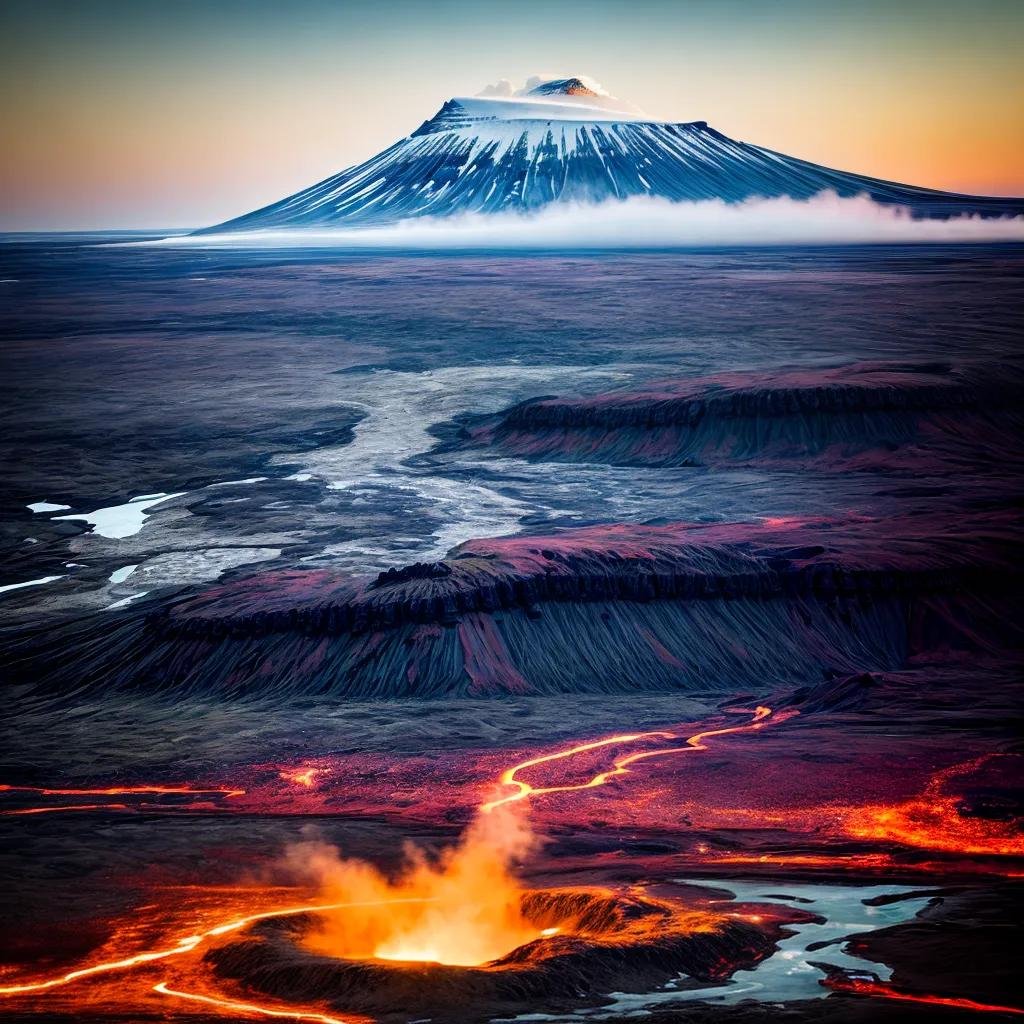
Imagine a country where massive glaciers, active volcanoes, black-sand beaches, waterfalls, geothermal springs and the Northern Lights can all be found within the same national landscape.
That country is Iceland.
Located in the North Atlantic, Iceland is one of the world’s most unusual countries because its landscape is shaped by two powerful forces at the same time: volcanic activity and ice.
That is why Iceland is often described as the “Land of Fire and Ice.” Its official tourism authority describes it as a country of extreme contrasts, with some of Europe’s largest glaciers and some of the world’s most active volcanoes.


🌋 Why Is Iceland Called the “Land of Fire and Ice”?
The name sounds almost like something from a fantasy movie, but it describes Iceland’s geology surprisingly well.
On one side, Iceland has enormous glaciers and ice-covered mountains.
On the other, it is a highly volcanic country where geothermal heat rises from deep beneath the Earth’s surface.
Volcanic activity is considered a normal part of life in Iceland, and the country’s geology also provides opportunities for geothermal energy.
This creates landscapes where black lava fields can exist beside bright glaciers, while hot geothermal water can emerge from the ground in an otherwise freezing environment.
That extraordinary combination is one of Iceland’s biggest natural attractions.
🧊 Iceland’s Massive Glaciers
Although the country’s name suggests ice, Iceland is not completely covered by glaciers.
However, its glaciers are among its most spectacular natural features.
One of the best known is:
Vatnajökull
It is the largest glacier in Iceland and one of the largest in Europe.
The glacier has shaped the surrounding landscape for thousands of years, creating valleys, rivers, volcanic features and dramatic ice formations.
Iceland’s official tourism information lists Vatnajökull among the country’s UNESCO World Heritage sites.


🔥 A Country Built by Volcanoes
Iceland is located in a geologically active region where tectonic forces and volcanic activity have played a major role in creating the island.
Volcanoes are not simply distant geological features here.
They are part of Iceland’s living landscape.
Lava fields, volcanic mountains, craters and geothermal areas can be found in different parts of the country.
The Reykjanes Peninsula has been particularly active in recent years. Iceland’s official tourism authority reports that the peninsula experienced eight eruptions since 2023, with the latest of those listed there ending on August 5, 2025.
This is one reason Iceland is fascinating to geologists as well as travellers.
🌡️ How Can Iceland Be So Hot and So Cold?
This is perhaps the most interesting contradiction about Iceland.
The country can have:
🧊 Glaciers
and at the same time:
🔥 Geothermal heat
Deep underground, heat from the Earth’s interior warms water and rocks.
That heat can reach the surface through geothermal areas.
The result is a landscape containing:
- Hot springs
- Geysers
- Geothermal pools
- Steam vents
- Volcanic areas
Iceland has used this natural heat extensively for heating and other purposes, making geothermal energy an important part of its energy story.


💨 The Country Where Geothermal Energy Is Part of Everyday Life
In many countries, hot water and heating require large amounts of conventional fuel.
Iceland’s geology gives it an unusual advantage.
Geothermal resources provide naturally heated water that can be used for:
- Heating
- Bathing
- Swimming pools
- Certain industrial uses
- Electricity generation
The country’s official tourism authority describes Iceland as having abundant clean, renewable energy because of its distinctive geography and geology.
This is a fascinating example of how a country’s natural environment can influence its technology and everyday life.
🌌 The Northern Lights: Iceland’s Magical Winter Sky
One of Iceland’s most famous natural attractions is the:
Aurora Borealis — Northern Lights
During the darker months, the night sky can sometimes fill with moving colours ranging from green to pink, purple and other shades.
The phenomenon is caused by interactions between charged particles from the Sun and Earth’s upper atmosphere.
Iceland’s official tourism information says the Northern Lights season generally runs from September to April, when darkness provides suitable viewing conditions.
But seeing the Northern Lights is never guaranteed.
You need a combination of:
Darkness + suitable weather + solar activity + clear skies.
That uncertainty is part of the excitement.


☀️ The Opposite Happens in Summer
Iceland’s winter darkness has a remarkable opposite.
During summer, the country experiences extremely long daylight hours.
Around the period from mid-May to mid-July, the Midnight Sun creates nights that remain unusually bright.
So Iceland can offer two completely different experiences:
Winter:
🌌 Long darkness and opportunities to see the Northern Lights
Summer:
☀️ Extremely long daylight and the Midnight Sun
This dramatic difference between seasons is one of the country’s most memorable characteristics.
🌊 Iceland’s Famous Black-Sand Beaches
Most people imagine beaches as places covered with golden or white sand.
Iceland has something very different.
Some of its beaches are covered with dark volcanic sand.
The colour comes from volcanic material that has been broken down over time.
These beaches create a spectacular contrast:
Black sand + white waves + green cliffs + grey sky
The result looks almost unreal.
Iceland’s volcanic geology is therefore visible not only in mountains and lava fields, but also along its coastline.


💧 Waterfalls Everywhere
Iceland is also famous for spectacular waterfalls.
Its combination of:
Glaciers + snow + rainfall + mountains + rivers
creates ideal conditions for powerful waterfalls.
Some waterfalls are surrounded by cliffs, while others fall from broad plateaus or narrow valleys.
Water is one of the most important elements in Iceland’s landscape, and travelling through the country can reveal completely different waterfalls within a relatively short distance.
🏞️ Iceland Is One of the World’s Least-Densely Populated Countries
Iceland has a very small population compared with the size of its territory.
At the end of the first quarter of 2026, Statistics Iceland recorded a population of 395,050.
The country’s official tourism authority describes Iceland as one of the world’s most sparsely populated countries, with almost two-thirds of residents living in the capital area in the southwest.
That means enormous areas outside the main urban region have relatively few inhabitants.
For visitors, this creates a remarkable feeling of space.
You can travel through landscapes where there may be mountains, lava fields, glaciers and ocean—but very few buildings.
🏙️ Reykjavík: A Small Capital With a Big Personality
Iceland’s capital is:
Reykjavík
It is the country’s largest urban centre and the heart of its political, cultural and economic life.
Despite being a capital city, Reykjavík is much smaller than the world’s giant metropolitan areas.
That gives it a distinctive character.
Visitors can experience:
- Modern architecture
- Cafés and restaurants
- Museums
- Nordic culture
- Geothermal swimming pools
- Easy access to spectacular natural landscapes
The capital region is home to the majority of Iceland’s population.


🧬 Iceland’s Unique Connection With Nature
Iceland’s geography has influenced almost every aspect of life.
The country’s:
Volcanoes
created land.
Glaciers
shaped valleys and rivers.
Geothermal heat
provides energy and hot water.
Ocean
supports fishing and coastal communities.
Long winter darkness
creates ideal conditions for experiencing the Northern Lights.
Long summer daylight
changes the rhythm of everyday life.
In other words, Iceland’s natural environment isn’t just something people visit.
Nature is deeply connected to life in Iceland.
🐋 Wildlife in Iceland
Iceland’s waters and coastal environments support a variety of marine life.
Depending on the region and season, visitors may encounter:
- Whales
- Seabirds
- Puffins
- Seals
- Arctic wildlife
The country’s official tourism resources highlight wildlife experiences such as whale watching and puffin spotting among its attractions.
The famous Atlantic puffin has also become one of Iceland’s most recognisable wildlife symbols.
🏛️ A Country With a Viking Heritage
Iceland’s modern culture is strongly connected to its Norse and Viking-era history.
The country has preserved a remarkable literary tradition, including the famous Icelandic sagas.
Its language has also retained many features of Old Norse.
This means Iceland offers a fascinating combination:
Ancient heritage + modern society
Traditional stories and language exist alongside advanced technology, modern infrastructure and contemporary urban life.
🌋 One of the World’s Best Natural Laboratories
For scientists, Iceland is more than a beautiful tourist destination.
It is a natural laboratory for studying:
- Volcanic activity
- Earthquakes
- Glaciers
- Geothermal systems
- Plate tectonics
- Climate change
- Renewable energy
The country’s unusual geology makes it particularly valuable for understanding how Earth’s natural systems work.
🌍 Why Is Iceland So Special?
Many countries have mountains.
Many have glaciers.
Many have beaches.
Many have volcanoes.
But Iceland brings an extraordinary number of these features together in one relatively small country.
You can experience:
🌋 Volcanoes
🧊 Glaciers
🌌 Northern Lights
☀️ Midnight Sun
💨 Geothermal areas
🌊 Waterfalls
🖤 Black-sand beaches
🐋 Marine wildlife
🏔️ Dramatic mountains
all within the same island nation.
That combination is what makes Iceland genuinely unique.
🤯 10 Amazing Facts About Iceland
1️⃣ Iceland is widely known as the Land of Fire and Ice.
2️⃣ It has both major glaciers and active volcanic areas.
3️⃣ The country has extensive geothermal resources.
4️⃣ The Northern Lights can be seen during suitable dark and clear conditions, generally from September to April.
5️⃣ The Midnight Sun creates exceptionally long daylight periods around summer.
6️⃣ Iceland has dramatic black-sand volcanic beaches.
7️⃣ Its population was 395,050 at the end of Q1 2026.
8️⃣ Almost two-thirds of its population lives in the capital region.
9️⃣ The Reykjanes Peninsula has experienced repeated volcanic eruptions in recent years.
🔟 Iceland’s geology provides abundant renewable geothermal and hydropower resources.
🇮🇸 The Real Story Behind Iceland
Iceland is much more than a beautiful travel destination.
It is a country where Earth’s most powerful natural forces are visible almost everywhere.
Fire rises from beneath the ground.
Ice covers enormous areas.
Waterfalls cut through valleys.
Geothermal heat creates warm water.
The ocean surrounds the country.
And during the right winter night, the sky can suddenly come alive with the Northern Lights.
That combination makes Iceland one of the most extraordinary natural environments on Earth.