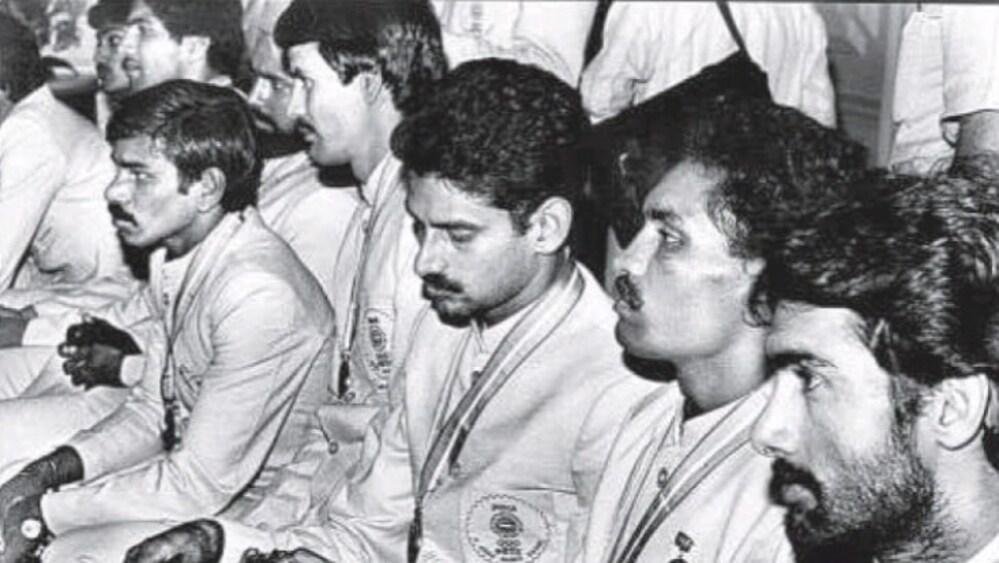
When we talk about India’s great volleyball players, Pusarla Venkata Ramana deserves a special place in the story.
A former Indian international volleyball player, Ramana represented India and was part of the team that won a bronze medal at the 1986 Asian Games in Seoul. He later received the Arjuna Award in 2000 for his contribution to Indian volleyball.
But his story became even more interesting because his sporting family produced another Indian champion — his daughter P. V. Sindhu, one of India’s most successful badminton players.
👤 P. V. Ramana — Personal Details
| Detail | Information |
|---|---|
| Full Name | Pusarla Venkata Ramana |
| Nationality | Indian 🇮🇳 |
| Sport | Volleyball |
| Birthplace | Nirmal, present-day Telangana |
| Height | About 6 ft 3 in |
| Profession | Former volleyball player; Indian Railways employee |
| National Team | India |
| Major Medal | 1986 Asian Games Bronze |
| Arjuna Award | 2000 |
| Daughter | P. V. Sindhu |
Available biographical records identify Nirmal as his birthplace and confirm his Indian national-team career and Arjuna Award.
📅 Date of Birth
An important point for a factual biography: a reliable public source does not clearly establish P. V. Ramana’s exact date of birth. Major biographical databases list his birth year/date as unavailable. So it is better not to publish an invented date.
🌱 Early Life
P. V. Ramana was born in Nirmal, in a family whose roots are connected with Andhra Pradesh.
According to biographical accounts, his family originally came from the Eluru region and later moved through Guntur and Nirmal.
He grew up in Hyderabad with his siblings after losing his father at a young age.
His early years helped shape the determination that would later become an important part of his sporting career.
🏐 Discovering Volleyball
Ramana developed an interest in sport at a young age.
Volleyball eventually became his main sporting path, and he progressed to the highest level in India.
His athletic ability and height were valuable qualities for a volleyball player.
He eventually earned a place in the Indian men’s national volleyball team.


🇮🇳 Representing India
Playing for the national team is one of the biggest achievements an Indian athlete can reach.
Ramana represented India at international level and competed at major events.
His most notable team achievement came at the 1986 Asian Games in Seoul.
India won the bronze medal in men’s volleyball.
The Sports Authority of India also identifies Ramana as a former Indian volleyball player and member of the bronze-medal-winning 1986 Asian Games team.
🥉 The 1986 Asian Games Bronze Medal
The Asian Games are one of the biggest sporting competitions in the world.
Winning a medal there requires years of preparation, teamwork and international-level competition.
For Ramana and his teammates, the 1986 Seoul bronze medal became one of the defining achievements of their careers.
It also placed Ramana among the notable players in Indian volleyball history.
🏅 The Arjuna Award
Ramana’s contribution to Indian volleyball was eventually recognized with one of India’s major sporting honors.
He received the Arjuna Award in 2000.
The Volleyball Federation of India lists P. V. Ramana — 2000 among its volleyball Arjuna Award recipients.
The award represented national recognition for his contribution to the sport.
🚆 Life With Indian Railways
Ramana was also associated with Indian Railways, where he worked in Secunderabad.
Indian Railways has historically provided employment and sporting opportunities to many Indian athletes.
For Ramana, this allowed him to combine his professional life with his sporting career.
👨👩👧 A Family of Athletes
Perhaps the most fascinating part of Ramana’s story is his sporting family.
His wife P. Vijaya was also a national-level volleyball player.
Their elder daughter, P. V. Divya, played netball at national level.
And their younger daughter became one of India’s biggest sporting stars:
🏸 P. V. Sindhu
Both of Sindhu’s parents were national-level volleyball players.


🏸 From Volleyball to Badminton
Interestingly, P. V. Sindhu did not follow her parents into volleyball.
Instead, she chose badminton.
Her parents’ sporting background nevertheless gave her an environment in which discipline, training and competitive sport were already part of family life.
Sindhu went on to become an Olympic medalist and world champion.
Her father Ramana’s sporting career therefore became part of a much larger Indian sporting story.
🌟 A Sporting Family’s Influence
Ramana’s story demonstrates something interesting about sporting families.
Children don’t necessarily have to choose the same sport as their parents.
What can be passed from one generation to another is:
- 🏃 Discipline
- 💪 Physical fitness
- 🧠 Competitive mindset
- ⏰ Training habits
- 🏆 Respect for sport
- 🇮🇳 Commitment to representing India
Ramana’s volleyball career created a sporting environment that later became part of Sindhu’s journey.
🏐 Why P. V. Ramana Matters in Indian Volleyball
Indian volleyball has often received less attention than cricket, badminton or hockey.
Players from earlier generations had to build their careers without today’s enormous media coverage and commercial opportunities.
Ramana belonged to that generation.
His achievements show that Indian volleyball has a long and proud history of international athletes.
🤯 Interesting Facts About P. V. Ramana
1. 🇮🇳 He represented India
Ramana was a member of the Indian men’s national volleyball team.
2. 🥉 He won an Asian Games medal
He was part of India’s bronze-medal-winning volleyball team at the 1986 Seoul Asian Games.
3. 🏅 He received the Arjuna Award
He was honored with the award in 2000.
4. 🚆 He worked for Indian Railways
His professional career was associated with Indian Railways in Secunderabad.
5. 🏐 His wife also played volleyball
P. Vijaya was a national-level volleyball player.
6. 🏸 His daughter became an international badminton champion
P. V. Sindhu went on to win Olympic medals and the 2019 World Championship title.
7. 👨👩👧 Sport runs through the family
Both parents were national-level volleyball players, while their daughters also pursued competitive sport.
🌟 What Young Athletes Can Learn From Ramana
P. V. Ramana’s journey offers several valuable lessons.
1. Sport can become a lifelong journey
An athlete’s influence doesn’t necessarily end when competitive playing ends.
2. Family support matters
A positive sporting environment can encourage children to develop their own talents.
3. Different generations can create different sporting stories
Ramana chose volleyball.
His daughter chose badminton.
Both made their mark in Indian sport.
4. Every sport deserves recognition
Indian sporting history isn’t limited to cricket.
Volleyball has produced its own national heroes.
🇮🇳 From a Volleyball Court to a Sporting Legacy
P. V. Ramana’s name deserves recognition not simply because he is the father of a famous athlete.
He had his own sporting career.
He represented India.
He won an Asian Games bronze medal.
He received the Arjuna Award.
And he contributed to Indian volleyball during an important period in its history.
His family’s later achievements added another fascinating chapter to that story.
🏐 One generation played volleyball.
🏸 The next generation conquered badminton.
🇮🇳 Together, they became part of India’s sporting history.


🏁 Final Thoughts
P. V. Ramana’s journey reminds us that behind every sporting achievement there is often a long story of discipline, sacrifice and persistence.
He represented India at the highest level of volleyball and helped win a historic Asian Games bronze.
Years later, his daughter P. V. Sindhu created her own extraordinary sporting legacy in badminton.
But Ramana’s achievements should be remembered independently.
🏐 P. V. Ramana was not only part of a famous sporting family — he was an Indian volleyball champion in his own right. 🇮🇳
🇮🇳 MANA BHARATHAM
Stories, Facts & Wonders From India
🌐 Website: allpincodes.online
📖 Blog: MANA BHARATHAM
Know India. Explore India. Celebrate India. 🇮🇳