Have you ever seen a place so beautiful that it looked like it belonged on another planet?
Our Earth is filled with landscapes that seem almost impossible.
There are lakes with extraordinary colors, mountains shaped by millions of years of erosion, glowing caves, giant salt flats and forests that look like something from a fantasy movie.
The best part?
These places are real.
Let’s explore some of the most incredible natural wonders our planet has created.


🏔️ 1. Zhangjiajie – Mountains That Look Like Another World
In China’s Hunan Province, towering sandstone pillars rise dramatically from the landscape.
This is Zhangjiajie.


The narrow rock towers can disappear into clouds and mist, creating an almost otherworldly scene.
Over millions of years, erosion gradually shaped the sandstone formations.
🤯 Nature’s Architecture
No architect designed these mountains.
Wind, rain, weathering and geological processes slowly created them.
🤍 2. Pamukkale – White Terraces of Turkey
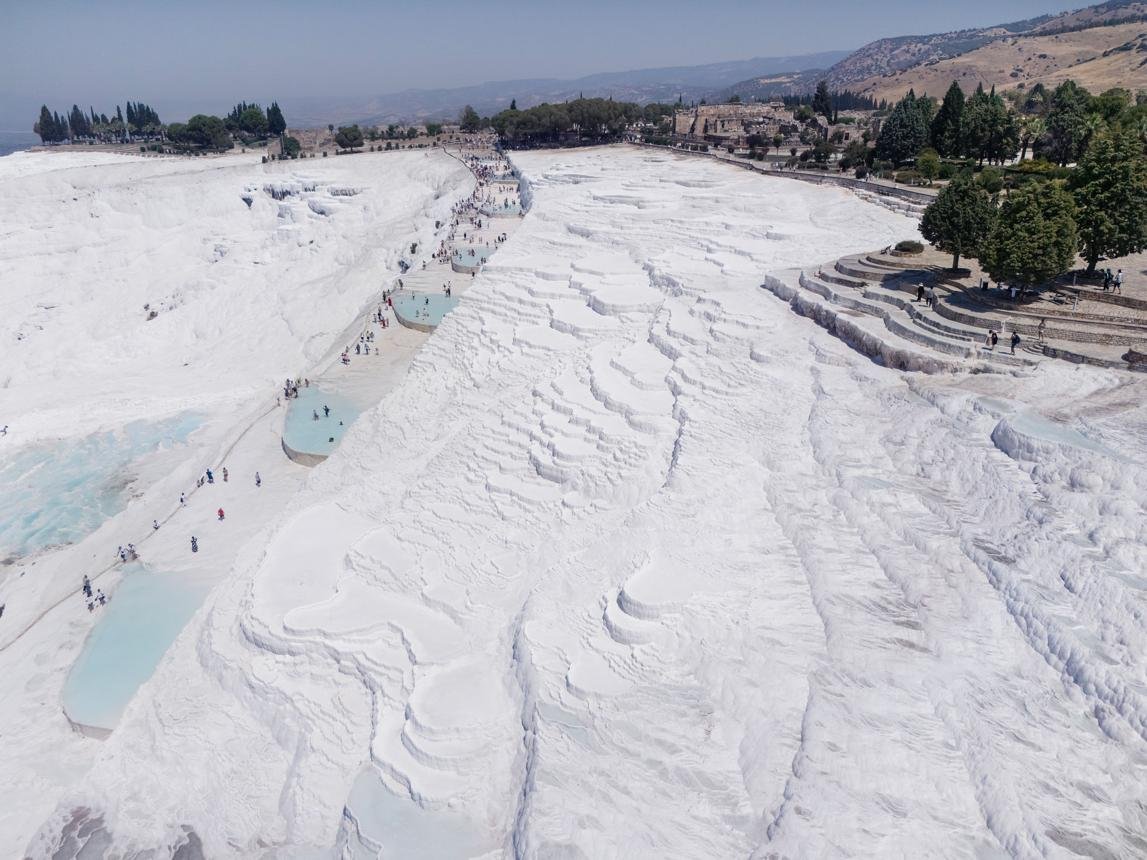
In southwestern Turkey is a spectacular geological formation called Pamukkale.
Its name means “cotton castle.”


Mineral-rich thermal water has deposited calcium carbonate over time, creating white terraces and pools.
From a distance, the landscape can look covered in snow.
But it is actually a geological formation created by flowing mineral-rich water.
🪞 3. Salar de Uyuni – The World’s Giant Mirror
Bolivia is home to Salar de Uyuni, one of the world’s largest salt flats.


During the rainy season, a thin layer of water can cover the salt surface.
The result can be extraordinary.
The ground reflects the sky so clearly that the horizon almost disappears.
It can feel as though you’re walking across the clouds.
🌌 Why Does It Look Like a Mirror?
The enormous, exceptionally flat salt surface allows shallow water to create a near-perfect reflection under suitable conditions.
🌊 4. Great Barrier Reef – A World Beneath the Ocean
Off the coast of Australia lies the Great Barrier Reef, the world’s largest coral reef system.


It is made up of thousands of individual reefs and hundreds of islands.
The reef provides habitat for an enormous variety of marine life.
Under the surface is a completely different world filled with:
- 🐠 Colorful fish
- 🪸 Corals
- 🐢 Sea turtles
- 🦈 Sharks
- 🐙 Marine invertebrates
The reef is also an important example of how delicate marine ecosystems can be.
🏜️ 5. The Wave – A Natural Stone Sculpture
In Arizona, United States, is a sandstone formation known as The Wave.


Its curved layers look like frozen waves.
The patterns formed through geological processes involving erosion and weathering.
The result is one of the most recognizable examples of naturally sculpted rock.
🌈 6. Rainbow Mountains – Nature’s Color Palette
Some mountains around the world appear to be painted with different colors.
One famous example is the Rainbow Mountain region of Peru.


The colors come from different minerals within the rocks.
Depending on lighting and weather conditions, layers of red, yellow, green and other shades can become visible.
🎨 A Mountain Painted by Geology
There are no artificial colors here.
The Earth’s own minerals created the patterns.
🧊 7. The Blue Ice Caves of Iceland
Iceland’s glaciers can contain spectacular ice caves.


Inside the ice, light can produce intense blue colors.
The appearance of glacier caves can change from year to year because glaciers are constantly moving and melting.
This means an ice cave that exists one winter may look completely different later.
🌋 8. Yellowstone’s Grand Prismatic Spring
Inside Yellowstone National Park is the famous Grand Prismatic Spring.


The enormous hot spring is famous for its brilliant colors.
The different colors are largely associated with heat-loving microorganisms living around the spring.
The center can appear intensely blue, while the surrounding areas can show orange, yellow and green shades.
🔥 Life in Extreme Conditions
Microorganisms living in hot environments demonstrate how adaptable life can be.
🏔️ 9. The Dolomites – Mountains Shaped by Time
The Dolomites in northern Italy are famous for their dramatic limestone peaks.


Their steep cliffs and distinctive shapes were created through a combination of geological processes and erosion.
At sunrise and sunset, the mountains can take on warm colors that make the landscape especially spectacular.
🌲 10. The Amazon Rainforest – A Living Natural Wonder
The Amazon rainforest is one of the most extraordinary ecosystems on Earth.


It covers a huge area of South America and contains an extraordinary diversity of plants and animals.
The rainforest is also deeply connected to the Amazon River system.
From above, the endless green canopy can stretch farther than the eye can see.
But below the canopy is an even more complex world.
🌊 11. Ha Long Bay – Limestone Islands Rising From the Sea
Vietnam’s Ha Long Bay is famous for hundreds of limestone islands and islets rising dramatically from the water.


The landscape was shaped over long geological periods by erosion and changes in sea level.
The result is a maze of cliffs, islands and sheltered waters.
🕳️ 12. Waitomo Glowworm Caves – A Starry Sky Underground
New Zealand’s Waitomo region is famous for caves containing glowing organisms.


Inside the dark caves, tiny glowing organisms create points of light across the ceiling.
From below, it can look like a star-filled night sky.
✨ Nature’s Underground Galaxy
There is no actual sky above.
The lights come from living organisms.
🧂 13. The Dead Sea – A Lake Where Floating Is Easy
The Dead Sea, located between Jordan and Israel/West Bank, is famous for its extremely high salt concentration.


The high salinity makes the water much denser than ordinary freshwater.
This makes it unusually easy for people to float.
The surrounding landscape is also remarkable, with mountains and desert terrain surrounding the water.
🏜️ 14. Antelope Canyon – Curved Walls of Stone
In Arizona, narrow sandstone canyons have been shaped by water and erosion.
One famous example is Antelope Canyon.


The smooth, flowing walls create beautiful patterns.
When sunlight enters through openings above, it can illuminate the canyon walls dramatically.
The result looks almost like an abstract painting.
🌍 How Does Nature Create Such Incredible Places?
The answer is time.
A single rainstorm cannot create a giant canyon.
A single wave cannot create an island.
A single earthquake cannot build an entire mountain range.
But over thousands, millions or even hundreds of millions of years, small changes can produce enormous results.
Nature uses:
- 🌧️ Rain
- 🌊 Water
- 🌬️ Wind
- 🧊 Ice
- 🌋 Volcanic activity
- 🌡️ Temperature changes
- 🪨 Erosion
- 🌍 Tectonic movement
Together, these forces constantly reshape our planet.
🤯 Amazing Natural Wonder Facts
🏔️ Some mountains were shaped over millions of years by erosion.
🪞 Salar de Uyuni can become a giant natural mirror after rainfall.
🪸 The Great Barrier Reef is an enormous interconnected coral reef system.
🔥 Yellowstone contains spectacular geothermal features.
🧊 Glacier caves can change as glaciers move.
🌈 Mineral-rich rocks can create naturally colorful mountains.
✨ Some caves appear to have stars because of bioluminescent organisms.
🌊 Rivers and oceans have carved many of Earth’s most spectacular landscapes.
🌟 Final Thoughts
The Earth doesn’t need special effects.
It creates them naturally.
A salt flat can turn into a mirror.
A mountain can become rainbow-colored.
A cave can look like the night sky.
A glacier can glow blue.
A river can carve a canyon.
And an ocean can hide an entire ecosystem beneath its surface.
These natural wonders remind us that our planet is constantly changing.
What looks impossible may simply be nature working slowly for a very long time.
And that may be the most beautiful mystery of all.
❓ Frequently Asked Questions
What is a natural wonder?
A natural wonder is an extraordinary feature or phenomenon created by natural processes rather than by humans.
Why are some mountains different colors?
Different minerals within rocks can produce different colors.
Why does Salar de Uyuni look like a mirror?
During suitable rainy conditions, a thin layer of water can cover the extremely flat salt surface and reflect the sky.
Why are some ice caves blue?
Dense glacial ice absorbs and scatters light differently from ordinary ice, often producing intense blue tones.
How are canyons formed?
Canyons can form through long-term erosion by rivers, wind, ice and other geological processes.
Are natural wonders permanent?
Not necessarily. Natural landscapes continue changing through erosion, weather, climate and geological activity.