In the next article, we’ll explore how the Ramayana became part of Indonesian culture, the famous Ramayana reliefs at Prambanan, the traditional Wayang shadow-puppet theatre, the Ramayana Ballet, and how Java and Bali developed their own distinctive interpretations of Rama’s story.


The Ramayana in Indonesia
Indonesia may seem geographically far from India, but the Ramayana became deeply rooted in Indonesian cultural traditions.
The story became especially influential in:
🇮🇩 Java
🌴 Bali
Over centuries, Indonesian artists, writers and performers adapted the epic to local traditions.
Today, the Ramayana can still be experienced through:
🛕 Temple architecture
🎭 Dance
🎨 Art
🗿 Stone reliefs
🎭 Wayang theatre
🎵 Music
How Did the Ramayana Reach Indonesia?
The Ramayana became part of the cultural exchange between the Indian subcontinent and Southeast Asia.
Trade, religious contact and political connections helped Indian literary and religious traditions travel across the region.
But once the story reached Indonesia, it did not remain unchanged.
Local communities adapted it according to their own languages, artistic traditions and beliefs.
Prambanan: A Stone Story of Rama
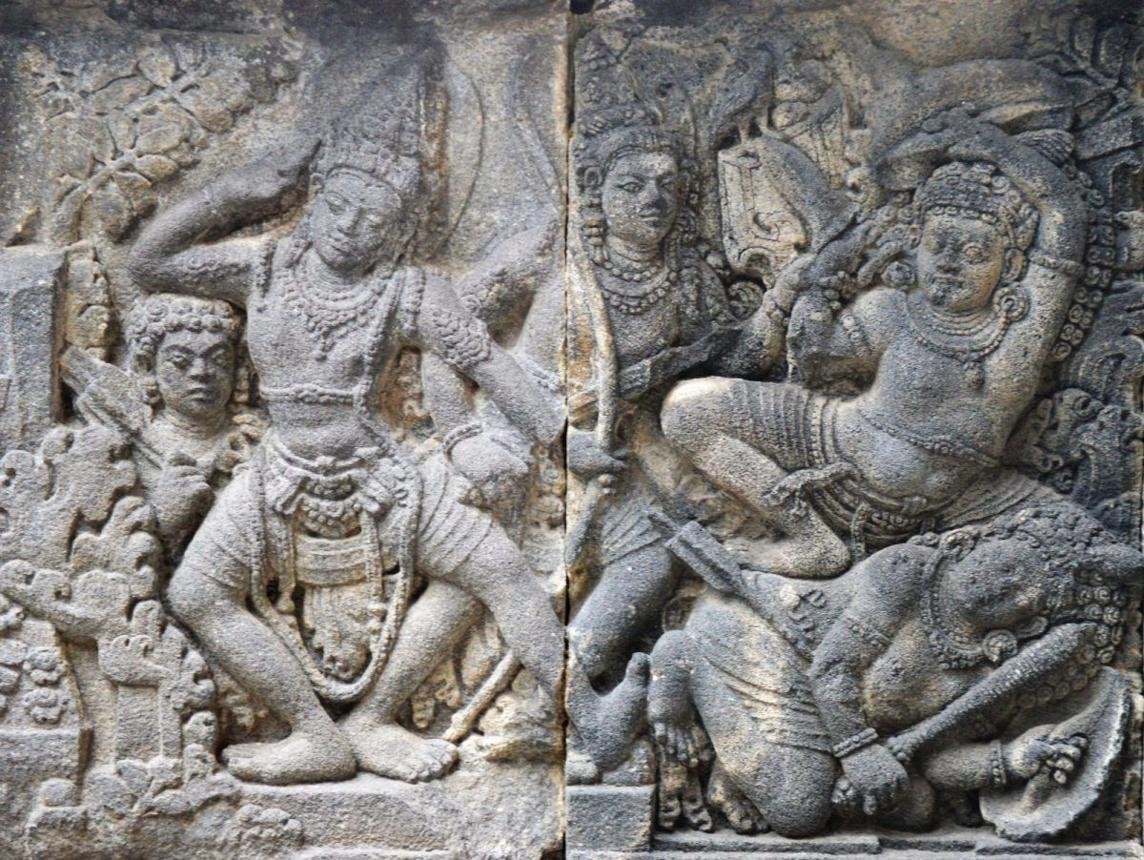
One of Indonesia’s most remarkable connections with the Ramayana can be found at Prambanan Temple in Central Java.
The temple complex is famous for its magnificent Hindu architecture and detailed stone reliefs.
Among these are scenes depicting episodes from the Ramayana.


Reading the Story in Stone
The Ramayana reliefs at Prambanan create a visual sequence.
Instead of reading a book, visitors can follow the story through carved stone panels.
The reliefs depict scenes involving:
🏹 Rama
🌸 Sita
🐒 Hanuman
👑 Ravana
⚔️ The battle
🌳 Forest adventures
The temple therefore becomes both an architectural monument and a visual storytelling space.
The Indonesian Ramayana Tradition
The Indonesian version of the Ramayana developed its own literary and cultural characteristics.
Javanese traditions incorporated the story into local performance and storytelling.
The characters remained recognizable, but their presentation became distinctly Indonesian.
This is particularly clear in Wayang.
Wayang Kulit
Wayang Kulit is one of Indonesia’s most famous traditional shadow-puppet forms.
The puppets are made from carefully carved leather.
During a performance, the puppets are placed between a light source and a screen.
The audience sees their shadows.


The Dalang
The central performer in Wayang is the dalang, the puppeteer and storyteller.
The dalang controls the puppets while also helping bring the story to life through narration and dialogue.
Music from the gamelan ensemble accompanies the performance.
The result combines:
🎭 Puppetry
🗣️ Storytelling
🎵 Music
🥁 Rhythm
📖 Epic narrative
Rama and Sita in Wayang
Rama and Sita are among the important figures appearing in Indonesian Ramayana traditions.
The puppets themselves have distinctive shapes and designs.
Rather than attempting to create realistic human figures, Wayang uses stylized forms.
The shape of a puppet can communicate its personality and status.
Hanuman in Indonesian Performance
Hanuman is especially popular in Indonesian Ramayana performances.
His adventures provide opportunities for action, humor and dramatic storytelling.
He may appear in scenes involving:
🐒 Rama’s mission
🌊 The journey to Lanka
🔥 His encounter with the enemy
⚔️ Battles
🙏 His service to Rama
The character’s energy makes him particularly suitable for performance.


The Ramayana Ballet at Prambanan
Indonesia also presents the Ramayana through spectacular dance performances.
The Ramayana Ballet at Prambanan is particularly famous.
The performance combines:
💃 Traditional dance
🎵 Music
🎭 Drama
👑 Costumes
🔥 Stage effects
The setting near the Prambanan temple complex creates a dramatic atmosphere.
A Story Without Modern Dialogue
Dance performances communicate much of the story through movement, expression and choreography.
The audience can follow major events even when the performance relies heavily on visual storytelling.
Rama’s journey, Sita’s abduction, Hanuman’s actions and the battle with Ravana can all be presented through dance.


Java Gives the Ramayana Its Own Identity
Javanese culture did not simply copy Indian traditions.
It transformed the epic.
The Ramayana became connected with:
🎭 Javanese theatre
🎵 Gamelan music
🎨 Local visual styles
🗣️ Javanese storytelling
👑 Court traditions
This created a distinctive Indonesian Ramayana world.
The Ramayana in Bali
Bali also has a strong Ramayana tradition.
The epic appears in:
💃 Dance
🎭 Theatre
🎨 Painting
🛕 Temple culture
Balinese artists often portray Rama, Sita, Hanuman and Ravana through highly expressive artistic forms.


Ramayana and Balinese Dance
Balinese dance uses expressive:
👀 Eye movements
🤲 Hand gestures
💃 Body movements
🎭 Costumes
🎵 Music
Ramayana scenes can therefore be communicated through a combination of movement and expression.
The result is very different from a written epic, yet the basic characters remain familiar.
Indian and Indonesian Ramayana Traditions
There are clear similarities between the traditions.
Both feature:
🏹 Rama
🌸 Sita
🐒 Hanuman
👑 Ravana
⚔️ The conflict in Lanka
But there are also differences in:
- Character details
- Supporting stories
- Artistic styles
- Performance traditions
- Language
- Local cultural interpretation
This is exactly what makes the Indonesian tradition so interesting.
Why Did the Story Survive for Centuries?
The Ramayana was flexible enough to enter different cultural environments.
A temple could tell the story through stone.
A puppeteer could tell it through shadows.
A dancer could tell it through movement.
A musician could tell it through sound.
A storyteller could tell it through words.
The same epic could therefore reach different audiences.
The Ramayana as Living Heritage
The Indonesian Ramayana is not merely an ancient historical subject.
It continues to appear in modern cultural performances.
Tourists and local audiences can experience:
🎭 Ramayana Ballet
🎭 Wayang performances
💃 Traditional dance
🛕 Temple art
This allows the tradition to remain connected with contemporary cultural life.
A Story That Crossed the Ocean
The journey of the Ramayana to Indonesia is remarkable.
A story that developed in the Indian cultural world travelled across the sea and became part of another civilization.
Indonesia then gave it:
🎨 New artistic forms
🎭 New performance styles
🗣️ New languages
🌴 New cultural settings
The result is a tradition that is connected to India but unmistakably Indonesian.
Conclusion
Indonesia has preserved the Ramayana through some of Southeast Asia’s most extraordinary artistic traditions.
At Prambanan, the story appears in stone.
In Wayang Kulit, it appears as moving shadows.
In the Ramayana Ballet, it appears through dance and music.
In Bali, it continues through performance and visual art.
🌏 The Indonesian Ramayana shows that when an epic travels to another culture, it does not simply survive — it can grow into something new.
In the next part, we will travel to Cambodia and explore the Khmer Ramayana tradition, known as the Reamker, including its connection with Angkor Wat, classical dance and Cambodian art