In the next article, we’ll explore Cambodia’s unique Ramayana tradition known as the Reamker, its connection with Angkor Wat, Khmer classical dance, the characters of Preah Ream, Neang Seda and Krong Reap, and how the ancient epic became part of Cambodia’s cultural heritage.


What Is the Reamker?
The Reamker is Cambodia’s Khmer adaptation of the Ramayana.
The name is commonly understood in relation to Rama’s glory.
Like the Indian Ramayana, the Reamker tells the story of:
🏹 Rama
🌸 Sita
🐒 Hanuman
👑 Ravana
⚔️ The struggle between the forces supporting Rama and those opposing him
But Cambodia developed its own version through Khmer literature, sculpture, dance and theatre.
Rama Becomes Preah Ream
In the Cambodian tradition, Rama is known as Preah Ream.
He remains a noble and heroic figure whose journey involves exile, separation from Sita and the struggle against the powerful ruler of Lanka.
The themes of:
⚖️ Duty
🙏 Loyalty
❤️ Love
👑 Royal responsibility
💪 Courage
remain central to the story.
Sita Becomes Neang Seda
Sita is known as Neang Seda in the Khmer tradition.
Her story remains closely connected with Preah Ream.
She is portrayed as an important figure whose separation from Rama drives much of the narrative.
Cambodian artistic traditions have represented Neang Seda through:
💃 Classical dance
🎨 Painting
🗿 Sculpture
🎭 Theatre
Ravana Becomes Krong Reap
The antagonist Ravana is known as Krong Reap.
His image in Cambodian art is powerful and highly decorative.
He is often shown wearing elaborate royal costumes and crowns.
Like Ravana in Indian traditions, Krong Reap represents enormous power, ambition and opposition to Rama.


Hanuman in the Reamker
Hanuman is one of the most popular characters in Cambodian Ramayana traditions.
He remains a loyal ally of Preah Ream.
But Khmer storytelling gives Hanuman its own distinctive characteristics.
He is presented as:
🐒 Brave
💪 Powerful
🧠 Intelligent
🙏 Loyal
⚔️ Energetic
His adventures provide some of the most exciting scenes in Cambodian performance traditions.
The Famous Khmer Classical Dance
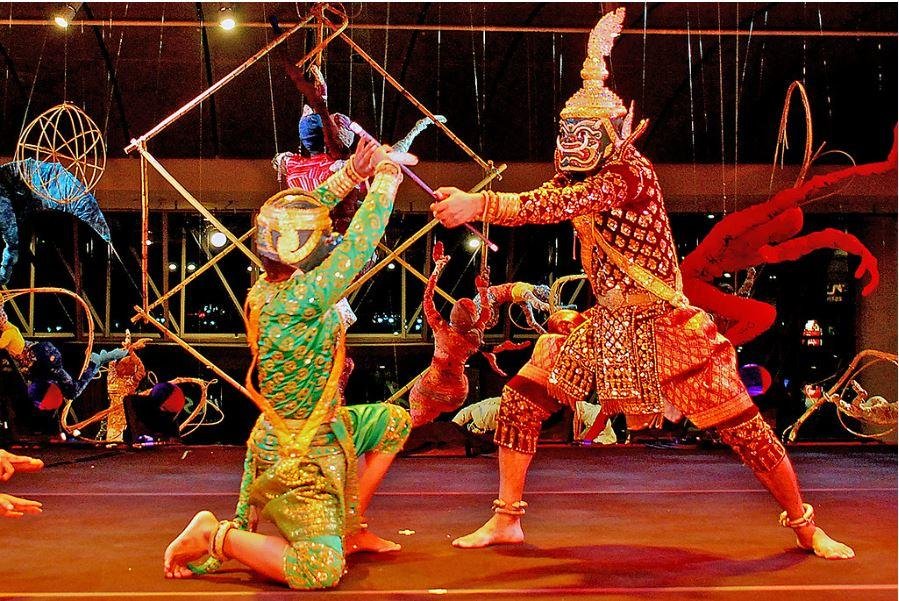
The Reamker has been closely connected with Cambodia’s classical dance tradition.
Khmer classical dance is known for its:
💃 Controlled movements
🤲 Hand gestures
👑 Elaborate costumes
🎨 Detailed makeup
🎵 Traditional music
Dancers can communicate entire scenes through carefully choreographed movements.


Telling a Story Through Movement
A Reamker performance does not depend only on spoken dialogue.
A dancer’s:
👀 Eyes
🤲 Hands
💃 Body position
🙂 Facial expression
can communicate emotions and actions.
This allows the audience to understand the story through movement.
Ramayana Scenes at Angkor Wat
One of Cambodia’s greatest connections with the Ramayana can be seen at Angkor Wat.
The enormous temple complex contains extensive bas-reliefs.
Among the scenes represented are episodes connected with the Ramayana tradition.
The stone walls therefore preserve part of the epic visually.


Stories Carved in Stone
Imagine entering a monumental temple centuries ago and seeing epic stories carved directly into the walls.
Instead of a printed book, the temple itself becomes a storytelling medium.
Artists used:
🪨 Stone
📐 Architecture
👑 Royal imagery
⚔️ Battle scenes
to preserve stories for future generations.
The Reamker in Khmer Art
Cambodian artists have portrayed the Reamker in many forms.
These include:
🗿 Stone carvings
🎨 Paintings
🏛️ Temple decoration
💃 Dance
🎭 Theatre
The artistic style is unmistakably Khmer.
Even when the story connects with the wider Ramayana tradition, the visual language reflects Cambodia.
A Different Cultural Interpretation
The Cambodian Reamker contains elements that distinguish it from Indian versions.
Some episodes are developed differently.
Some characters receive additional stories.
The relationships between characters can also be interpreted differently.
This is natural when an epic becomes part of another culture.
Why Did Cambodia Embrace the Ramayana?
The Ramayana became connected with Khmer ideas of:
👑 Kingship
⚖️ Order
🙏 Morality
🌟 Heroism
🛕 Sacred traditions
The story could therefore fit naturally into the artistic and political world of ancient Khmer civilization.
The Temple as a Storytelling Space
Khmer temples were not simply places of worship.
They were also spaces filled with:
🗿 Sculpture
🎨 Visual narratives
📖 Mythological stories
🏛️ Architecture
The Ramayana became one of the stories that could be expressed through this enormous artistic environment.
Hanuman and Cambodian Performance
Hanuman is especially effective in dance and theatre because of his dramatic personality.
His scenes can include:
🐒 Leaping
⚔️ Fighting
❤️ Loyalty
😄 Playful moments
🌊 Journeys
These qualities make him one of the most memorable figures in Reamker performances.


The Reamker Today
The Reamker remains part of Cambodia’s cultural heritage.
It continues to appear through:
🎭 Traditional performances
💃 Classical dance
🎨 Art
📚 Literature
🏛️ Cultural heritage programs
This allows younger generations to encounter a story that has been part of Khmer culture for centuries.
India and Cambodia: Two Ramayana Traditions
The Indian Ramayana and Cambodian Reamker share a recognizable foundation.
Both feature:
🏹 Rama
🌸 Sita
🐒 Hanuman
👑 Ravana
⚔️ Lanka
But their artistic forms are different.
India has:
🎨 Indian painting traditions
🎭 Regional theatre
🛕 Temple sculpture
💃 Classical dance
Cambodia has:
🎨 Khmer murals and sculpture
💃 Khmer classical dance
🗿 Angkorian reliefs
🎭 Reamker performance
The comparison shows how one epic can develop multiple cultural identities.
A Story Preserved Across Centuries
The survival of the Reamker demonstrates the power of cultural memory.
Generations of:
👨🎨 Artists
💃 Dancers
🎭 Performers
📚 Writers
🗣️ Storytellers
have helped preserve the tradition.
Each generation receives the story and passes it forward.
Why the Reamker Matters
The Reamker is important not only because it is connected to the Ramayana.
It also tells us about Cambodia itself.
Through the Reamker, we can see:
🎨 Khmer artistic creativity
🏛️ Ancient architecture
💃 Dance traditions
📖 Literary culture
👑 Historical ideas about kingship
The epic became a window into Khmer civilization.
Conclusion
Cambodia transformed the Ramayana into the Reamker, giving the ancient story a distinctly Khmer identity.
Rama became Preah Ream.
Sita became Neang Seda.
Ravana became Krong Reap.
And Hanuman became one of the most exciting figures in Khmer performance.
From the stone walls of Angkor Wat to the movements of Khmer classical dancers, the Ramayana continues to live within Cambodian culture.
🇰🇭 The Reamker shows how an ancient story can cross borders, enter a new civilization and become part of that civilization’s own cultural identity.
In the next part, we will travel to Laos and explore the Lao Ramayana tradition, Phra Lak Phra Lam, and discover how Rama and Lakshmana became central figures in Lao literature, religion and storytelling.