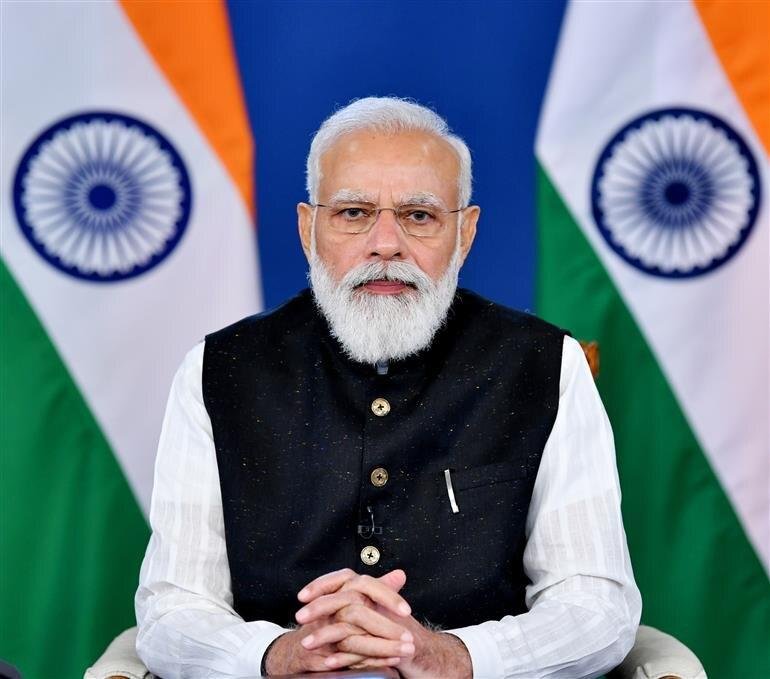
India’s political journey in the 21st century has been strongly shaped by Narendra Modi, a leader whose life moved from a modest childhood in Vadnagar to the highest elected office in the country.
Born on 17 September 1950, Modi grew up in Vadnagar, Gujarat, in a family of modest means. According to the official Prime Minister’s Office biography, he helped his family at their tea stall while growing up and developed an early interest in reading, debate and public service.
Today, Narendra Modi is serving his third consecutive term as Prime Minister of India, having taken oath for the third time on 9 June 2024.


👤 Narendra Modi — Quick Facts
| Detail | Information |
|---|---|
| Full Name | Narendra Damodardas Modi |
| Date of Birth | 17 September 1950 |
| Birthplace | Vadnagar, Gujarat, India |
| Nationality | Indian 🇮🇳 |
| Political Party | Bharatiya Janata Party (BJP) |
| Office | Prime Minister of India |
| First Became PM | 26 May 2014 |
| Third Term Began | 9 June 2024 |
| Earlier Major Office | Chief Minister of Gujarat |
| Gujarat CM Tenure | 2001–2014 |
🌱 Early Life in Vadnagar
Narendra Modi was born in Vadnagar, a historic town in northern Gujarat.
The official PM biography describes his childhood as one of modest circumstances. He grew up in a small family home and helped with the family’s tea-stall business while continuing his education.
As a youngster, he developed an interest in books and debates. The same biography describes him as an energetic and hardworking student who spent considerable time reading in the local library.
His early years would eventually become an important part of the public story surrounding his rise in Indian politics.
🇮🇳 A Young Man Drawn Toward Public Service
During his youth, Modi became involved with the Rashtriya Swayamsevak Sangh (RSS).
His political journey developed gradually through organisational work rather than beginning with an elected office.
During the 1980s, he became increasingly involved in political organisation in Gujarat.
In 1987, he began working as a General Secretary of the BJP in Gujarat, according to the Prime Minister’s official biography.
His organisational abilities helped establish his reputation within the party.
🏛️ The Road to Gujarat
The major turning point came in 2001, when Narendra Modi became Chief Minister of Gujarat.
He entered state administration after years of organisational experience.
As Chief Minister, his political identity became closely associated with:
- Economic development
- Infrastructure
- Investment
- Administrative reforms
- Technology
- Governance
His supporters highlighted Gujarat’s economic growth and infrastructure development, while his tenure also became the subject of intense political debate and criticism, particularly over the 2002 Gujarat riots.
A balanced understanding of his political career requires acknowledging both his supporters’ praise and the controversies surrounding his record.
🗳️ Gujarat Elections
Modi and the BJP won successive Gujarat Assembly elections during his time as Chief Minister.
His long tenure in Gujarat established him as one of India’s most prominent political leaders.
By the early 2010s, his national profile had grown considerably.
The next step would be Delhi.
🇮🇳 2014 — The Journey to Delhi
The 2014 Indian general election transformed Narendra Modi’s political career.
The BJP won a majority in the Lok Sabha, and Modi became India’s Prime Minister.
He took oath on:
26 May 2014
He became the 15th Prime Minister of India.


It marked the beginning of a new national political era.
🏛️ A Different Style of Governance
One of the phrases associated with Modi’s approach to administration has been:
“Minimum Government, Maximum Governance.”
His government placed considerable emphasis on technology, digital systems, direct delivery of welfare benefits and large-scale public programmes.
His supporters describe his leadership as decisive and development-focused.
Critics, meanwhile, have raised concerns about issues including institutional independence, political polarisation, civil liberties and the treatment of dissent.
That contrast has made Modi one of the most discussed political figures in contemporary India.
💻 Digital India
One of the major themes of the Modi government’s governance model has been digital transformation.
Digital India was launched in 2015 with the broader objective of expanding digital infrastructure, online government services and digital access.
The growth of digital payments, online public services and technology-based governance became important parts of India’s changing economic landscape.
🏦 Jan Dhan Yojana
The Pradhan Mantri Jan Dhan Yojana was introduced to expand access to banking services.
The programme focused on bringing people who had limited access to formal banking into the financial system.
It became one of the major flagship initiatives associated with Modi’s first term.
🧼 Swachh Bharat Mission
Another highly visible programme was the Swachh Bharat Mission, launched in 2014.
Its central focus was sanitation and cleanliness.
The campaign encouraged construction and use of toilets, waste management and public participation in cleanliness efforts.
It became one of the most recognizable government campaigns of the Modi era.
👧 Beti Bachao, Beti Padhao
The Beti Bachao, Beti Padhao programme was launched in 2015.
Its stated focus includes addressing issues related to the declining child sex ratio and promoting the education and empowerment of girls.
The programme became part of the government’s broader messaging around women’s development and participation.
🇮🇳 Make in India
Make in India was introduced to encourage manufacturing, investment and industrial development within the country.
The campaign used the image of a lion made from mechanical components as its visual identity.
The larger goal was to strengthen India’s position as a global manufacturing destination.
🛣️ Infrastructure and Connectivity
Infrastructure has remained a major focus of the Modi government’s development agenda.
Roads, railways, airports, ports, digital connectivity and urban infrastructure have received significant attention.
The government has presented infrastructure expansion as an important foundation for economic growth.
🌍 India’s Changing Global Presence
Modi has also placed strong emphasis on India’s international relationships.
During his tenure, India has sought deeper engagement with:
🇺🇸 United States
🇯🇵 Japan
🇦🇺 Australia
🇪🇺 European countries
🌍 African nations
🌏 Asian neighbours
🌐 G20 and other multilateral institutions
His government has promoted the idea of India playing a larger role in global affairs.
🌍 India and the G20
India hosted the G20 Summit in New Delhi in 2023.
The summit became an important diplomatic event for India.
The New Delhi Leaders’ Declaration was adopted during India’s G20 presidency.
The government presented the event as evidence of India’s growing international influence.
🧘 International Yoga Day
Another area associated strongly with Modi’s international outreach has been yoga.
The United Nations declared 21 June as International Day of Yoga in 2014 following India’s initiative.
Yoga subsequently became a major part of India’s cultural diplomacy.
🚀 India’s Space Ambitions
India’s space programme also achieved several notable milestones during Modi’s years in office.
The Chandrayaan-3 mission successfully landed on the Moon in August 2023.
India became the first country to successfully land a spacecraft near the Moon’s south polar region.
The achievement became a major source of national pride.


🏛️ A New Parliament Building
India inaugurated its new Parliament building in 2023.
The building was presented as part of the country’s transition toward modern parliamentary infrastructure while drawing on Indian cultural and architectural themes.
The new Parliament became another highly visible symbol of India’s evolving political institutions.
🗳️ 2019 — A Second Term
In the 2019 general election, the BJP again secured a majority in the Lok Sabha.
Narendra Modi returned as Prime Minister for a second consecutive term.
The result strengthened his position as one of India’s most electorally successful national leaders of the modern era.
🏛️ Major Constitutional and Policy Changes
The second Modi government introduced several major policy changes.
Among the most consequential was the 2019 decision concerning Article 370, which changed the constitutional status of Jammu and Kashmir and reorganised the former state into two Union Territories.
The move received strong support from the BJP and its supporters but also generated significant political and legal debate.
🕌 Ram Mandir
The construction and inauguration of the Ram Mandir in Ayodhya became another major political and cultural development during Modi’s tenure.
The temple was inaugurated in January 2024.
For many Hindus, the event represented the culmination of a decades-long religious and political movement.
It was also a deeply debated issue in India’s political history.
🗳️ 2024 — Third Term as Prime Minister
The 2024 Lok Sabha election produced another major milestone.
The BJP-led NDA secured enough seats to form the government, and Narendra Modi took oath as Prime Minister for the third consecutive time on 9 June 2024.
He thus became one of the few Indian Prime Ministers to serve three consecutive terms.
🇮🇳 Narendra Modi in 2026
As of 2026, Narendra Modi remains the Prime Minister of India.
The official PM India website records his third term and continues to list him as Prime Minister.
In June 2026, the Union Cabinet marked another significant milestone: Modi became the longest-serving elected Prime Minister of India in continuous elected service, according to a Cabinet resolution, surpassing Jawaharlal Nehru’s previous record.
🏆 Awards and Recognition
Narendra Modi has received various international honours and recognitions during his political career.
These have included awards and state honours from several countries.
Such recognition reflects the importance of India’s international relationships during his tenure.
📚 Narendra Modi as an Author
Modi has also written books and poetry.
His writings and speeches frequently discuss:
- Leadership
- Development
- India
- Youth
- Spirituality
- National identity
- Personal discipline
His public communication has become an important part of his political style.
📱 The Power of Social Media
Modi has been particularly successful in using social media as a political communication tool.
His speeches, government programmes, travels and messages are regularly shared through digital platforms.
This has allowed him to communicate directly with millions of followers without relying entirely on traditional media.
His digital presence has become one of the defining characteristics of modern Indian political campaigning.
🤔 Why Is Narendra Modi So Influential?
Supporters point to several qualities:
💪 Strong political communication
He has developed a distinctive style of public speaking.
🎯 Clear political messaging
His campaigns often focus on simple and memorable themes.
📱 Digital communication
He has made extensive use of social media.
🌍 International visibility
His government has actively promoted India’s role abroad.
🏗️ Development agenda
Infrastructure and technology have remained major themes.
At the same time, his critics point to concerns about political polarisation, media freedom, institutional checks and balances, and minority rights.
Understanding Modi’s influence therefore requires looking at both his achievements and the debates surrounding his leadership.
🤯 Interesting Facts About Narendra Modi
1. 📅 He was born in 1950
He was born only three years after India’s independence and is the first Indian Prime Minister born in independent India, according to the PM’s official biography.
2. 🍵 He helped at his family’s tea stall
His official biography describes his childhood involvement in the family tea-stall business.
3. 📚 He enjoyed reading
His childhood biography describes his strong interest in books and local-library reading.
4. 🏛️ He served as Gujarat Chief Minister
He led Gujarat for around 13 years before becoming Prime Minister.
5. 🇮🇳 He became Prime Minister in 2014
He took office on 26 May 2014.
6. 🇮🇳 He won a third consecutive term
He was sworn in for his third term on 9 June 2024.
7. 🏆 He crossed a historic service milestone
In 2026, the Union Cabinet recognised him as the longest-serving elected Prime Minister in continuous elected service.
🌟 The Story Behind the Leader
Narendra Modi’s story is ultimately a story of political transformation.
A child from Vadnagar.
A young man involved in organisational work.
A political organiser in Gujarat.
A long-serving Chief Minister.
And finally, the Prime Minister of India.
His journey has been accompanied by extraordinary electoral success, major policy changes, international visibility and intense political controversy.
Whatever one’s political opinion may be, his impact on contemporary Indian politics is difficult to ignore.
🇮🇳 Final Thoughts
Narendra Modi’s political career has become one of the defining stories of modern India.
His supporters see him as a decisive leader who has strengthened India’s global position and accelerated development.
His critics challenge aspects of his governance and political style.
Both perspectives are part of the larger story.
What makes his journey particularly striking is its beginning: a modest childhood in Vadnagar followed by decades of political work before reaching India’s highest elected office.
🇮🇳 From Vadnagar to New Delhi — Narendra Modi’s journey is a remarkable chapter in India’s democratic story.
🇮🇳 MANA BHARATHAM
Stories, Facts & Wonders From India
✍️ Written by Pasupuleti Saida Rao
🌐 Website: allpincodes.online
Know India. Explore India. Celebrate India. 🇮🇳