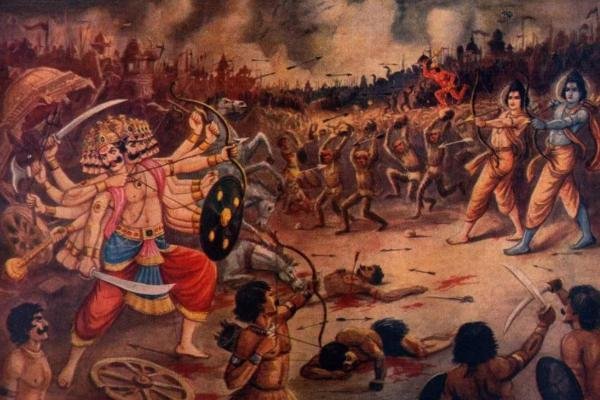
In Part 14, the great war in Lanka became increasingly intense.
Ravana lost two of his greatest warriors — Kumbhakarna and Indrajit.
The Vanara army continued to fight beside Rama.
Now Ravana himself prepares for the final confrontation.
The conflict that began with Sita’s abduction has reached its climax.
⚔️ Rama and Ravana Are Ready to Face Each Other


Rama and Ravana Face Each Other
Suggested image: respectful traditional Indian artwork depicting Rama and Ravana facing each other on the battlefield.
👑 Ravana Prepares for the Final Battle
Ravana has suffered enormous losses.
His brother Kumbhakarna is gone.
His son Indrajit has been defeated.
Many of his commanders have fallen.
But Ravana refuses to surrender.
He prepares his weapons and enters the battlefield.
For Ravana, this is no longer simply a battle to protect Lanka.
His pride, power and determination are all at stake.
🏹 Rama Stands Ready
Rama also prepares for the final battle.
He knows that defeating Ravana is the only way to rescue Sita and end the war.
Lakshmana, Hanuman, Sugriva, Vibhishana and the Vanara warriors remain nearby.
The battlefield becomes silent for a moment.
Then the final confrontation begins.
⚔️ The Battle Between Rama and Ravana
Rama and Ravana exchange powerful weapons.
Both are highly skilled warriors.
Ravana uses many different weapons and abilities.
Rama responds with his own divine weapons.
The battle is described in the traditional epic as extraordinary and intense.
Neither side gives up easily.


The Final Battle Begins
🏹 Ravana’s Great Power
Ravana is not presented as an ordinary enemy.
He is a powerful ruler and warrior with great knowledge and abilities.
He fights Rama with determination.
At several points, the battle appears uncertain.
Rama understands that he must remain calm and focused.
🌟 Vibhishana Helps Rama
Vibhishana knows Ravana better than anyone on Rama’s side.
He understands his brother’s strengths and weaknesses.
During the battle, Vibhishana provides Rama with important information.
His knowledge becomes valuable in the final confrontation.
🐒 Hanuman Protects Rama’s Army
While Rama fights Ravana, Hanuman continues supporting the Vanara forces.
He helps injured warriors and battles Ravana’s forces.
His courage remains an important source of strength for Rama’s army.
The Vanaras continue fighting until the very end.


Hanuman Supports Rama’s Army
🕉️ The Guidance of Agastya
Before the decisive part of the battle, the traditional Ramayana includes an important episode involving Sage Agastya.
Agastya teaches Rama a sacred hymn known as the Aditya Hridayam.
It is associated with devotion to the Sun.
Rama receives this spiritual guidance and prepares himself mentally for the final confrontation.
The episode highlights an important theme of the epic:
Courage is supported by inner strength and discipline.
☀️ Rama Regains His Strength
After receiving the teaching, Rama becomes focused and determined.
He prepares for the decisive battle.
Ravana also prepares his most powerful weapons.
The final stage has arrived.


Sage Agastya and Rama
⚔️ The Decisive Duel
Rama and Ravana continue their duel.
Arrows fill the sky.
The battlefield watches the two warriors.
Ravana fights with enormous determination.
Rama remains focused.
Eventually, Rama prepares a powerful divine weapon.
🏹 Rama’s Final Arrow
According to the traditional account, Rama uses a powerful divine arrow against Ravana.
The weapon is prepared with great concentration.
Rama releases it.
The arrow strikes Ravana.
Ravana falls.


Ravana Falls
👑 The Fall of Ravana
Ravana’s death marks the end of the war.
The ruler who refused to return Sita has been defeated.
Lanka’s forces are broken.
The Vanara army celebrates Rama’s victory.
But Rama does not treat Ravana’s death simply as a reason for celebration.
The epic also presents Ravana as a powerful and learned figure whose pride and choices ultimately led to his downfall.
🕊️ Vibhishana Becomes King
After Ravana’s death, Rama asks Vibhishana to perform the final rites for his brother.
Vibhishana initially struggles emotionally.
But Rama reminds him that Ravana was his brother and deserved proper rites.
After the funeral, Vibhishana is made the ruler of Lanka.


Vibhishana Becomes King of Lanka
❤️ Sita Is Finally Free
After Ravana’s defeat, Sita is brought before Rama.
The moment is emotionally significant.
Rama and Sita have been separated for a long time.
The traditional narrative then presents the Agni Pariksha, or trial by fire, as a major episode.
Different Ramayana traditions interpret and narrate this episode differently.
For a blog article, it is important to acknowledge that later regional retellings sometimes present additional or different details.
🔥 The Agni Pariksha
In the Valmiki tradition, Sita undergoes a test involving fire.
The episode is traditionally connected with demonstrating her purity and innocence.
Agni, the fire deity, appears in the story and confirms Sita’s purity.
Rama then accepts Sita.
This remains one of the most discussed and debated episodes in Ramayana literature.


Sita and the Agni Pariksha
🛕 Rama’s Journey Back to Ayodhya
With the war over and Sita rescued, Rama prepares to return to Ayodhya.
He is accompanied by:
- Sita
- Lakshmana
- Hanuman
- Sugriva
- Vibhishana
- Other allies
The journey back is made using the Pushpaka Vimana, traditionally described as a celestial flying vehicle.
✈️ The Pushpaka Vimana
The Pushpaka Vimana is one of the most fascinating elements of the Ramayana.
The traditional story describes it as a remarkable flying vehicle associated with Ravana.
After Ravana’s death, Rama uses it to travel back toward Ayodhya.
During the journey, Rama points out important places connected with their adventures.


Rama and Sita Return to Ayodhya
🕰️ Bharata Is Waiting
While Rama has been away, Bharata has been ruling Ayodhya as a caretaker.
He has not accepted the kingdom as his own.
He has remained committed to Rama’s return.
According to the traditional story, Bharata has been waiting for Rama to complete the period of exile.
Now the moment has finally arrived.
🏠 Rama Returns to Ayodhya
Rama, Sita and Lakshmana finally return to Ayodhya.
The city celebrates their arrival.
People welcome Rama with enormous happiness.
The long period of exile has ended.


Rama Returns to Ayodhya
👑 Rama’s Coronation
Rama is crowned king of Ayodhya.
Sita becomes queen.
Lakshmana, Bharata and Shatrughna remain beside him.
Hanuman and the other allies are also honoured.
This coronation is traditionally known as Pattabhishekam.
It represents the restoration of Rama’s rightful position.
🌟 Rama Rajya
The period associated with Rama’s rule is traditionally called Rama Rajya.
In popular cultural understanding, it represents an ideal kingdom characterised by:
- Justice
- Peace
- Good governance
- Responsibility
- Prosperity
- Protection of the people
The phrase Rama Rajya continues to have cultural importance in India.


Rama Pattabhishekam
🕉️ Is the Story Over?
Not completely.
The Lanka war and Rama’s return to Ayodhya form the conclusion of a major part of the Ramayana.
But the traditional epic continues.
There are important later events involving:
- Sita’s life in the kingdom
- The birth of Lava and Kusha
- The Ashwamedha
- The later meeting between Rama and his sons
- Sita’s final departure
These events are mainly covered in the Uttara Kanda.
Different Ramayana traditions and scholarly interpretations discuss the Uttara Kanda differently, so the remaining articles will carefully distinguish the traditional narrative from later interpretations.
🌟 What Can We Learn From Ravana’s Story?
Ravana is often remembered simply as the villain of the Ramayana.
But the epic presents a more complex picture.
He is described as:
Powerful
Highly learned
A great ruler
A skilled warrior
Yet his pride and decisions ultimately lead to destruction.
The lesson is powerful:
Knowledge without wisdom can become dangerous.
Power without self-control can lead to downfall.
🌟 What Can We Learn From Rama?
Rama’s journey is filled with difficult decisions.
He loses his kingdom.
He lives in exile.
Sita is abducted.
He searches for her.
He builds alliances.
He fights Ravana.
And eventually returns to Ayodhya.
His story is traditionally associated with:
Duty
Courage
Responsibility
Self-control
Leadership
❤️ The Importance of Hanuman
Without Hanuman, Rama’s search for Sita would have been far more difficult.
Hanuman:
✅ Meets Rama
✅ Helps Sugriva
✅ Crosses the ocean
✅ Finds Sita
✅ Carries Rama’s message
✅ Returns with Sita’s message
✅ Supports Rama during the war
His character represents devotion combined with action.
🕉️ Conclusion
The great war of Lanka has ended.
Ravana has fallen.
Vibhishana becomes king of Lanka.
Sita is rescued.
Rama begins his journey back to Ayodhya.
After years of exile and struggle, Rama finally returns home.
The people celebrate.
And Rama is crowned king.
👑 The story of exile has become a story of return.
But the Ramayana still has another important chapter to tell.