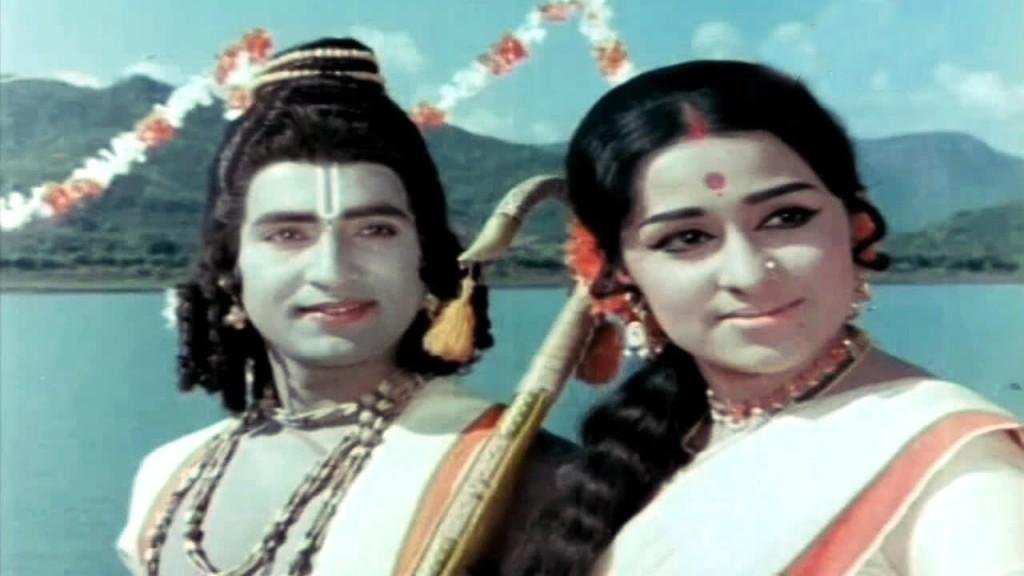
In the next article, we’ll explore how the Ramayana moved from traditional storytelling and theatre into Indian cinema and television, how filmmakers portrayed Rama, Sita, Hanuman and Ravana, and why screen adaptations introduced the epic to millions of modern viewers.


When the Ramayana Entered the Screen
For centuries, people experienced the Ramayana through:
📖 Books
🗣️ Storytelling
🎭 Theatre
💃 Dance
🛕 Temple traditions
The arrival of cinema created a completely new way to present the epic.
Instead of imagining Ayodhya, the forest or Lanka while listening to a storyteller, audiences could now see those worlds on screen.
The Early Years of Indian Cinema
Mythological stories became an important part of early Indian cinema.
The Ramayana was particularly suitable for filmmaking because it contained:
🏰 Royal kingdoms
🌳 Forest journeys
🐒 Extraordinary characters
⚔️ Great battles
🌊 The journey across the sea
✨ Supernatural elements
Filmmakers could transform these scenes into visual spectacles.
Rama on the Big Screen
Different filmmakers have presented Rama in different ways.
Some emphasize:
👑 His role as a prince and king
Others focus on:
🙏 His divine nature
Some portray:
⚖️ His commitment to dharma
Others emphasize:
❤️ His relationships with Sita, Lakshmana and Hanuman
Every adaptation therefore reflects the artistic choices of its creators.


The Importance of Sita
Cinema also gave filmmakers the opportunity to explore Sita’s character visually.
Her story includes:
❤️ Her relationship with Rama
🌳 Life in the forest
💔 Separation from Rama
🌿 Her time in Ashoka Vatika
🔥 The difficult events surrounding her return
Different adaptations have emphasized different aspects of her personality.
Sita can be portrayed as:
🌸 Gentle
💪 Strong
🙏 Devoted
👑 Dignified
🧠 Determined
Hanuman Becomes a Screen Icon
Among all Ramayana characters, Hanuman has been especially successful on screen.
His story provides filmmakers with spectacular visual possibilities:
🐒 His enormous strength
🌊 His leap across the ocean
🔥 His journey through Lanka
🏔️ The Sanjeevani mountain
⚔️ His battles
🙏 His devotion to Rama
Special effects have allowed filmmakers to present these episodes on a scale that earlier stage performances could not easily achieve.


Ravana on Screen
Ravana presents another interesting challenge for filmmakers.
His traditional image is already dramatic:
👑 Ten heads
⚔️ Multiple weapons
🔥 Powerful presence
🏰 A magnificent kingdom
Cinema can expand this image through elaborate costumes, sets, visual effects and sound.
At the same time, some modern interpretations explore Ravana as a complex character rather than simply a one-dimensional villain.
Television Changed Everything
Cinema reached audiences in theatres.
Television could bring the Ramayana directly into people’s homes.
This became especially significant when serialized adaptations allowed the story to unfold episode by episode.
Families could watch together and discuss the story afterward.


The Television Ramayana Era
Television adaptations of the Ramayana became a major cultural phenomenon in India.
The serialized format allowed viewers to follow:
📖 Rama’s childhood
🏹 His marriage with Sita
🌳 The exile
🦌 The golden deer episode
🐒 Hanuman’s arrival
⚔️ The battle with Ravana
👑 Rama’s return
The weekly format created anticipation among viewers.
A Shared Television Experience
One remarkable feature of early television was the way families and communities could watch the same program at the same time.
The Ramayana became more than entertainment.
For many viewers, watching the serial became part of a regular family routine.
In some places, roads and public spaces were reported to become quieter during broadcasts because people were watching the program.
Ramayana and Modern Visual Effects
Modern technology has changed how filmmakers can portray the epic.
Today, creators can use:
🎬 Computer-generated imagery
🌊 Digital oceans
🏰 Large virtual kingdoms
⚔️ Elaborate battle scenes
🐒 Digital characters
🔥 Advanced visual effects
Scenes that once required simple stage techniques can now be presented on a much larger visual scale.


Cinema Can Also Change Interpretation
A screen adaptation is never exactly the same as reading the epic.
Filmmakers must make decisions about:
🎬 Which episodes to include
⏱️ How long each scene should last
🎭 How characters should behave
🎨 What the locations should look like
🗣️ Which dialogue to use
Because of this, every adaptation offers an interpretation.
The original literary tradition and the screen version should therefore not automatically be treated as identical.
Different Languages, Different Audiences
The Ramayana has appeared in Indian cinema and television across multiple languages.
This includes major film industries working in:
🇮🇳 Hindi
🇮🇳 Telugu
🇮🇳 Tamil
🇮🇳 Kannada
🇮🇳 Malayalam
🇮🇳 Bengali
🇮🇳 Other Indian languages
Regional productions can incorporate local artistic traditions while presenting the familiar epic.
The Ramayana for a New Generation
Cinema and television have helped younger audiences encounter the Ramayana in new ways.
A child may first discover:
🐒 Hanuman through an animated film
or:
🏹 Rama through a television series
or:
📱 Ramayana stories through digital videos.
This demonstrates how the epic continues to adapt to changing forms of media.
Animation and the Ramayana
Animation opened another door.
Animated productions can present the epic to children through:
🎨 Stylized characters
🌈 Colorful worlds
🎵 Music
⚡ Action sequences
📖 Simplified storytelling
Animation can make complex episodes easier for younger audiences to understand.


From Theatre to Television to Digital Media
The Ramayana has travelled through several forms:
Oral storytelling → Manuscripts → Theatre → Cinema → Television → Animation → Digital media
Each new medium changed how audiences experienced the story.
But the central characters continued to survive.
Why Screen Adaptations Matter
Film and television have helped preserve the Ramayana as a part of popular culture.
They have:
📺 Reached enormous audiences
🎬 Created memorable visual interpretations
👨👩👧👦 Encouraged family viewing
🌍 Introduced the story to new audiences
📱 Made the epic accessible through modern media
At the same time, viewers can benefit from remembering that a screen adaptation is one interpretation among many.
The Ramayana Beyond India
Screen adaptations have also helped introduce Rama’s story to audiences outside India.
The Ramayana has long traditions across Asia, and modern media provides another way for international audiences to encounter its characters and themes.
The story can therefore continue to travel across cultural and geographical boundaries.
Conclusion
The arrival of cinema and television transformed the way people experience the Ramayana.
The epic moved from:
📖 Pages
🎭 Stages
🗣️ Storytellers
to:
🎬 Cinemas
📺 Television screens
📱 Digital platforms
Yet the core story continued to inspire audiences.
🕉️ The Ramayana has survived for centuries because it has always found a new medium through which each generation can experience it.
In the next part, we will explore the Ramayana beyond India — how the story travelled across Southeast Asia and became part of the cultures of Thailand, Indonesia, Cambodia, Laos and other countries.