Introduction
The Ramayana is one of the most important and influential epic traditions of India. For generations, the story of Lord Rama, Sita, Lakshmana, Hanuman and Ravana has been remembered through literature, religious traditions, festivals, theatre, music and storytelling.
But the Ramayana is much more than the story of a king and a war.
It is a story about dharma, family, sacrifice, loyalty, courage, devotion and the choices people make during difficult times.
The story begins long before Rama leaves Ayodhya for the forest.
It begins with a great sage, a grieving bird, a powerful king and a question:
Can the story of an ideal human being be told?
This is where the traditional story of the Ramayana begins.
Maharshi Valmiki
Suggested image: a respectful traditional artistic depiction of Maharshi Valmiki composing the Ramayana.
📖 Who Wrote the Ramayana?
The Valmiki Ramayana is traditionally attributed to Maharshi Valmiki.
Valmiki is revered in Indian tradition as the Adi Kavi, meaning the first poet.
According to the traditional account, Valmiki once approached the sage Narada and asked whether there was a person in the world who possessed extraordinary virtues.
Valmiki wanted to know about a person who was:
- Truthful
- Courageous
- Compassionate
- Wise
- Self-controlled
- Dutiful
- Respected by others
- Firm in following dharma
Narada told him about Rama, the prince of Ayodhya.
This conversation becomes an important starting point for the story.
🐦 The Story of the Two Birds
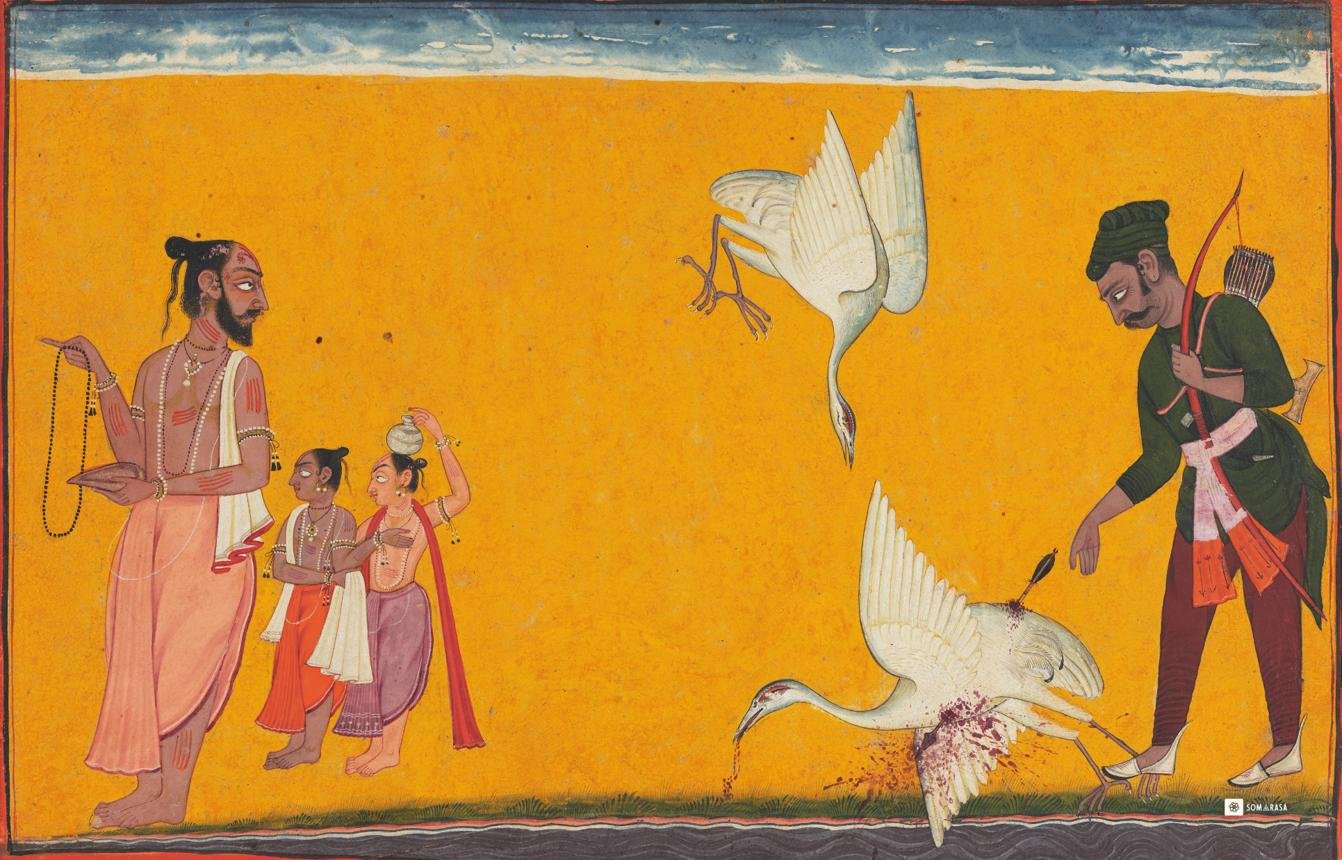
One of the most famous traditional episodes connected with the origin of the Ramayana occurs when Valmiki is travelling near the River Tamasa.
He sees a pair of krauncha birds together.
A hunter suddenly kills one of them.
Seeing the surviving bird suffering, Valmiki is deeply moved.
Words emerge from him in a poetic form.
According to the traditional account, this becomes the beginning of the shloka form associated with Sanskrit poetry.
This moment is traditionally remembered as the birth of Valmiki’s poetic expression.


Valmiki and the Krauncha Birds
Suggested image: traditional Indian artwork depicting Valmiki near the river witnessing the krauncha birds.
🕉️ Brahma and the Great Story
Traditional accounts of the Ramayana describe another important event involving Brahma.
Valmiki is encouraged to compose the story of Rama.
He is told that the events of Rama’s life can be expressed through poetry.
Valmiki then composes the great epic describing the life of Rama, including his childhood, marriage, exile, the search for Sita, the conflict with Ravana and his eventual return to Ayodhya.
The story is traditionally known as the Ramayana.
👑 Who Was Rama?
Rama was the eldest son of King Dasharatha of Ayodhya.
He was born into the royal family of the Ikshvaku dynasty.
The traditional Ramayana presents Rama as a person deeply committed to dharma.
He is respected for his:
❤️ Compassion
🛡️ Courage
🙏 Respect for parents
⚖️ Commitment to duty
🤝 Loyalty to friends and allies
👑 Responsibility as a ruler
These qualities become especially important as Rama’s life takes an unexpected turn.


Rama and Ayodhya
Suggested image: a traditional, respectful depiction of Rama associated with Ayodhya.
🏰 Ayodhya: The City of Rama
The story of Rama is closely connected with Ayodhya.
Ayodhya is traditionally described as the capital of the kingdom ruled by Dasharatha.
It is presented in the Ramayana as a prosperous and important city.
The people of Ayodhya greatly respected their king and the royal family.
Among Dasharatha’s sons, Rama was particularly admired.
As the eldest prince, he was expected to play an important role in the future of the kingdom.
But before that could happen, a series of events would completely change his life.
👨👩👦 King Dasharatha and His Four Sons
King Dasharatha had four sons:
1. Rama
2. Bharata
3. Lakshmana
4. Shatrughna
According to the traditional story, Rama was the son of Kausalya.
Bharata was the son of Kaikeyi.
Lakshmana and Shatrughna were the sons of Sumitra.
The four brothers grew up together, and the Ramayana gives great importance to their relationship.
Lakshmana, in particular, develops an exceptionally strong bond with Rama.
👬 Rama and Lakshmana
Rama and Lakshmana are remembered as brothers whose relationship went far beyond ordinary family affection.
Lakshmana remained closely connected with Rama throughout many important events of the story.
Later, when Rama was sent into exile, Lakshmana chose to accompany him.
This becomes one of the great examples of brotherly loyalty in the epic.


Rama and Lakshmana
👑 Rama’s Childhood and Education
As princes, Rama and his brothers were trained in various skills appropriate to their royal responsibilities.
The Ramayana tradition describes Rama as skilled in:
- Archery
- Warfare
- Knowledge
- Discipline
- Moral conduct
- Leadership
Rama’s character is not presented only through physical strength.
His ability to control himself, respect elders and follow his responsibilities becomes equally important.
This is one reason Rama’s character became such an important part of Indian cultural and religious traditions.
🧘 The Arrival of Vishwamitra
As Rama grows older, another important character enters the story:
Sage Vishwamitra
Vishwamitra comes to King Dasharatha and asks for Rama’s help.
The sage is performing religious rituals, but powerful forces are disturbing them.
Dasharatha initially hesitates.
Rama is still young, and the king is concerned about sending his son into danger.
But Vishwamitra explains that Rama is capable of protecting the sacred activity.
Eventually, Rama goes with Vishwamitra.
And this becomes the beginning of a major new chapter in Rama’s life.
🌳 The Beginning of Rama’s Journey
Until this point, Rama’s life has been largely connected with Ayodhya, his family and his education as a prince.
Now he begins travelling beyond the familiar world of the royal palace.
He encounters forests, sages and powerful beings.
He learns more about the responsibilities that come with his abilities.
And soon, he will face his first major challenges.
🌟 Why Is the Beginning of Ramayana Important?
The beginning of the Ramayana establishes the central ideas that will appear throughout the entire epic.
Dharma
Doing what one believes is right and fulfilling one’s responsibilities.
Family
The relationships between parents, brothers, husband and wife are central to the story.
Sacrifice
Characters repeatedly face situations where personal happiness conflicts with duty.
Courage
Rama and other characters face dangerous situations without abandoning their responsibilities.
Devotion
The later relationship between Rama and Hanuman becomes one of the best-known examples of devotion in Indian tradition.
🤔 What Will Happen Next?
Rama’s peaceful life as a prince is about to become much more adventurous.
His journey with Vishwamitra will lead him to encounters that change his life.
He will meet Ahalya.
He will travel toward Mithila.
And there, Rama’s destiny will take another major turn.
👑 He will meet Sita.
But that story belongs to the next part.
🕉️ Conclusion
The Ramayana begins with a simple but powerful idea: the story of a person whose life represents an extraordinary commitment to dharma and duty.
From Valmiki’s poetic vision to Rama’s childhood in Ayodhya, the opening chapters introduce the people and values that will shape the entire epic.
Rama begins as a prince.
But the events that await him will test his character in ways no ordinary prince could imagine.
His journey will take him from the royal city of Ayodhya to forests, kingdoms and eventually the battlefield of Lanka.