
When we think about India, several national symbols immediately come to mind—the Tricolour, the Ashoka Chakra, the national anthem, and the majestic State Emblem of India.
The familiar image of the three visible lions appears on government documents, official publications and many institutions across the country.
But have you ever wondered where this emblem came from?
Why are there four lions?
What does the Dharma Chakra represent?
And why are the words “Satyameva Jayate” written beneath it?
The story of India’s State Emblem goes back more than two thousand years to the reign of Emperor Ashoka.


5
The Origin of the Indian State Emblem
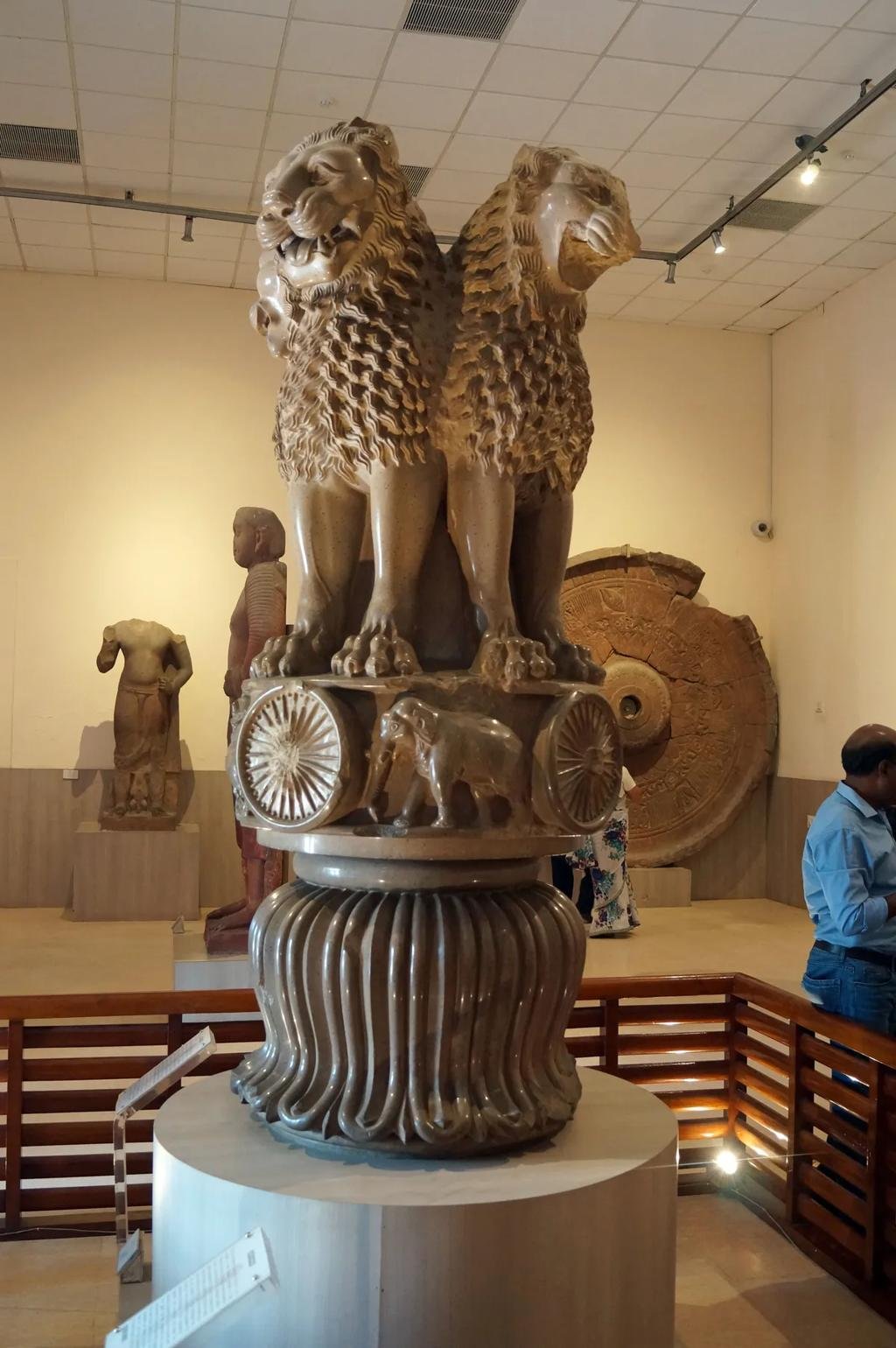
The State Emblem of India is based on the Lion Capital of Ashoka at Sarnath.
Emperor Ashoka of the Mauryan Empire commissioned numerous pillars and monuments across his vast empire. One of the most important was erected at Sarnath, near Varanasi.
Sarnath is especially significant in Buddhist history because it is traditionally regarded as the place where Gautama Buddha delivered his first sermon after attaining enlightenment.
The Lion Capital created during Ashoka’s reign eventually became the inspiration for India’s modern State Emblem.
According to the Government of India’s official description, the State Emblem is an adaptation of the Lion Capital of Ashoka at Sarnath.
🦁 Why Are There Four Lions?
The original Lion Capital features four lions standing back-to-back.
Each lion faces a different direction.
From the front, however, only three lions are visible. The fourth lion is positioned behind them.
This is why the official emblem generally appears to show three lions even though the original sculpture contains four.
The lions give the emblem a powerful and dignified appearance and connect modern India with its ancient historical heritage.


5
The Dharma Chakra Beneath the Lions
Below the lions is a circular platform known as the abacus.
The original Sarnath Lion Capital contains representations of animals and Dharma Chakras on this section.
The Dharma Chakra is an important symbol associated with the teachings of Buddhism and with the wider idea of Dharma.
The modern State Emblem is based on the ancient sculpture but is not an exact reproduction of every part of it.
One noticeable difference is that the bell-shaped lotus at the bottom of the original sculpture is not included in the official State Emblem.
🐘 The Elephant, Horse, Bull and Lion
The original abacus of the Sarnath Lion Capital contains representations of four animals:
- Elephant
- Horse
- Bull
- Lion
They are separated by Dharma Chakras.
These details are part of the artistic and historical character of the original Ashokan sculpture.
Many explanations about the individual symbolic meanings of these animals can be found online. However, not every interpretation has the same historical or official basis.
Therefore, it is better to distinguish between documented history and later interpretations.
🇮🇳 When Did India Adopt the State Emblem?
After India became independent in 1947, the new nation needed official symbols that reflected its history and identity.
The ancient Lion Capital of Ashoka provided a natural connection between India’s historical heritage and its modern republican identity.
The State Emblem was adopted for official use when India became a republic on 26 January 1950.
Since then, it has become one of the most recognizable symbols associated with the Government of India.


6
“Satyameva Jayate” — Truth Alone Triumphs
One of the most meaningful features of India’s State Emblem is the inscription underneath it:
सत्यमेव जयते
In English, it means:
“Truth Alone Triumphs.”
The phrase comes from the Mundaka Upanishad.
Its inclusion gives the State Emblem a message that goes beyond political authority.
It reminds us that truth and moral values should remain at the foundation of public life.
The Government of India officially describes the motto as “Satyameva Jayate” — “Truth Alone Triumphs.”
Why Is the Fourth Lion Not Visible?
This is one of the most common questions about India’s State Emblem.
The answer is simple.
The original sculpture has four lions arranged back-to-back.
When viewed from one direction, only three can be seen clearly.
The fourth lion is behind them.
Therefore, the official two-dimensional representation normally shows three visible lions.


4
The State Emblem and the Government of India
The State Emblem is used in many official contexts.
It can be seen on:
- Government documents
- Official publications
- Government offices
- Certain official certificates and communications
- Government websites
- Various official institutions
However, the emblem is not simply a logo that anyone can freely use.
India has laws governing the proper use of the State Emblem. The State Emblem of India (Prohibition of Improper Use) Act, 2005, along with the relevant rules, regulates its use.
This is important for bloggers and website owners.
If you are writing an article about India’s State Emblem, it is better to use an appropriate historical image for illustration rather than treating the official emblem as your own website logo or commercial branding.
🇮🇳 State Emblem vs Ashoka Chakra
Another common source of confusion is the difference between the State Emblem and the Ashoka Chakra.
They are not the same symbol.
The Ashoka Chakra appears at the centre of India’s national flag.
The State Emblem is based on the Lion Capital of Ashoka and features the lions, the abacus and the motto Satyameva Jayate.
Both have historical connections with Emperor Ashoka, but they represent different national symbols.
Why Is the State Emblem Important?
The State Emblem connects modern India with an ancient chapter of Indian history.
It represents more than a group of lions carved in stone.
It carries the memory of:
- Ancient Indian art
- The Mauryan period
- Emperor Ashoka
- Sarnath
- Dharma
- India’s republican identity
- The principle of truth
That is why the emblem has such an important place in India’s official identity.
The Journey From Sarnath to Modern India
More than two thousand years ago, a magnificent stone capital was created during the reign of Emperor Ashoka.
Centuries passed.
Kingdoms changed.
Empires disappeared.
India eventually became an independent nation.
Then, in 1950, the ancient Lion Capital became the foundation of one of the most important symbols of the Republic of India.
That journey—from an ancient monument at Sarnath to the official emblem of a modern democratic republic—is what makes the story so fascinating.


4
A Symbol of History, Responsibility and Truth
The next time you see India’s State Emblem, look beyond the three visible lions.
Remember that the emblem represents a much larger story.
It connects India with its ancient past while representing the modern Republic.
The lions represent the majesty of the emblem.
The Dharma Chakra connects it with the idea of Dharma.
The ancient sculpture connects modern India with the Mauryan period.
And beneath everything is the powerful message:
Satyameva Jayate — Truth Alone Triumphs.
Conclusion
The State Emblem of India is one of the country’s most important national symbols.
Its story begins at Sarnath, with the magnificent Lion Capital created during the reign of Emperor Ashoka.
Thousands of years later, that ancient artwork became the foundation of the emblem of independent India’s Republic.
It reminds us that a nation’s identity is not created overnight.
It is built from history, culture, values and the memories passed from one generation to another.
The four lions, the Dharma Chakra and the words Satyameva Jayate together create a symbol that represents India’s historical heritage and its commitment to truth.
🇮🇳 The State Emblem is not merely an official symbol—it is a bridge between India’s ancient past and its modern identity.