In the next article, we’ll explore Laos’s unique Ramayana tradition, Phra Lak Phra Lam, the important roles of Rama and Lakshmana, how the epic became connected with Lao Buddhist culture, and how the story continues through Lao literature, temples, art and traditional performances.


What Is Phra Lak Phra Lam?
Phra Lak Phra Lam is the Lao tradition based on the Ramayana.
The name itself highlights two important characters:
🏹 Phra Lam — Rama
🛡️ Phra Lak — Lakshmana
Unlike some other Southeast Asian traditions where Rama is emphasized primarily as the central figure, the Lao title places Rama and Lakshmana together at the heart of the story.
How Did the Ramayana Become Part of Laos?
The Ramayana travelled through the cultural networks of South and Southeast Asia.
As the story entered Laos, it encountered a society with its own:
📖 Literary traditions
🛕 Buddhist culture
🎭 Performing arts
🎨 Visual traditions
🗣️ Oral storytelling
The epic was therefore adapted rather than simply copied.
Phra Lam — Rama in Lao Tradition
Phra Lam represents the heroic and noble figure at the center of the story.
His journey includes familiar elements associated with the wider Ramayana tradition:
🏹 Courage
🌳 Exile and journeys
❤️ Love
⚔️ Conflict
👑 Kingship
But the Lao telling places these themes within its own cultural environment.
Phra Lak — Lakshmana’s Importance
The title Phra Lak Phra Lam gives special prominence to Lakshmana.
Lakshmana is traditionally known for his loyalty to Rama.
He accompanies Rama through difficult situations and remains an important companion.
The Lao title itself reminds readers that the relationship between the two brothers is central to the tradition.
The Role of Buddhism
One of the most interesting features of the Lao tradition is its connection with Buddhist culture.
The Ramayana entered a region where Theravada Buddhism was deeply influential.
As a result, the story was interpreted through a Lao Buddhist cultural framework.
This is an important example of how an epic can change when it enters a new religious and cultural environment.
A Story Told in Lao Literature
The tradition survived through written and oral forms.
Manuscripts preserved episodes of the story, while storytellers and performers helped keep it alive among communities.
Before modern mass media, such traditions were important ways for people to encounter epic narratives.
Phra Lak Phra Lam in Temple Art
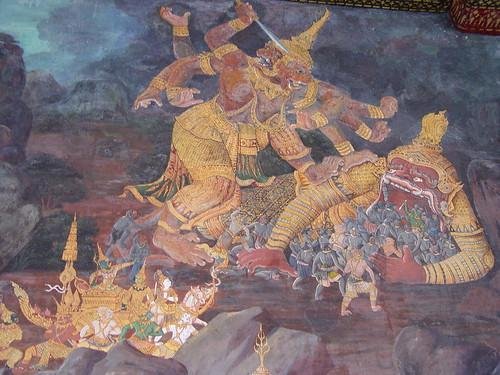
Ramayana-related stories can also be found in Lao visual traditions.
Temples became important places where stories could be represented through:
🎨 Murals
🖼️ Paintings
🛕 Decorative art
Visitors could encounter characters and scenes from traditional narratives in a religious setting.


The Story Through Visual Art
Just as Indian temples used sculpture and painting to communicate stories, Lao artists could use temple walls to make narratives visible.
A single painted scene could communicate:
🏹 A heroic moment
🌳 A forest journey
⚔️ A battle
👑 A royal court
❤️ A relationship between characters
The artwork becomes another form of storytelling.
Southeast Asia’s Many Ramayanas
By this point in our journey, we can see a fascinating pattern.
India has the Ramayana.
Thailand has the Ramakien.
Cambodia has the Reamker.
Laos has Phra Lak Phra Lam.
Indonesia developed its own Javanese and Balinese traditions.
The names and details differ, but the shared foundation remains recognizable.
The Importance of Local Adaptation
Why do these versions differ?
Because stories change when they enter new cultures.
Local writers and storytellers may introduce:
🗣️ New language
🎭 New performance styles
🙏 Local religious ideas
🎨 New artistic forms
👑 Local ideas about kingship
This does not make one version less important.
It demonstrates the creative power of storytelling.
Rama and Lakshmana as Brothers
The Lao title places an interesting emphasis on the relationship between the brothers.
Their relationship represents:
🤝 Loyalty
❤️ Brotherhood
🛡️ Protection
🙏 Duty
Lakshmana’s willingness to accompany and support Rama makes their relationship one of the important emotional elements of the story.
The Ramayana as a Moral Story
Like other Ramayana traditions, Phra Lak Phra Lam can be understood through themes such as:
⚖️ Good conduct
🙏 Loyalty
💪 Courage
❤️ Responsibility
👑 Leadership
These themes allowed the story to remain meaningful even after it entered a completely different cultural setting.
From Manuscripts to Performance
The Lao tradition demonstrates how stories can survive through multiple forms.
📜 Manuscripts preserve the words.
🎭 Performances preserve the dramatic tradition.
🎨 Paintings preserve the visual memory.
🗣️ Storytelling preserves the oral tradition.
Together, these forms help keep an epic alive.


Why Phra Lak Phra Lam Matters
Phra Lak Phra Lam is important because it demonstrates how far the Ramayana travelled.
The story crossed geographical boundaries.
It entered a different linguistic environment.
It interacted with Buddhist culture.
And it became part of Lao literary and artistic heritage.
The result is a tradition that is connected to the wider Ramayana world while possessing its own identity.
India and Laos: A Cultural Connection
The Lao tradition reminds us that cultural history is rarely isolated.
Ideas, stories and artistic traditions have moved between India and Southeast Asia for centuries.
The Ramayana provides one of the clearest examples of this long history of cultural exchange.
A Story With Many Voices
The journey from India to Laos does not represent the disappearance of the original story.
Instead, it created another voice.
The same broad epic could be remembered through different languages and traditions.
India → Ramayana
Thailand → Ramakien
Cambodia → Reamker
Laos → Phra Lak Phra Lam
Each version adds another chapter to the story’s remarkable cultural journey.
Conclusion
Phra Lak Phra Lam represents the Lao interpretation of the Ramayana tradition.
Its title itself highlights the importance of Phra Lak and Phra Lam — Lakshmana and Rama.
Through literature, storytelling, temple art and cultural traditions, the epic became part of Lao heritage.
🇱🇦 The Lao Ramayana shows that when a great story crosses a border, it can take on a new language, a new cultural setting and a new identity — while still carrying the memory of its ancient origins.
In the next part, we will travel to Myanmar and explore Yama Zatdaw, the Burmese Ramayana tradition, and discover how Rama’s story became part of Myanmar’s theatre, dance, literature and traditional culture.