From the First Airmail Flight to Modern International Airports


India’s aviation history is more than a story about airplanes. It is a story of innovation, communication, business, war, independence, and technological progress.
From the historic 1911 airmail flight between Allahabad and Naini to today’s enormous international airports and modern aircraft, Indian aviation has travelled an extraordinary distance.
But there is an important distinction:
India’s first airport, first aerodrome, first commercial airline and first airmail flight are different milestones.
Understanding them separately makes the history much clearer.
✈️ 1. BEFORE AIRPORTS — INDIA LOOKED TO THE SKY
At the beginning of the 20th century, powered aviation was still a new technology.
The Wright brothers had demonstrated powered flight in 1903, and aviation technology quickly began spreading around the world.
India soon became part of this exciting new era.
People who had previously depended on:
- 🚂 Railways
- 🐎 Horse-drawn transport
- 🚢 Ships
- 🛣️ Roads
could now imagine travelling through the sky.
📮 2. INDIA’S FIRST AIRMAIL FLIGHT — 1911


📅 18 February 1911
One of the most important dates in Indian aviation history is 18 February 1911.
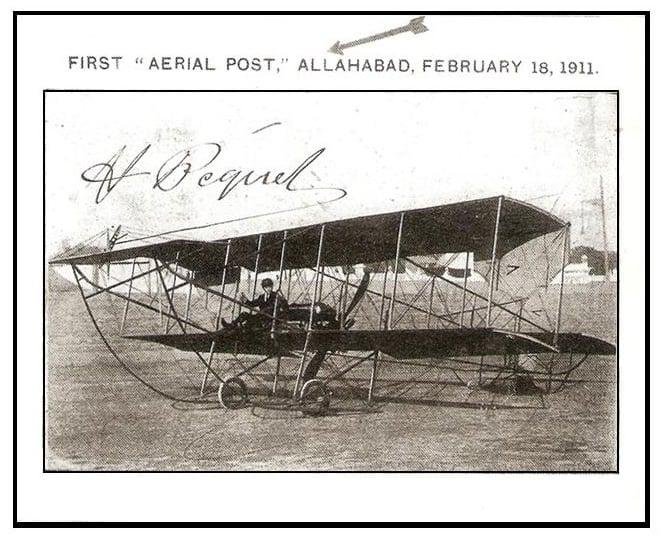
On that day, French pilot Henri Pequet flew from Allahabad to Naini, carrying mail.
The flight was associated with the Kumbh Mela, and it is widely recognised as the world’s first official airmail flight.
The aircraft was a Humber biplane.
The flight lasted only around 15 minutes, but its historical importance was enormous.
✉️ Mail had entered the age of aviation.
✈️ 3. WHAT WAS CARRIED ON THAT FIRST FLIGHT?
The aircraft carried a substantial quantity of mail.
Letters and other postal material were transported by air rather than by conventional surface transport.
The experiment demonstrated something revolutionary:
Aircraft could be used not only for adventure, but also for practical communication.
This idea eventually became the foundation for commercial aviation.
🛬 4. WHAT WAS INDIA’S FIRST AIRPORT?
This question is more complicated than it sounds.
Early aviation did not begin with airports resembling today’s terminals.
The earliest aircraft often used:
- Open fields
- Temporary landing grounds
- Military airfields
- Aerodromes
- Grass airstrips
There was no large passenger terminal, baggage system or modern runway.
Several locations therefore have historical importance depending on what is meant by “first airport.”
🛬 5. JUHU AERODROME — ONE OF INDIA’S EARLY AVIATION LANDMARKS


Juhu Aerodrome in Mumbai became one of India’s most important early civil aviation locations.
It played a major role in the development of aviation in Bombay.
During the early decades of Indian aviation, Juhu became associated with:
- Mail flights
- Passenger aviation
- Flying activities
- Early airline operations
- Aviation training
It was an important stepping stone toward Mumbai becoming one of India’s major aviation centres.
✈️ 6. THE FIRST AIRLINES BEGIN TO APPEAR
As aviation technology improved, flying gradually moved from demonstrations to commercial operations.
Air services began developing between important cities.
Aircraft were initially small compared with modern passenger planes.
They carried relatively few passengers and were much more affected by:
- Weather
- Mechanical problems
- Limited navigation technology
- Poor infrastructure
- Shorter flying ranges
Yet the industry continued growing.
🇮🇳 7. J.R.D. TATA AND INDIAN AVIATION


One of the most important personalities in Indian aviation history was J. R. D. Tata.
He became India’s first licensed pilot in 1929.
Three years later, in 1932, Tata launched an air-mail service that developed into Tata Airlines.
This became one of the foundations of modern commercial aviation in India.
J.R.D. Tata’s contribution to Indian aviation is therefore enormous.
✈️ 8. TATA AIRLINES — 1932


📅 15 October 1932
Tata’s air service began operations.
J.R.D. Tata himself flew the first service from Karachi to Bombay, carrying mail.
The route was part of a larger air-mail network.
The aircraft was a small de Havilland Puss Moth.
Compared with today’s wide-body passenger aircraft, it was tiny.
But its significance was enormous.
It marked the beginning of a major Indian aviation company.
✈️ 9. FROM TATA AIRLINES TO AIR INDIA
Tata Airlines expanded over the years.
In 1946, it was renamed:
Air India
After India’s independence, the government became increasingly involved in aviation.
Air India eventually became India’s internationally recognised national airline.
Its aircraft would eventually fly to destinations across:
🌏 Asia
🌍 Europe
🌎 North America
🌍 Africa
🌏 Middle East
🇮🇳 10. NATIONALISATION OF AIRLINES
In 1953, India’s airline industry underwent a major change.
The government nationalised the major airlines.
Two principal organisations emerged:
✈️ Air India International
For international operations.
✈️ Indian Airlines
For domestic services.
This arrangement continued for decades.
🏢 11. INDIA’S EARLY AIRPORT INFRASTRUCTURE


As air travel grew, India needed proper airport infrastructure.
Major aviation centres developed around:
- Delhi
- Bombay
- Calcutta
- Madras
These cities became the backbone of India’s early commercial aviation system.
Airport infrastructure gradually developed from simple airfields into more sophisticated terminals.
🏙️ 12. DELHI — PALAM AIRPORT
Delhi became one of India’s most important aviation hubs.
The Palam Airport area played a major role in the development of Delhi’s civil aviation.
As passenger numbers increased, airport infrastructure had to expand.
Today, Delhi is home to one of India’s largest airports:
Indira Gandhi International Airport
🌆 13. MUMBAI — FROM JUHU TO SANTA CRUZ
Mumbai’s aviation history began with early aerodromes such as Juhu.
As commercial aviation expanded, the Santa Cruz Airport became increasingly important.
Eventually, Mumbai’s main international airport became:
Chhatrapati Shivaji Maharaj International Airport
Mumbai remains one of India’s most important aviation centres because of its:
- Financial importance
- Large population
- International business connections
- Tourism
- Cargo traffic
🌏 14. KOLKATA — ONE OF INDIA’S OLDEST AVIATION CENTRES


Kolkata has a long aviation history.
Its airport developed from the Dum Dum aviation area.
Today it is known as:
Netaji Subhas Chandra Bose International Airport
Kolkata’s geographical location made it particularly important for connections with eastern India and Southeast Asia.
🛫 15. CHENNAI — SOUTH INDIA’S AVIATION GATEWAY


Chennai also developed into a major aviation centre.
The city’s airport became important for:
- Southern India
- International connections
- Business travel
- Cargo
- Tourism
Today, Chennai International Airport is one of India’s major airports.
🏗️ 16. AIRPORTS AFTER INDEPENDENCE
After 1947, aviation became an important part of India’s infrastructure development.
The country needed better connections between:
- Delhi
- Mumbai
- Kolkata
- Chennai
- Hyderabad
- Bengaluru
- Ahmedabad
- Other regional centres
As the economy grew, demand for air travel increased.
🏢 17. AIRPORTS AUTHORITY OF INDIA
The management of civil aviation infrastructure gradually became more organised.
The Airports Authority of India (AAI) was established in 1995 through the merger of the International Airports Authority of India and the National Airports Authority.
AAI became an important organisation responsible for managing and developing airports and air navigation services across India.
✈️ 18. THE LIBERALISATION OF INDIAN AVIATION
The 1990s brought major changes.
India began opening its aviation sector to greater private participation.
This eventually created an environment in which new airlines could emerge.
The result was increasing competition and more choices for passengers.
✈️ 19. THE RISE OF PRIVATE AIRLINES


Private airlines transformed Indian aviation.
New carriers introduced competition in:
- Domestic routes
- Airfares
- Passenger services
- Frequent-flyer programmes
- Aircraft technology
Air travel gradually became accessible to a much larger section of India’s population.
🛫 20. LOW-COST AIR TRAVEL CHANGES EVERYTHING
One of the biggest transformations came with the expansion of low-cost airlines.
The basic idea was simple:
Make flying affordable to more people.
Instead of treating air travel as a luxury available mainly to business travellers and wealthy passengers, low-cost carriers helped bring millions of ordinary travellers into the aviation market.
This dramatically increased passenger numbers.
🛬 21. MODERN AIRPORTS LOOK COMPLETELY DIFFERENT


Compare an early aerodrome with a modern Indian international airport.
Today’s major airports can include:
- 🛍️ Shopping areas
- 🍽️ Restaurants
- 🛋️ Premium lounges
- 🅿️ Multi-level parking
- 🚆 Metro connections
- 🛄 Automated baggage systems
- 🛂 Immigration facilities
- 🛫 Multiple runways
- 📱 Digital information systems
- 🛰️ Advanced air-traffic systems
The airport has effectively become a small city.
🏙️ 22. DELHI INTERNATIONAL AIRPORT


Indira Gandhi International Airport is one of India’s principal aviation gateways.
It serves the National Capital Region and connects India with destinations around the world.
Its modern terminals handle enormous passenger volumes.
The airport is also connected to Delhi’s wider transportation system.
🌆 23. MUMBAI INTERNATIONAL AIRPORT


Mumbai’s airport serves one of India’s largest metropolitan economies.
Its Terminal 2 is known for its large-scale architecture and extensive art displays.
The airport handles both domestic and international passengers.
Because Mumbai is India’s major financial centre, aviation plays a critical role in connecting the city with global business markets.
🌴 24. KOCHI INTERNATIONAL AIRPORT — A UNIQUE MODEL


Cochin International Airport became internationally known for an unusual feature:
☀️ Large-scale solar power generation.
The airport pioneered the use of solar energy on a major scale and became an important example of renewable-energy integration into airport operations.
It demonstrated that airports can combine transportation infrastructure with clean-energy technology.
🌱 25. GREEN AIRPORTS
Modern Indian airports are increasingly incorporating environmental technologies.
These can include:
- Solar power
- Energy-efficient buildings
- Rainwater harvesting
- LED lighting
- Waste management
- Water recycling
- Electric ground vehicles
The goal is to reduce the environmental impact of rapidly expanding air travel.
✈️ 26. REGIONAL CONNECTIVITY
Not every Indian city needs a giant international airport.
Regional airports are extremely important for connecting smaller cities.
India’s UDAN (Ude Desh ka Aam Naagrik) programme was launched in 2016 to improve regional air connectivity and make flying more accessible.
The programme helped bring scheduled air services to additional regional airports and routes.
🛫 27. AIR TRAVEL BECOMES MORE ACCESSIBLE
The growth of Indian aviation has changed how people travel.
Earlier:
Train = normal long-distance transport
Airplane = expensive luxury
Today:
Train + Bus + Airplane = different choices depending on time, cost and distance
For a journey of several hundred or thousand kilometres, flying can save many hours.
This has transformed:
- Business travel
- Tourism
- Emergency travel
- Education
- Employment
- Family travel
🛰️ 28. TECHNOLOGY IN MODERN AIRPORTS
Today’s airports use advanced technology at almost every stage.
🛂 Biometric systems
Used in some airport processes to speed passenger movement.
🛄 Automated baggage systems
Move luggage between check-in, screening and aircraft areas.
📱 Digital boarding
Passengers can use mobile boarding passes.
🛰️ Air traffic management
Controllers coordinate aircraft movements in increasingly sophisticated airspace systems.
🤖 Artificial intelligence
AI and automated analytics are increasingly being explored for security, operations and passenger management.
🛩️ 29. DRONES — A NEW CHAPTER
India’s aviation story is no longer limited to passenger aircraft.
Drones are being used for:
- Agriculture
- Mapping
- Infrastructure inspection
- Surveying
- Photography
- Disaster management
- Delivery experiments
This represents another major change in India’s relationship with aviation.
🚁 30. HELICOPTERS AND REGIONAL AVIATION
Helicopters are especially useful where conventional aircraft or roads may not be practical.
They are used for:
- Emergency response
- Medical evacuation
- Disaster relief
- Offshore operations
- Tourism
- Government services
- Search and rescue
Mountainous and remote regions can particularly benefit from helicopter operations.
✈️ 31. INDIA’S AIRLINE INDUSTRY TODAY
India has developed into one of the world’s most important aviation markets.
Major airlines operate extensive domestic networks, while international carriers connect Indian cities with destinations around the world.
The Indian market has been shaped by:
- Rapid economic growth
- A huge population
- Expanding middle class
- Affordable airfares
- Tourism
- Business travel
- New airports
- Regional connectivity
🌏 32. INDIA’S PLACE IN GLOBAL AVIATION
India is now one of the world’s major aviation markets.
Its importance is driven by the enormous number of potential passengers and the country’s growing economy.
Indian airports increasingly serve as international gateways connecting:
Asia ↔ India ↔ Middle East ↔ Europe ↔ North America
The country’s geographical position also makes it strategically important for international aviation.
🏗️ 33. INDIA’S AIRPORT BOOM
India has been expanding and modernising airport infrastructure.
New and upgraded airports are appearing in different regions.
Some major modern airport developments include:
- Delhi
- Mumbai
- Bengaluru
- Hyderabad
- Kochi
- Goa
- Ahmedabad
- Navi Mumbai
- Noida/Jewar region
- Other regional centres
The objective is to accommodate increasing passenger and cargo demand.
🛬 34. JEWAR / NOIDA INTERNATIONAL AIRPORT


The Noida International Airport project at Jewar in Uttar Pradesh is one of India’s major new airport developments.
It is intended to provide another major aviation gateway for the Delhi-NCR region.
The project reflects the scale of India’s expected future growth in air travel.
🌊 35. NAVI MUMBAI INTERNATIONAL AIRPORT


Mumbai’s existing airport operates in a densely developed urban environment.
The Navi Mumbai International Airport is being developed to add significant aviation capacity to the Mumbai metropolitan region.
It represents one of the most important airport infrastructure projects in western India.
📊 36. INDIA’S AVIATION JOURNEY — IMPORTANT MILESTONES
| Year | Major Event |
|---|---|
| 1903 | Powered flight demonstrated by the Wright brothers |
| 1911 | Historic Allahabad–Naini airmail flight |
| 1929 | J.R.D. Tata receives pilot licence |
| 1932 | Tata’s air-mail service begins |
| 1932 | Tata Airlines begins operations |
| 1946 | Tata Airlines becomes Air India |
| 1947 | India becomes independent |
| 1953 | Major airlines nationalised |
| 1980s–90s | Indian airport infrastructure expands |
| 1995 | Airports Authority of India established |
| 1990s | Civil aviation liberalisation accelerates |
| 2000s | Rapid expansion of private airlines |
| 2010s | Large-scale modern airport development |
| 2016 | UDAN regional connectivity programme launched |
| 2020s | New airports, modern terminals and digital aviation systems expand |
✈️ 37. THEN AND NOW
| Feature | Early Aviation | Modern Aviation |
|---|---|---|
| Aircraft | Small propeller planes | Jets & advanced turboprops |
| Passenger capacity | Very small | Hundreds on large aircraft |
| Navigation | Basic | Satellite & advanced systems |
| Airports | Open fields/aerodromes | Huge terminals |
| Ticketing | Manual | Online/mobile |
| Baggage | Manually handled | Automated systems |
| Communication | Limited | Digital |
| Security | Basic | Advanced screening |
| Air traffic | Limited | Highly coordinated |
| Energy | Aviation fuel | Increasing efficiency & sustainable aviation research |
| Passenger experience | Basic | Lounges, retail, digital services |
🤔 38. DID YOU KNOW?
✈️ FACT 1
The first Indian airmail flight happened in 1911, decades before modern commercial aviation became common.
✈️ FACT 2
J.R.D. Tata became India’s first licensed pilot in 1929.
✈️ FACT 3
Tata’s air service began in 1932.
✈️ FACT 4
India’s aviation industry was nationalised in 1953.
✈️ FACT 5
Cochin International Airport became famous worldwide for its large-scale solar-energy initiative.
✈️ FACT 6
Modern Indian airports can process enormous numbers of passengers while simultaneously managing aircraft, baggage, security and immigration.
🌍 39. THE FUTURE OF INDIAN AVIATION
India’s aviation industry is entering another major phase.
The coming years could bring:
✈️ More airports
New airports and expanded terminals will be needed as passenger numbers grow.
⚡ More efficient aircraft
Airlines are increasingly ordering newer aircraft with better fuel efficiency.
🌱 Sustainable aviation fuel
SAF could eventually play an important role in reducing aviation’s carbon footprint.
🤖 More automation
Biometrics, AI and digital systems can reduce waiting times.
🚁 Urban air mobility
Electric vertical take-off and landing aircraft are being explored globally, though large-scale commercial use remains a developing technology.
🛰️ Better air traffic management
Digital systems will become increasingly important as India’s skies become busier.
❤️ 40. THE STORY BEHIND EVERY FLIGHT
When we board an airplane today, the experience may feel routine.
Check-in.
Security.
Boarding.
Take-off.
Landing.
But India’s aviation journey began with something remarkably simple:
A small aircraft carrying mail from Allahabad to Naini in 1911.
More than a century later, millions of passengers travel through India’s airports every year.
From a temporary landing ground to enormous international terminals, Indian aviation has undergone an extraordinary transformation.
🇮🇳 CONCLUSION
India’s aviation story is a journey from experimental flights to global connectivity.
The historic 1911 airmail flight demonstrated that aircraft could serve a practical purpose.
J.R.D. Tata and Tata Airlines helped establish organised commercial aviation.
After independence, India developed national airline systems and expanded its airport infrastructure.
Later, liberalisation and private airlines transformed the industry again.
Today, modern airports, regional connectivity programmes, new airlines, advanced aircraft and digital technologies are shaping India’s aviation future.
✈️ 1911 began a new chapter in India’s skies.
🌏 Today, India is building an aviation network designed for a much more connected future.


🇮🇳 MANA BHARATHAM
Stories, Facts & Wonders From India
✍️ Written by Pasupuleti Saida Rao