In the next article, we’ll explore the connection between Dussehra and the Ramayana, the tradition of burning Ravana’s effigy, how different parts of India celebrate the festival, and how the story of Rama’s victory continues to shape one of India’s most important annual celebrations.


What Is Dussehra?
Dussehra, also known as Vijayadashami, is one of the major festivals celebrated in India.
The festival has different traditions in different regions.
In many North Indian traditions, Dussehra is closely connected with the Ramayana and Rama’s victory over Ravana.
The celebration represents the victory of righteousness over wrongdoing.
The Ramayana Connection
According to the Ramayana tradition, Rama’s conflict with Ravana reaches its climax in the great battle in Lanka.
Rama ultimately defeats Ravana.
Because of this story, Dussehra became associated with the idea of:
⚖️ Dharma overcoming adharma
🌟 Good overcoming evil
🙏 Righteousness overcoming arrogance
💪 Courage overcoming injustice
The festival therefore carries a message that extends beyond the battle itself.
Why Is Ravana’s Effigy Burned?
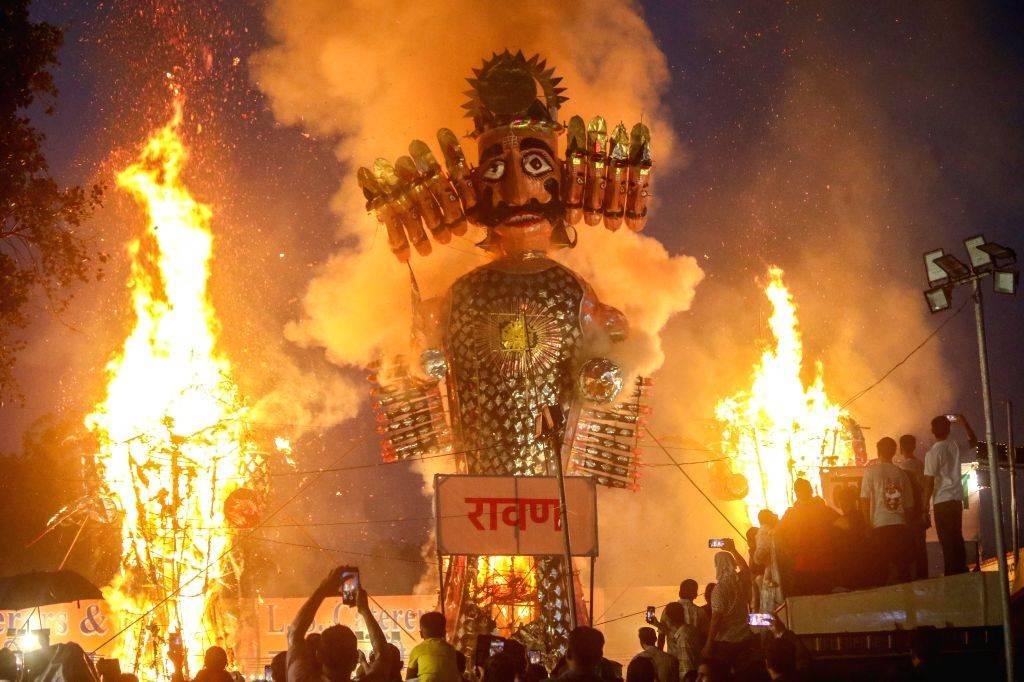
One of the most recognizable Dussehra traditions is the burning of a large effigy of Ravana.
In many celebrations, effigies of Ravana, Kumbhakarna and Meghnada are also displayed.
At the climax of the event, the effigies are set alight.


The burning symbolizes the destruction of negative qualities traditionally associated with Ravana’s downfall.
These can include:
- Pride
- Arrogance
- Uncontrolled desire
- Abuse of power
- Adharma
The effigy therefore becomes a visual reminder of the larger moral message of the festival.
The Ten Heads of Ravana
Ravana is commonly represented with ten heads in traditional art.
These ten heads have been interpreted in different ways across traditions.
They can be understood symbolically as representing different negative tendencies or forms of human weakness.
However, there is no single universally accepted interpretation of what each head represents.
The image has nevertheless become one of the most recognizable symbols of the Ramayana.
Rama’s Victory
During many Dussehra celebrations, Rama is represented as the figure who defeats Ravana.
An actor may portray Rama on a decorated stage or chariot.
The event often reaches its climax when the arrow of Rama is symbolically used to ignite the Ravana effigy.
For spectators, this creates a dramatic connection between the ancient story and the festival being celebrated today.


Dussehra in North India
In many parts of North India, Dussehra is strongly connected with Ramlila.
For several days, communities may perform episodes from the Ramayana.
The final performance often coincides with Vijayadashami.
People gather to watch the conclusion of Rama’s battle with Ravana.
Large effigies are then burned as part of the celebration.
Dussehra in Delhi
Delhi hosts large public Dussehra celebrations in different locations.
Ramlila performances can attract thousands of spectators.
Large Ravana effigies become a major attraction.
Families often attend the celebrations together, making Dussehra both a religious and community event.
Kullu Dussehra
In Kullu, Himachal Pradesh, Dussehra has a distinctive local tradition.
Rather than simply focusing on the burning of Ravana’s effigy, the festival is strongly connected with local deity traditions and processions.
The celebration can continue for several days.
This is an excellent example of how the same festival can develop very different forms in different parts of India.


Mysuru Dasara
In Karnataka, Mysuru Dasara is famous for its royal heritage and grand celebrations.
The festival is closely associated with the worship of Goddess Chamundeshwari.
The spectacular procession, decorations and cultural programs make Mysuru Dasara very different from the Ramlila-centered celebrations of North India.
This demonstrates an important point:
Dussehra does not have exactly the same meaning or ritual form everywhere in India.
Dussehra in West Bengal and Eastern India
In several eastern regions, Vijayadashami is strongly associated with Durga Puja.
The festival marks the conclusion of the Durga Puja celebrations.
Devotees participate in ceremonies and processions before the immersion of Durga images.
Here, the festival’s central story is connected with Goddess Durga’s victory over Mahishasura, rather than Rama’s victory over Ravana.


One Festival, Different Stories
This is one of the fascinating features of Vijayadashami.
In different regions, the festival can emphasize different traditions.
North India
Rama’s victory over Ravana and Ramlila.
Karnataka
Mysuru Dasara and the worship of Chamundeshwari.
West Bengal and Eastern India
The conclusion of Durga Puja.
Other regions
Local traditions, temple celebrations and cultural events.
The festival therefore demonstrates the diversity within Indian traditions.
The Message Behind the Celebration
Even though the stories and rituals vary, many Dussehra traditions share a common theme:
The triumph of righteousness over destructive forces.
The celebration encourages people to think about the qualities they want to overcome within themselves.
Instead of seeing Ravana only as a character from an ancient story, the effigy can become a symbolic reminder of human weaknesses.
Dussehra and Children
For children, Dussehra can be an especially memorable festival.
They may see:
🎭 Ramlila performances
🏹 Rama with his bow
🐒 Hanuman
👑 Ravana
🔥 Giant effigies
🎆 Fireworks and celebrations
These experiences help introduce younger generations to stories from Indian tradition.
Dussehra as a Community Celebration
Dussehra brings people together.
Families attend public events.
Communities organize performances.
Artists create elaborate costumes and stage sets.
Local volunteers help manage celebrations.
Food stalls and cultural programs often appear around large events.
The festival therefore becomes a combination of religion, storytelling, art and community life.


From Ancient Epic to Modern Festival
The Ramayana is an ancient epic tradition.
Dussehra is a modern annual celebration experienced by millions of people.
The connection between the two shows how stories can continue to influence public culture for centuries.
Even with modern technology, television, cinema and social media, people still gather to watch the same basic story being performed.
What Ravana’s Burning Can Teach Us
The burning of Ravana can be viewed symbolically as an invitation to examine our own lives.
What qualities should we overcome?
Perhaps:
Arrogance → Humility
Hatred → Compassion
Selfishness → Service
Uncontrolled desire → Self-control
Abuse of power → Responsibility
In this interpretation, Dussehra becomes more than a celebration of someone else’s defeat.
It becomes a reminder of personal improvement.
Conclusion
Dussehra is one of India’s most diverse festivals.
In some places, the central focus is Rama and the Ramayana.
In others, the festival is connected with Goddess Durga or local traditions.
The burning of Ravana’s effigy has nevertheless become one of the most recognizable symbols of the festival.
🕉️ The message is simple but powerful: victory is not only about defeating an enemy; it is also about overcoming the negative qualities that can exist within ourselves.
In the next part, we will explore how the Ramayana entered Indian literature in different languages — and how poets across India created their own remarkable versions of the epic.