

🔥 Turkmenistan’s “Door to Hell”: The Mysterious Crater That Has Been Burning for Decades
Deep inside the Karakum Desert of Turkmenistan, there is a huge crater that has fascinated travellers, scientists and photographers for decades.
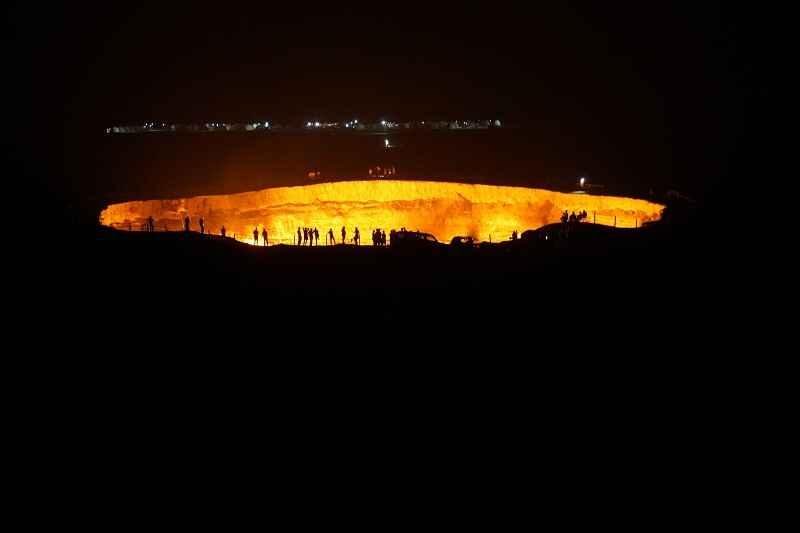
At night, the crater glows with hundreds of flames.
The site is popularly known around the world as:
The “Door to Hell”
Its official name is the Darvaza Gas Crater.
The story behind this extraordinary place is a combination of natural gas, a drilling accident, fire and an unusual decision made decades ago.
🌋 What Is the Darvaza Gas Crater?
The Darvaza Gas Crater is a large depression in the Karakum Desert where natural gas has burned for many years.
Natural gas escaping from the ground can ignite, producing the spectacular flames that made the site famous.
During the day, visitors can see the enormous crater and the surrounding desert.
But at night, the scene becomes completely different.
The darkness of the desert makes the orange flames appear even more dramatic.


🕳️ How Did the “Door to Hell” Begin?
This is where the story becomes complicated.
The crater is generally associated with Soviet-era natural-gas exploration in the 1970s.
According to widely reported accounts, drilling operations encountered an underground natural-gas pocket.
The ground then collapsed, creating a large crater.
Because of concerns about escaping gas, the gas was deliberately ignited.
The expectation was that the gas would burn away relatively quickly.
But the fire continued.
And continued.
And continued.
The exact history and timing of the initial incident have been disputed, so claims about the precise year and circumstances should be treated carefully.
What is certain is that the crater became one of Turkmenistan’s most famous natural-gas landmarks.
🔥 Why Does It Keep Burning?
The simplest explanation is:
Natural gas continues to reach the crater from underground deposits.
As the gas escapes and burns, flames appear across parts of the crater.
The amount of visible fire can change depending on conditions and gas flow.
This is why photographs of the site can look different from one another.
Sometimes the flames appear relatively small.
At other times, the crater seems to glow intensely.
🌙 The Crater Looks Completely Different at Night
During daylight, the Darvaza crater looks like a giant hole in a vast desert.
At night, however, the flames become the dominant feature.
The surrounding landscape becomes almost completely dark, making the orange and yellow flames stand out dramatically.
This contrast is one of the main reasons the site became famous internationally.
The nickname “Door to Hell” was popularised because the glowing crater looks almost otherworldly.


🏜️ Where Is the Door to Hell?
The crater is located in the Karakum Desert, one of the world’s major deserts.
Turkmenistan itself is dominated by desert landscapes.
The Karakum covers a large portion of the country and contains vast areas of sand, rocky terrain and extremely dry conditions.
That makes the location of the crater even more dramatic.
Imagine travelling through kilometres of empty desert and suddenly seeing a giant crater glowing with fire in the darkness.
That is the experience that has made Darvaza so memorable.
⛽ Why Is Turkmenistan Important for Natural Gas?
The Door to Hell is not famous simply because of its flames.
It also reflects something much larger about Turkmenistan:
The country has enormous natural-gas resources.
Turkmenistan is one of the world’s important natural-gas-producing countries.
The country’s economy has historically depended heavily on its energy sector, particularly natural gas.
This makes the Darvaza crater an unusual symbol of both the power and unpredictability of underground natural resources.
🌍 A Geological Attraction With a Human Story
The Door to Hell is sometimes described as a purely natural wonder.
But that is not quite accurate.
The crater’s modern history is closely connected with human drilling activity.
That makes it different from a volcano or naturally formed canyon.
It is an example of how:
Human exploration + geology + natural gas
can combine to create a landscape that looks completely natural.
🧪 Why Are Scientists Interested in Places Like This?
Natural-gas craters and burning gas sites can provide opportunities to study:
- Underground gas systems
- Methane emissions
- Desert geology
- Microorganisms living in extreme environments
- Effects of long-term gas combustion
Researchers have even investigated microorganisms capable of surviving in extreme environments around the crater.
Such environments can help scientists understand how life might survive under harsh conditions.
🦠 Life in an Extreme Environment
The Karakum Desert is already an extreme environment.
Temperatures can become very high during the day and conditions can be extremely dry.
A burning gas crater creates an even more unusual environment.
Yet microscopic organisms can survive in surprisingly difficult conditions.
Studying such organisms can help scientists understand the limits of life on Earth.
It may also contribute to broader research into how life could potentially survive in extreme environments elsewhere.
🚨 Is the Door to Hell Still Burning?
The answer is more complicated than simply saying “yes.”
Turkmen authorities have discussed reducing or extinguishing the Darvaza fire because of concerns about:
- Natural-gas waste
- Environmental impacts
- Methane emissions
- Energy resources
Turkmenistan’s government has also explored ways to reduce the crater’s burning.
Therefore, the appearance and future of the crater should not be assumed to remain unchanged forever.
This is important for anyone writing about the site in a current article.
🌱 Why Does the Crater Create an Environmental Problem?
Natural gas contains methane, and methane is a powerful greenhouse gas.
When gas escapes into the atmosphere without being burned, it can contribute significantly to climate change.
Even though burning converts much of the methane into carbon dioxide and water, uncontrolled gas combustion is still a form of wasted energy and can have environmental consequences.
That is why Turkmenistan has had an incentive to reduce the gas loss associated with the crater.
🇹🇲 Turkmenistan Is Much More Than the Door to Hell
The crater may be the country’s most internationally recognisable unusual attraction, but Turkmenistan has much more to offer.
The country is known for:
- The Karakum Desert
- Ancient Silk Road history
- Ashgabat’s distinctive architecture
- Ancient archaeological sites
- Traditional carpets
- Akhal-Teke horses
- Natural-gas resources
- Unique Central Asian culture
So the Door to Hell should be seen as one fascinating part of a much larger country.


🐎 The Famous Akhal-Teke Horse
Turkmenistan is also famous for the Akhal-Teke horse, an ancient breed known for its distinctive appearance, endurance and speed.
The horse has enormous cultural importance in Turkmenistan.
Its history is closely connected with the country’s nomadic and equestrian traditions.
This creates an interesting contrast:
Underground — enormous natural-gas resources.
Above ground — one of Central Asia’s most famous horse cultures.
🏛️ Ashgabat: A Very Unusual Capital City
Turkmenistan’s capital is Ashgabat.
The city is famous for its striking white-marble buildings, grand avenues and monumental architecture.
Its appearance is dramatically different from the image many people have of a typical Central Asian city.
Ashgabat has even gained international recognition for the enormous scale and distinctive appearance of its marble architecture.
The capital and the desert crater therefore represent two completely different sides of Turkmenistan:
Modern monumental architecture
and
Remote desert wilderness.
🤯 10 Amazing Facts About the Door to Hell
1️⃣ The site is officially known as the Darvaza Gas Crater.
2️⃣ It is located in Turkmenistan’s Karakum Desert.
3️⃣ The crater is associated with Soviet-era natural-gas exploration.
4️⃣ Natural gas escaping from underground has fuelled the flames.
5️⃣ The site became internationally famous because of its spectacular appearance at night.
6️⃣ It is popularly called the “Door to Hell.”
7️⃣ The crater is linked to human drilling activity rather than being a conventional natural volcanic crater.
8️⃣ Scientists have investigated extreme microbial life associated with the environment.
9️⃣ Turkmenistan has considered reducing or extinguishing the fire because of environmental and economic concerns.
🔟 The crater has become one of the most unusual landmarks associated with Central Asia.
🌟 Why Is This Story So Interesting?
Most famous natural attractions were created entirely by nature.
Mountains formed through geological processes.
Waterfalls were shaped by rivers.
Canyons were carved by erosion.
Volcanoes formed through Earth’s internal forces.
But the Door to Hell has a different story.
It is connected to:
Human exploration
Underground natural gas
A geological collapse
A decision to ignite the escaping gas
One of the world’s strangest landscapes.
That combination is what makes the Darvaza Gas Crater so fascinating.
🇹🇲 The Final Story of the “Door to Hell”
Deep in the Karakum Desert, a hole in the Earth became a window into Turkmenistan’s enormous underground gas reserves.
For decades, flames have made the crater glow against the darkness of the desert.
But the future of the site may be different.
As Turkmenistan tries to manage its natural-gas resources and reduce environmental impacts, the famous fire may eventually become a memory rather than a permanent feature.
Whether the flames continue for years or eventually disappear, the story of the Darvaza Gas Crater will remain one of the most unusual chapters in the history of modern energy exploration.
Leave a Reply