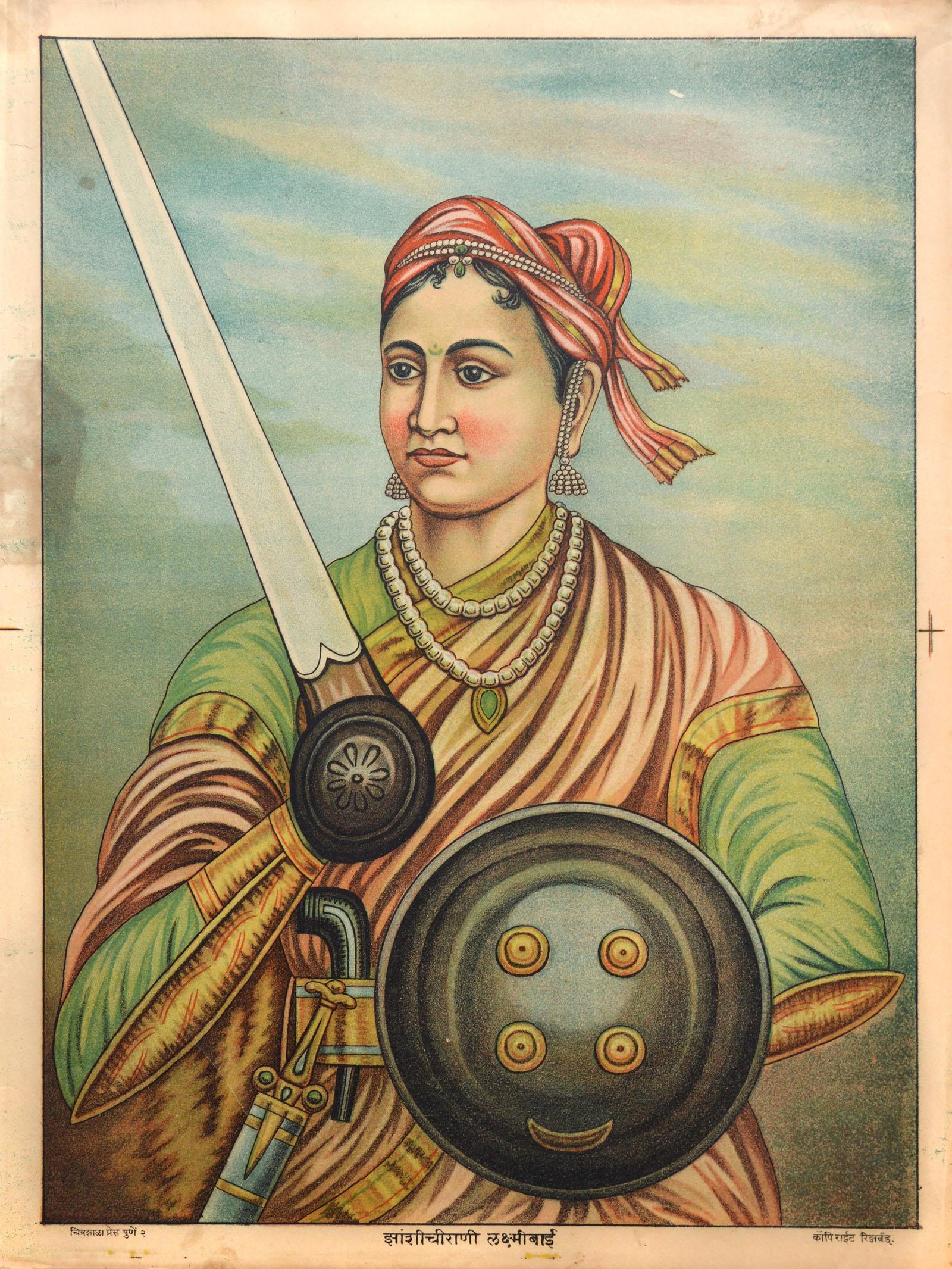


🗡️ Rani Lakshmibai — The Warrior Queen of Jhansi
Indian history is filled with extraordinary women who stood against enormous challenges.
Among the most celebrated is Rani Lakshmibai of Jhansi, remembered for her courage, leadership and resistance during the Indian Rebellion of 1857.
Born as Manikarnika Tambe, she later became the queen of Jhansi after marrying Maharaja Gangadhar Rao.
Her life was short, but her courage made her immortal in Indian history.
👑 Who Was Rani Lakshmibai?


Rani Lakshmibai was born as Manikarnika Tambe around 1828 in Varanasi.
Her father was Moropant Tambe, who served in the court of the Peshwa.
She was affectionately called Manu during her childhood.
Unlike the traditional expectations placed on many girls of her era, Manu was encouraged to learn skills such as:
🏇 Horse riding
⚔️ Sword fighting
🏹 Archery
🥋 Martial training
These skills later became an important part of her identity as a warrior queen.
🐎 A Childhood Unlike Others


Young Manikarnika grew up in an environment where she was exposed to physical training and stories of bravery.
She became an accomplished horse rider.
Historical accounts and later traditions associate her with horses including Sarangi, Pavan and Baadal, although details vary among sources.
Her confidence and determination became noticeable from a young age.
💍 Marriage to the Maharaja of Jhansi
Manikarnika married Maharaja Gangadhar Rao Newalkar, the ruler of Jhansi.
After marriage, she was given the name:
👑 Lakshmibai
She became the Rani of Jhansi.


Jhansi was an important kingdom in central India.
For Lakshmibai, becoming queen meant more than living in a palace.
She gradually became involved in the administration and affairs of the state.
💔 A Difficult Period for Jhansi
The royal family experienced tragedy when the couple’s biological son died in infancy.
Later, Gangadhar Rao and Lakshmibai adopted a son named Damodar Rao.
Soon after the adoption, Gangadhar Rao died in 1853.
Lakshmibai became a young widow and ruler of Jhansi.
But an even greater political challenge was approaching.
⚖️ The Doctrine of Lapse


The British East India Company had adopted a policy known as the Doctrine of Lapse.
Under this policy, certain princely states could be annexed if their ruler died without a biological male heir, and the British did not recognise an adopted heir for succession.
After Gangadhar Rao’s death, the British refused to recognise Lakshmibai’s adopted son Damodar Rao as the successor in the manner she wanted.
Jhansi was subsequently annexed.
Lakshmibai strongly opposed the decision.
Her resistance would eventually become part of the larger upheaval of 1857.
🔥 The Revolt of 1857


In 1857, a major uprising against British rule erupted in several parts of northern and central India.
The uprising began among sections of the Bengal Army and quickly spread to different regions.
Jhansi became one of the important centres of conflict.
Lakshmibai emerged as a leading figure in the defence of the city.
🛡️ The Defence of Jhansi


British forces under Sir Hugh Rose advanced toward Jhansi in 1858.
Lakshmibai organised the defence of the city.
She worked with soldiers and local supporters to resist the advancing British forces.
The fighting became intense.
Eventually, British forces breached Jhansi’s defences.
Lakshmibai managed to escape from the fort with her adopted son.
Her escape became one of the most famous episodes associated with her legend.
🐎 The Legendary Escape
According to popular accounts, Lakshmibai escaped from Jhansi on horseback while carrying young Damodar Rao.
Whether every detail of later retellings is historically precise is difficult to establish.
But the image of the queen riding out of Jhansi has become one of the most powerful symbols of India’s resistance.
She continued the struggle rather than surrendering.
⚔️ Joining Forces at Kalpi


After leaving Jhansi, Lakshmibai reached Kalpi.
There she joined other rebel leaders, including Tatya Tope.
They attempted to continue resistance against British forces.
The rebels eventually moved toward Gwalior, where they captured the strategically important city for a period.
🏰 The Battle of Gwalior


Gwalior became the final major battlefield in Lakshmibai’s life.
British forces under Hugh Rose moved against the rebels.
Lakshmibai fought in the battle.
She was killed on 18 June 1858, near Gwalior.
She was only around 29 years old.
Her death transformed her from a warrior queen into a lasting symbol of resistance.
🗡️ A Warrior Who Refused to Surrender
Lakshmibai’s historical importance comes not only from the battles she fought.
It also comes from the decision she made:
She refused to simply accept the loss of her kingdom.
She faced a powerful colonial empire with limited resources.
Her determination made her one of the most remembered personalities of the 1857 uprising.
👩🦱 A Symbol of Women’s Courage


Lakshmibai became an enduring symbol of women’s courage.
At a time when women were rarely associated with military leadership in public life, she became a ruler who personally participated in armed resistance.
Her story has inspired:
- Writers
- Poets
- Artists
- Filmmakers
- Historians
- Students
- Women’s organisations
📜 Lakshmibai in Indian Literature
One of the most famous literary tributes to her is the Hindi poem “Jhansi ki Rani” by poet Subhadra Kumari Chauhan.
The poem helped make the popular image of Lakshmibai even more powerful across generations.
Her story continues to appear in:
📚 Books
🎭 Plays
🎬 Films
📺 Television
🎨 Paintings
🗿 Statues
🏫 School textbooks
🏛️ Jhansi Fort Today


The Jhansi Fort remains one of the most important places associated with Lakshmibai.
The massive fort stands on a hill overlooking the city.
Visitors can see:
🏰 Fort walls
🛕 Historic temples
🚪 Ancient gateways
🗿 Statues
🌆 Views over Jhansi
The fort has become a powerful physical reminder of the events of 1857–58.
🗿 Statues Across India


Statues of Lakshmibai can be found in many Indian cities.
She is frequently depicted on horseback, holding a sword and carrying her young son.
This artistic representation has become one of the most recognisable images of India’s freedom struggle.
🇮🇳 Why Rani Lakshmibai Still Inspires India
Lakshmibai lived during a very different period.
Yet the values associated with her story remain powerful:
Courage
Standing up when the situation appears impossible.
Determination
Continuing despite setbacks.
Leadership
Taking responsibility during a crisis.
Self-respect
Refusing to surrender one’s principles easily.
Love for one’s homeland
Protecting one’s people and kingdom.
🤯 Interesting Facts About Rani Lakshmibai


🗡️ 1.
Her childhood name was Manikarnika Tambe.
👧 2.
She was popularly called Manu as a child.
👑 3.
After marriage, she became known as Lakshmibai.
🏰 4.
She became the queen of Jhansi.
👶 5.
Her adopted son was named Damodar Rao.
🔥 6.
She became a prominent figure during the 1857 uprising.
🐎 7.
She was highly skilled in horse riding.
⚔️ 8.
She personally participated in the defence of Jhansi.
🏹 9.
She is remembered as a skilled and courageous warrior.
🏰 10.
She continued fighting after leaving Jhansi and later fought around Gwalior.
💔 11.
She died on 18 June 1858.
🇮🇳 12.
She remains one of India’s most famous symbols of resistance.
🌟 Rani Lakshmibai’s Greatest Legacy
Rani Lakshmibai did not live to see India become independent.
She died nearly 90 years before India’s independence in 1947.
Yet her story became part of the nation’s long historical memory of resistance to colonial rule.
She demonstrated that leadership is not determined by age or gender.
A young queen, facing a powerful empire, became one of the most enduring figures of India’s history.
🏁 Final Thoughts
The story of Rani Lakshmibai is a story of a young woman who faced extraordinary circumstances.
She lost her husband.
She faced the loss of her kingdom.
She confronted a powerful colonial authority.
She fought alongside her soldiers.
And when defeat appeared close, she continued resisting.
Her life reminds us that courage does not mean having no fear.
It means standing firm when the situation is difficult.
That is why her name continues to echo through Indian history:
🗡️ Rani Lakshmibai of Jhansi
👑 The Warrior Queen
🇮🇳 A Symbol of Courage
🔥 A Legend of India’s 1857 Uprising
🇮🇳 MANA BHARATHAM
Stories, Facts & Wonders From India
✍️ Written by Pasupuleti Saida Rao
🌐 allpincodes.online