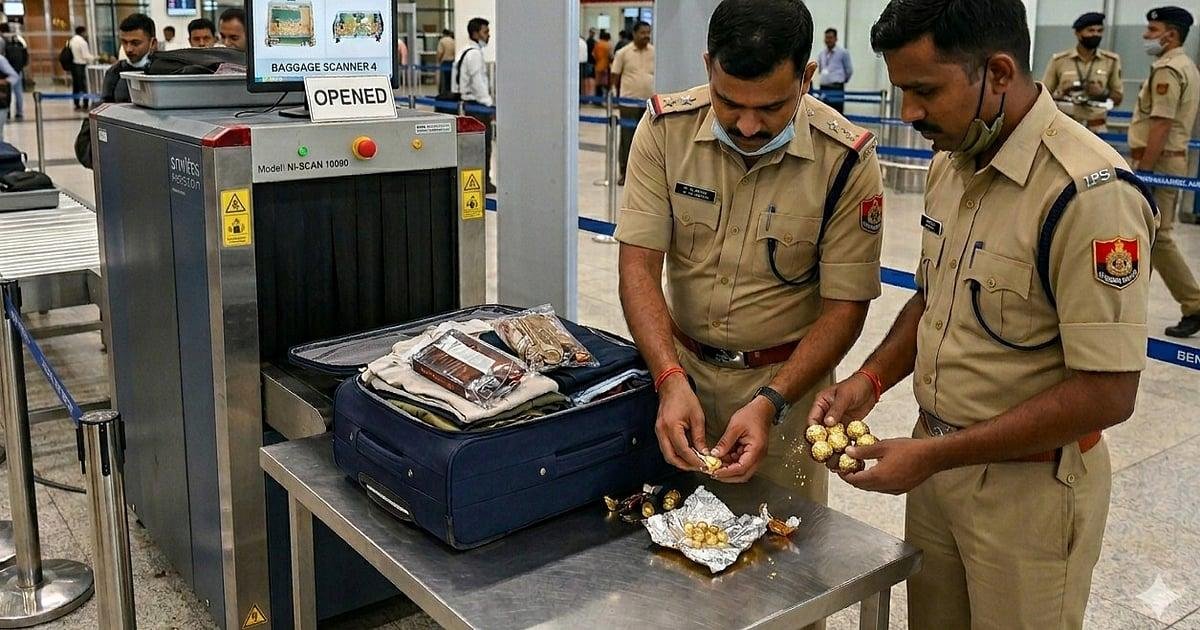


Smuggling is the illegal movement of goods across international borders, usually to evade customs duty, import/export restrictions or bans. India’s Directorate of Revenue Intelligence (DRI) describes itself as the country’s apex anti-smuggling agency under CBIC.
India’s long land borders, coastline, international airports, seaports and extensive trade network make preventing smuggling an important law-enforcement and national-security challenge.
Importantly, not every undeclared item is automatically “smuggling” in the same sense. Some goods are prohibited, some are restricted and some are legal if the required declaration, licence and customs duty requirements are followed.
📋 Major Types of Smuggling in India


The major categories include:
- 🪙 Gold and precious-metal smuggling
- 💊 Narcotics and psychotropic-substance smuggling
- 🚬 Cigarette and tobacco smuggling
- 💨 E-cigarette smuggling
- 💵 Foreign-currency smuggling
- 🔫 Arms and ammunition smuggling
- 🐅 Wildlife trafficking
- 🌳 Illegal trafficking of plants and forest products
- 🏺 Antiquities smuggling
- 📱 Electronics and high-value consumer-goods smuggling
- 👟 Counterfeit and pirated-goods trafficking
- 💰 Fake-currency trafficking
- 🧪 Hazardous and environmentally regulated goods
- 🌱 Certain agricultural/plant products
- 📦 Commercial fraud and trade-based smuggling
These categories overlap in some cases, and the exact legal classification depends on the goods and circumstances.
1. 🪙 Gold Smuggling


Gold remains one of the major smuggling concerns identified by DRI.
According to DRI, gold-smuggling cases have involved international routes connected with the Gulf and Southeast Asia as well as land-border regions. Gold may be illegally brought into India without complying with customs requirements.
Recent DRI operations have continued to seize foreign-origin gold at airports and other locations. In an August 2026 nationwide operation, DRI reported seizures involving foreign-origin gold among other contraband.
Why is gold attractive to smugglers?
Gold has:
- High value compared with its weight
- Strong domestic demand
- An established resale market
- Internationally traded value
But legally importing gold and smuggling gold are completely different things. Passengers who meet applicable declaration and duty requirements are not automatically smuggling.
2. 💊 Drug Smuggling


Narcotics and psychotropic substances are among the most serious forms of smuggling.
DRI has identified narcotics as a major area of concern and has reported cases involving substances including heroin, MDMA, ketamine, mephedrone and other controlled substances.
Indian Customs classifies narcotic drugs and psychotropic substances among prohibited goods.
Drug trafficking can cause enormous social harm and is also connected with organised criminal networks.
3. 🚬 Cigarette and Tobacco Smuggling


Illegal cigarette trafficking is another major customs-enforcement concern.
Smuggled or counterfeit cigarettes can:
- Avoid customs duties
- Violate packaging requirements
- Damage legitimate businesses
- Reduce government revenue
- Create public-health concerns
DRI has reported cigarette-smuggling cases involving maritime routes and international transit hubs.
In September 2025, Chennai Customs reported seizure of 4.30 lakh cigarette sticks and 1,130 e-cigarette units, with an estimated value of ₹1.33 crore.
4. 💨 E-Cigarette Smuggling
E-cigarettes are another category that Indian enforcement agencies have specifically targeted.
The Prohibition of Electronic Cigarettes Act, 2019 prohibits their production, manufacture, import, export, transport, sale, distribution, storage and advertising in India.
DRI reported seizures of 3.53 lakh e-cigarette units in one of its recent bulletins across air-cargo terminals, foreign post offices, seaports and other locations.
5. 💵 Foreign-Currency Smuggling


Foreign currency can also be illegally moved across borders.
Indian Customs has rules concerning the amount and type of currency that passengers can carry and when declarations are required.
CBIC states that declaration is required for certain amounts of foreign exchange, including foreign currency notes exceeding specified limits.
DRI has reported foreign-currency seizures at airports including Delhi, Chennai, Calicut and Mangalore.
6. 🔫 Arms and Ammunition Smuggling


Illegal movement of firearms and ammunition is a serious security issue.
Indian Customs lists firearms among prohibited goods and ammunition among restricted goods, subject to applicable laws and permissions.
DRI has also reported intelligence relating to the movement of arms and ammunition through postal channels.
This category is particularly sensitive because illegal weapons can enter criminal and violent networks.
7. 🐅 Wildlife Smuggling


Wildlife trafficking is not simply a customs problem—it is an environmental and biodiversity issue.
Illegal trafficking can involve:
- Protected animals
- Animal parts
- Reptiles
- Birds
- Endangered species
- Wildlife-derived products
CBIC lists wildlife products among prohibited goods and endangered species among restricted categories.
DRI also works under laws relating to wildlife and international environmental agreements such as CITES.
8. 🌳 Illegal Plant and Forest-Product Trafficking
Certain plants, seeds and plant products are regulated because they can create:
- Agricultural risks
- Invasive-species risks
- Biodiversity damage
- Plant-disease risks
CBIC lists plants and their produce, including fruits and seeds, among restricted categories in applicable circumstances.
Illegal forest-product trafficking can also involve valuable species and protected materials.
9. 🏺 Antiquities Smuggling


India has an enormous archaeological and cultural heritage.
Antiquities can be illegally moved outside the country or brought into India in violation of applicable laws.
Indian Customs lists antiquities among prohibited goods in its passenger guidance.
The illegal trade in antiquities can permanently remove culturally important objects from their historical context.
10. 📱 Electronics Smuggling


Electronics can become the subject of customs violations when they are imported commercially without proper declarations, licences or duties, or are otherwise prohibited/restricted.
DRI has specifically noted smuggling concerns involving products such as iPads, iPhones, tablets and memory cards, including movement through courier and postal channels.
The key issue is not simply owning an imported phone or laptop—the legality depends on applicable customs rules and the circumstances of import.
11. 👟 Counterfeit and Pirated Goods


Counterfeit products may include fake versions of:
- Clothing
- Shoes
- Watches
- Bags
- Electronics
- Cosmetics
- Cigarettes
- Other branded products
CBIC identifies counterfeit and pirated goods, as well as goods violating enforceable intellectual-property rights, among prohibited categories.
This can hurt legitimate businesses and consumers while supporting organised illegal trade.
12. 💴 Fake Indian Currency
Fake currency is particularly serious because it can directly threaten the integrity of India’s monetary system.
CBIC lists counterfeit Indian currency notes, stamps and coins and fake currency notes among prohibited goods.
Such cases can involve both cross-border movement and wider criminal networks.
13. 🧪 Hazardous and Environmentally Regulated Goods
Some cross-border movements are regulated because they can harm:
🌍 The environment
☣️ Public health
🌊 Water systems
🌳 Ecosystems
🧬 Biodiversity
DRI works with laws and international agreements concerning hazardous waste, ozone-depleting substances, chemicals, wildlife and other environmentally sensitive materials.
14. 🌱 Agricultural Products
Certain agricultural products, plants, seeds and animal products are subject to restrictions or quarantine requirements.
This is important because uncontrolled movement can introduce:
- Plant diseases
- Insects
- Invasive species
- Agricultural pests
- Animal diseases
Therefore, an apparently ordinary product can still require permission or declaration.
15. 📦 Commercial Fraud and Trade-Based Smuggling
Smuggling isn’t always a person physically carrying illegal goods across a border.
Some schemes involve false trade documentation.
DRI identifies practices such as:
- Mis-declaration of goods
- Under-invoicing
- Over/under-shipment
- False description
- Multiple invoicing
- Misuse of Importer Exporter Codes
as areas of customs/commercial-fraud concern.
For example, a shipment can be declared as one product while authorities discover that the actual contents are different.
🚢 Where Can Smuggling Attempts Be Detected?


Smuggling cases can arise through different channels, including:
✈️ Airports
International passenger and cargo traffic.
🚢 Seaports
Containerised and maritime cargo.
🚂 Land borders
Cross-border movement through land routes.
📦 Courier and postal channels
International parcels and commercial shipments.
🚚 Cargo and logistics networks
Commercial imports and exports.
DRI’s recent reports show that enforcement operations can involve airports, seaports, courier channels and other locations.
⚠️ Smuggling vs Legal Import
This distinction is extremely important.
Imported product ≠ smuggled product.
For example, a passenger may legally bring certain goods into India if the applicable:
- Quantity limits
- Declaration requirements
- Customs duty
- Licences
- Import restrictions
are followed.
CBIC provides specific guidance for passengers and distinguishes between prohibited, restricted and permitted goods.
🛃 How Indian Agencies Fight Smuggling
India uses several enforcement mechanisms.
Directorate of Revenue Intelligence — DRI
The DRI is the apex anti-smuggling agency under Indian Customs/CBIC.
Indian Customs
Customs officers examine passengers, baggage and cargo and enforce customs laws.
Other specialised agencies
Depending on the commodity, investigations may also involve agencies and authorities responsible for narcotics, wildlife, financial crimes, weapons and other regulated areas.
🇮🇳 Why Smuggling Is Dangerous
Smuggling doesn’t only cause loss of customs revenue.
It can also contribute to:
💊 Drug addiction
🔫 Illegal weapons
🐅 Wildlife destruction
🌳 Environmental damage
💴 Counterfeit currency
🏺 Loss of cultural heritage
🚬 Illegal tobacco markets
💰 Organised crime
🌐 Cross-border criminal networks
This is why India’s anti-smuggling efforts are connected not only to taxation but also to public health, environmental protection, national security and economic security.
📌 Important Conclusion
There is no single fixed number of “types of smuggling” in India because smuggling is defined by the nature of the goods, the law violated and the method of illegal cross-border movement.
However, major categories include gold, narcotics, cigarettes, e-cigarettes, foreign currency, arms and ammunition, wildlife, plants, antiquities, counterfeit goods, fake currency, electronics and environmentally regulated products, along with customs and trade-related fraud. India’s DRI officially identifies many of these as major anti-smuggling concerns.
Recent DRI operations in 2026 show that these are not merely historical problems: authorities continue to seize gold, drugs, e-cigarettes, wildlife products, red sanders, foreign-origin tobacco products and other contraband in nationwide operations.
Note: This article explains the major categories and their legal/social significance. It does not provide operational instructions for carrying out smuggling.
🇮🇳 MANA BHARATHAM
Stories, Facts & Wonders From India
✍️ Written by Pasupuleti Saida Rao
Leave a Reply