

India is one of the world’s biggest television markets, and television news plays a major role in how millions of Indians follow politics, elections, sports, business, entertainment, crime, weather and breaking news.
From national Hindi news channels to powerful Telugu, Tamil, Malayalam, Kannada, Bengali, Marathi and other regional networks, India’s television news industry is extraordinarily diverse.
But exactly how many TV channels does India have? Which news channels get the highest TRP? And where does India stand globally?
Let’s look at the numbers and the changing television landscape.
📺 How Many TV Channels Are There in India?
According to India’s Ministry of Information & Broadcasting (MIB), the number of private satellite TV channels has grown dramatically over the past two decades.
The Ministry’s latest data shows:
🇮🇳 919 private satellite TV channels in 2025–26
The government data gives the following growth:
| Year | Private Satellite TV Channels |
|---|---|
| 2010–11 | 603 |
| 2011–12 | 822 |
| 2012–13 | 852 |
| 2013–14 | 859 |
| 2014–15 | 821 |
| 2015–16 | 847 |
| 2016–17 | 899 |
| 2017–18 | 877 |
| 2018–19 | 866 |
| 2019–20 | 918 |
| 2020–21 | 914 |
| 2021–22 | 898 |
| 2022–23 | 905 |
| 2023–24 | 912 |
| 2024–25 | 908 |
| 2025–26 | 919 |
These numbers include news as well as entertainment, music, sports, movies, devotional and other categories.
So, 919 does NOT mean India has 919 news channels.
It means India had 919 private satellite television channels across categories.
📰 How Many News Channels Does India Have?
India has hundreds of channels in the News & Current Affairs category.
The exact number changes because channels can receive permission, launch, surrender permission, merge, change category or stop operations.
This is why it is better to use the government’s permitted-channel figures rather than claiming an exact permanent number of operating news channels.
The Ministry also operates the Electronic Media Monitoring Centre (EMMC), which can monitor around 900 satellite channels.
🏆 Major Hindi News Channels in India


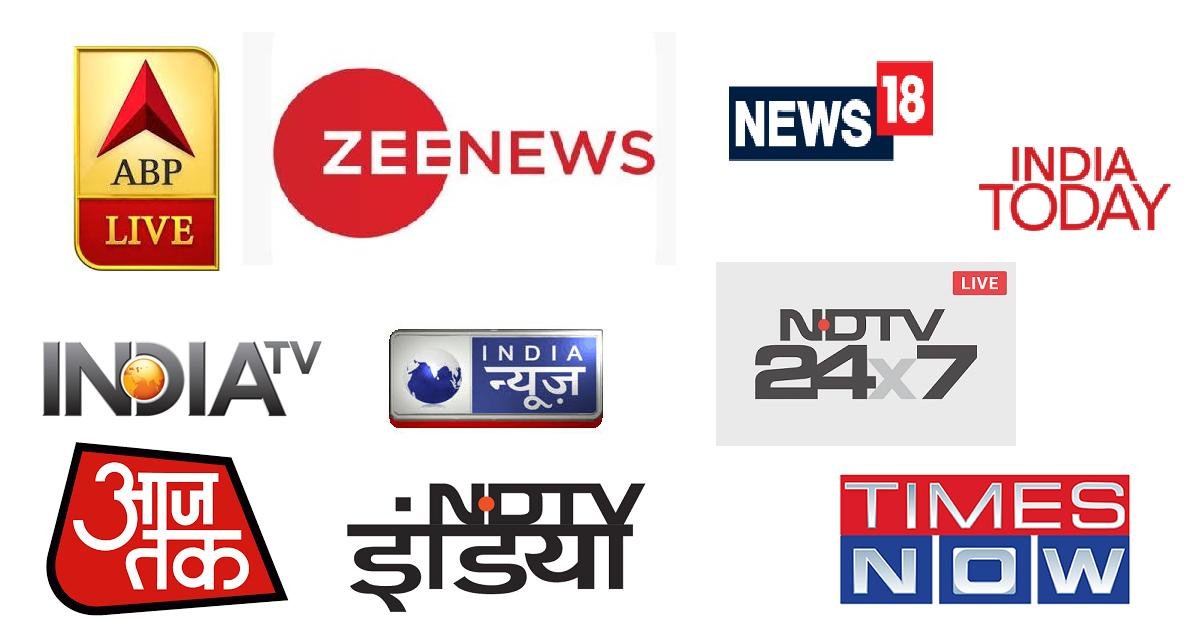
Some of India’s best-known Hindi news television brands include:
🔴 Aaj Tak
One of India’s most recognised Hindi news brands.
🔵 News18 India
A major Hindi-language news service belonging to the News18 network.
🟡 India TV
A major Hindi news broadcaster with a strong national audience.
🔴 Zee News
One of India’s established Hindi news channels.
🇮🇳 Republic Bharat
A prominent Hindi news channel from the Republic network.
🔵 TV9 Bharatvarsh
The Hindi news service of TV9 Network.
🟠 ABP News
A major Hindi news broadcaster belonging to the ABP network.
🟣 NDTV India
The Hindi news service of NDTV.
📰 News24
Another established Hindi news channel.
📺 Times Now Navbharat
The Hindi-language news service from the Times Network.
There are also many other Hindi and regional news channels operating across the country.
🌐 Major English News Channels


India also has a competitive English-language television news market.
Major brands include:
- NDTV 24×7
- Times Now
- CNN-News18
- Republic TV
- India Today Television
- WION
- NewsX
English news channels generally have a different audience profile from Hindi and regional-language channels.
Their audience includes urban viewers, business audiences, policymakers, professionals, international viewers and India’s English-speaking population.
🌟 Telugu TV News Channels
Since Telugu is one of India’s major television markets, Andhra Pradesh and Telangana have a particularly competitive news environment.


Major Telugu news brands include:
- TV9 Telugu
- NTV
- TV5 News
- Sakshi TV
- ABN Andhra Jyothy
- 10TV
- ETV Andhra Pradesh
- V6 News
The Telugu television market demonstrates an important characteristic of Indian media:
India is not just one television market. It is a collection of many powerful language markets.
📊 What Exactly Is TRP?
TRP means Television Rating Point.
In simple words, television ratings attempt to measure how many people are watching television content.
The data can help broadcasters and advertisers understand:
- Which programmes attract viewers
- Which channels are popular
- What people are watching
- How audiences change over time
- Where advertising may be placed
🏢 Who Measures TV Ratings in India?
The principal television audience measurement organisation has been BARC India — Broadcast Audience Research Council India.
BARC describes itself as a joint industry body representing broadcasters, advertisers and advertising/media agencies.
It says its TV measurement panel has approximately 180,000 individuals, and describes this as the world’s largest measurement operation of its kind.
⚠️ Important 2026 TRP Update
This is very important if you are publishing this article in 2026.
India introduced the Television Ratings Policy 2026 to make television audience measurement more transparent and accountable.
The new policy includes measures relating to:
- Larger measurement samples
- Independent audits
- Data protection
- Transparency
- Technology-neutral measurement
- Connected TV
- TV channels available through OTT platforms
- Restrictions on conflicts of interest
The policy increased the required metered homes from 50,000 to 80,000, with provisions for further expansion.
🚨 Why Are Current TRP Rankings Difficult to Give?
In 2026, this is a major issue.
The Ministry of Information & Broadcasting directed BARC to suspend publication of television ratings while BARC completes registration under the new TV Ratings Policy.
The suspension was later extended to both news and non-news television ratings.
As of a July 2026 Rajya Sabha response reported by Akashvani, the government said that no entity was registered under the new policy at that time.
Therefore, it would be misleading to publish an article saying:
“This is India’s current No. 1 news channel according to September 2026 TRP”
unless fresh official ratings are available.
🏅 What Were Earlier TRP Rankings Used For?
Before the 2026 ratings suspension, weekly BARC figures were widely used by the television industry.
For example, historical BARC data showed strong competition among Hindi news channels involving brands such as:
Aaj Tak, Republic Bharat, India TV, TV9 Bharatvarsh, News18 India and others.


But historical rankings should not be treated as today’s rankings.
📺 India’s Overall TV Audience Is Enormous
India’s television market remains one of the largest in the world.
The enormous population, large number of TV households and multiple language markets make India an exceptionally important television advertising and broadcasting market.
And India’s television industry is not limited to national channels.
A Telugu viewer may primarily watch Telugu channels.
A Tamil viewer may primarily watch Tamil channels.
A Bengali viewer may primarily watch Bengali channels.
A Hindi-speaking viewer may watch Hindi channels.
This creates a huge number of individual television ecosystems inside one country.
🌍 India’s Position in the Global Television Industry


India is a global television powerhouse, especially because of:
🇮🇳 1. Massive population
India’s huge population creates one of the world’s largest potential television audiences.
🗣️ 2. Multiple languages
India’s television industry serves many languages.
📺 3. Hundreds of TV channels
The country has hundreds of permitted private satellite channels.
📰 4. Strong news industry
National and regional news networks compete continuously for audiences.
📱 5. Huge digital audience
Almost every major television network now distributes content digitally.
🌎 6. Global Indian audience
Indian television content also reaches Indians and South Asian audiences outside India.
📱 Television News Is No Longer Only Television


Today’s major news organisations operate across multiple platforms.
A single news story can appear on:
📺 TV
▶️ YouTube
🌐 Website
📱 Mobile App
📸 Instagram
📘 Facebook
🐦 X
📡 Connected TV
🎙️ Podcasts
This means the influence of a news organisation can no longer be measured only by traditional television ratings.
🔥 TV TRP vs YouTube Views
These two numbers are not the same thing.
For example:
TV TRP measures television viewing using a specific audience-measurement methodology.
YouTube views measure video plays on YouTube.
Instagram followers measure followers.
Website traffic measures visits/page views.
Therefore:
A channel with a huge YouTube audience does not automatically have the highest TV TRP.
And a television channel with strong TRP does not necessarily have the largest YouTube audience.
📊 India’s Television Industry at a Glance
| Category | Information |
|---|---|
| 🇮🇳 Private satellite TV channels | 919 in 2025–26 |
| 📰 News/current affairs | Hundreds of permitted channels |
| 📡 TV rating body | BARC India has been the principal measurement body |
| 👥 BARC panel | About 180,000 individuals |
| 🌎 Global position | One of the world’s largest TV markets |
| 🗣️ Languages | Multiple national & regional languages |
| 📱 Digital distribution | YouTube, websites, apps, social media & connected TV |
| ⚠️ 2026 TRP situation | Ratings publication suspended pending new-policy registration |
🇮🇳 Why Indian TV News Is So Powerful
Indian television news has a unique structure.
Unlike countries where one or two national networks dominate, India has national + language + state + regional networks.
For example:
North India → Hindi news
Andhra Pradesh & Telangana → Telugu news
Tamil Nadu → Tamil news
Kerala → Malayalam news
Karnataka → Kannada news
West Bengal → Bengali news
Maharashtra → Marathi news
This regional structure gives Indian television enormous depth.
🚀 The Future of Indian News
The future of Indian news broadcasting is likely to be increasingly multi-platform.
The strongest media companies will not depend exclusively on television.
They will combine:
TV + YouTube + Website + App + Social Media + Connected TV + OTT
The biggest challenge will be balancing speed with accuracy.
In the age of instant breaking news, credibility, verification and responsible journalism will become increasingly important.
🇮🇳 Conclusion
India has one of the largest and most diverse television ecosystems on Earth.
The Ministry of Information & Broadcasting’s latest data records 919 private satellite TV channels in 2025–26.
Among them are hundreds of news and current-affairs services serving India’s enormous multilingual population.
Channels such as Aaj Tak, India TV, News18 India, Zee News, ABP News, TV9 Bharatvarsh, Republic Bharat, NDTV and many regional broadcasters compete for viewers.
However, current 2026 TRP rankings should be treated carefully, because television ratings publication has been suspended while the industry transitions to the new Television Ratings Policy framework.
India’s real strength is not just the number of channels.
It is the combination of:
🇮🇳 Huge population + 📺 massive TV ecosystem + 🗣️ multiple languages + 📰 strong news networks + 📱 enormous digital audience.
That combination makes India one of the most important television and news-media markets in the world.
🇮🇳 MANA BHARATHAM
Stories, Facts & Wonders From India
✍️ Written by Pasupuleti Saida Rao