In the next article, we’ll explore Rama’s Ashwamedha ceremony, the arrival of Lava and Kusha, their powerful recitation of the Ramayana, their meeting with Rama’s royal court, and the beginning of a remarkable revelation about their true identity.
The Ashwamedha Ceremony
After establishing his rule in Ayodhya, Rama decided to perform the Ashwamedha ceremony, an important royal ritual described in the later tradition of the Ramayana.
The ceremony was associated with royal authority and the prosperity of the kingdom.
A specially prepared horse was allowed to travel through different territories.
Wherever the horse travelled, rulers had to accept Rama’s authority or challenge it.
Lava and Kusha Hear About the Ceremony
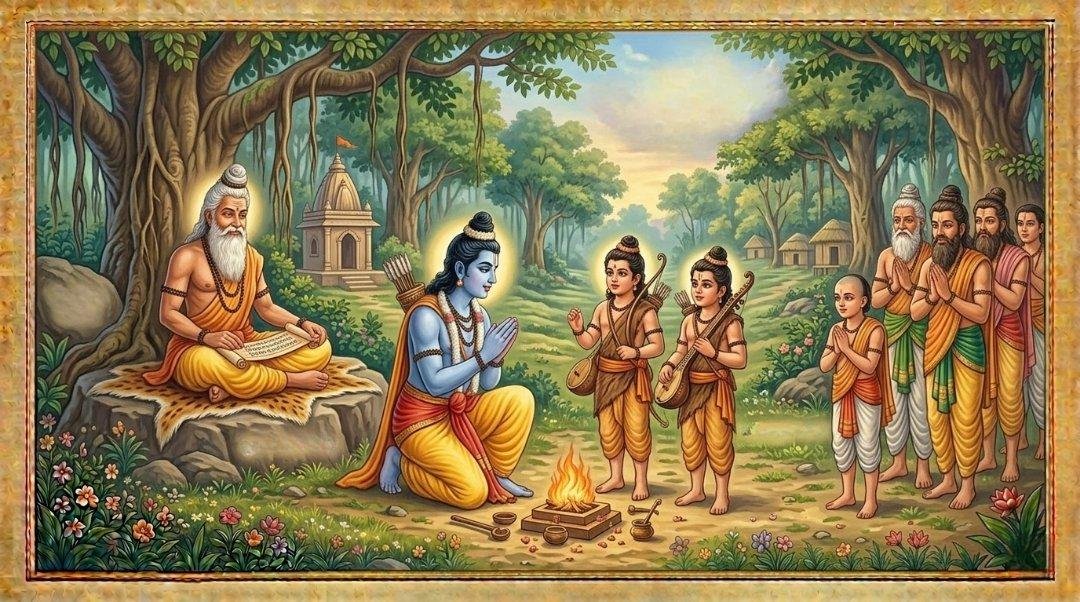
Meanwhile, Lava and Kusha were still living at Sage Valmiki’s ashram.
They had become highly skilled in reciting the Ramayana.
Valmiki had taught them the verses of the epic, and the brothers could sing the story with remarkable confidence.
As the royal horse and its accompanying warriors travelled through the region, the lives of Lava and Kusha were about to intersect with Rama’s kingdom.
The Two Young Warriors
Lava and Kusha were young, but they had been trained in archery and martial skills.
They were not afraid to stand up for what they believed was right.
Their courage and confidence surprised those who encountered them.
The events surrounding the Ashwamedha horse would soon bring them into conflict with powerful warriors connected to Rama’s kingdom.
A Remarkable Encounter
The young brothers demonstrated extraordinary skill.
They were able to face experienced warriors despite their young age.
Their courage attracted attention, and word of the two talented boys eventually reached the royal side.
But there was something nobody fully understood yet.
The two young warriors were not ordinary children.
They were Lava and Kusha, the sons of Rama and Sita.
Lava and Kusha Sing the Ramayana
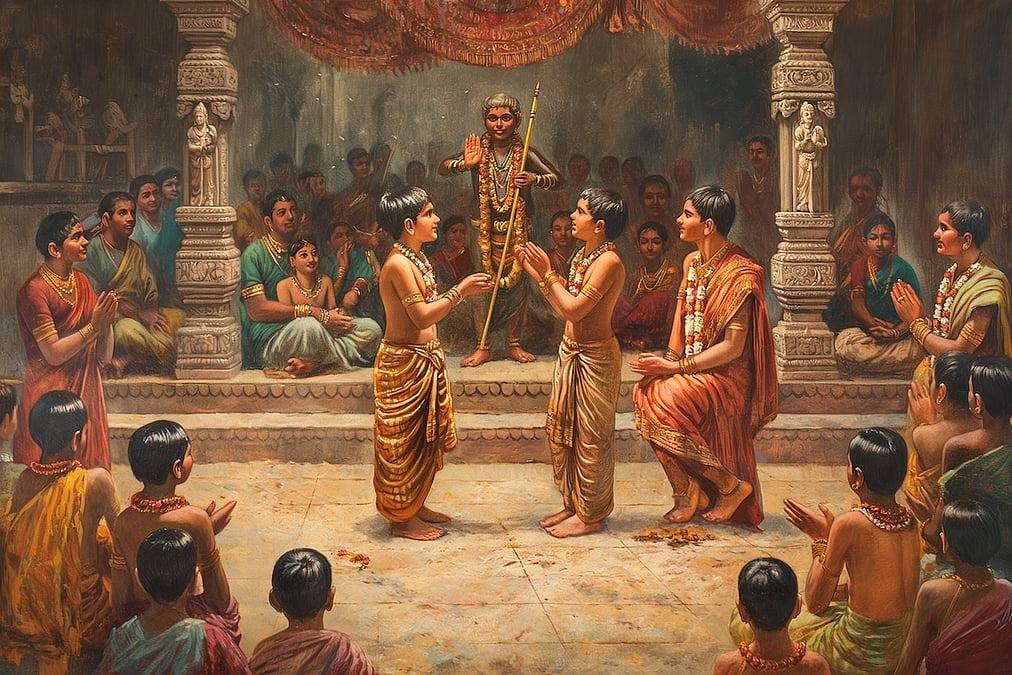
Eventually, Lava and Kusha came before Rama’s court.
Instead of immediately revealing their identity, they began singing the story of the Ramayana.
They described:
📖 Rama’s birth 👑 His life in Ayodhya 🌳 His exile 💍 His marriage to Sita 🦅 The search for Sita 🌊 The journey to Lanka ⚔️ The battle with Ravana 🏰 Rama’s return to Ayodhya
Rama listened carefully.
The story they were singing was his own life.
Rama Is Deeply Moved
As Rama listened to the boys’ recitation, he was deeply moved by the story.
The brothers sang with great confidence and emotion.
The people around Rama were also amazed by their talent.
Their performance raised an important question:
Who were these extraordinary young boys?
The Hidden Truth
The answer was one of the most emotional revelations in the later Ramayana tradition.
Lava and Kusha were the sons of Rama and Sita.
They had grown up away from the royal palace and had never lived as ordinary princes of Ayodhya.
Their connection to Rama was finally becoming clear.
A Father Meets His Sons
For Rama, the encounter carried deep emotional meaning.
He was hearing his own life story from the voices of his sons.
Lava and Kusha had inherited courage and talent from their parents, while their education under Valmiki had made them accomplished young men.
The meeting brought together two generations of the Ramayana.
The Importance of This Meeting
The meeting between Rama and Lava-Kusha is important because it connects several major parts of the Ramayana.
👑 Rama’s Kingdom
The story returns to Ayodhya and the royal court.
👩 Sita’s Life
Sita’s sons, raised away from Ayodhya, finally enter the story of their father’s kingdom.
📖 Valmiki’s Ramayana
The epic is being performed by the very children whose lives are connected to its central characters.
👨👦 Father and Sons
Rama finally encounters the sons he had been separated from.
A Story Passed From One Generation to Another
The story of Lava and Kusha also reminds us about the importance of preserving history through storytelling.
Before written books became widely available, stories were often remembered and passed from generation to generation through:
The Ramayana itself has survived through many such traditions.
Conclusion
The arrival of Lava and Kusha brings a major turning point in the later Ramayana.
Two young boys from Valmiki’s ashram enter the world of Ayodhya and amaze everyone with their courage and their beautiful recitation of the Ramayana.
Most importantly, their encounter with Rama begins to reveal the truth about their identity.
They are the sons of Rama and Sita.
But the story is not yet complete.
In the next part, we will explore Sita’s return to the story, the final meeting of Rama and Sita, and one of the most emotional moments in the entire Ramayana.
In the next article, we’ll explore the childhood of Lava and Kusha, their education under Sage Valmiki, their knowledge of the Ramayana, their remarkable skills, and how the two brothers eventually enter the story of Ayodhya and their father Rama.
The Birth of Lava and Kusha
After Sita found shelter at Sage Valmiki’s ashram, she began a new chapter of her life.
There, she gave birth to twin sons.
Their names were Lava and Kusha.
The two boys grew up in the peaceful surroundings of the ashram, far away from the royal palace of Ayodhya.
Although they were born into a royal family, their childhood was simple and closely connected with nature.
Growing Up at Valmiki’s Ashram
Lava and Kusha spent their early years surrounded by sages, forests and the peaceful atmosphere of the ashram.
Their mother Sita taught them important values, while Sage Valmiki guided their education.
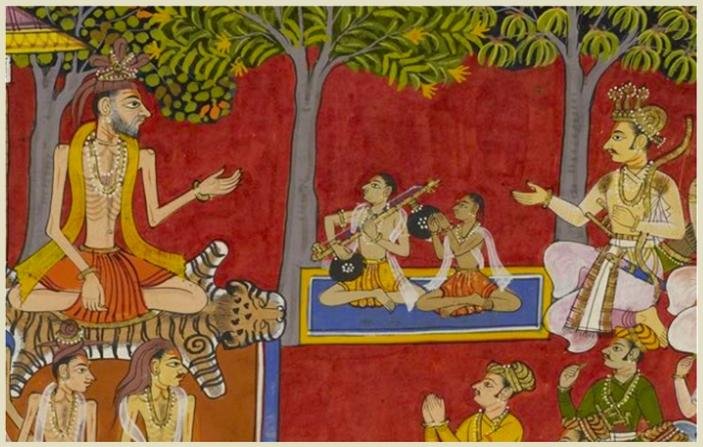
Education Under Sage Valmiki
Valmiki was not only a sage but also the great poet associated with the composition of the Ramayana.
Under his guidance, Lava and Kusha received a broad education.
They learned:
📖 Scriptures and knowledge 🏹 Archery 🎵 Music 🗣️ Recitation ⚔️ Martial skills 🧘 Discipline
They gradually became talented young men.
Learning the Ramayana
One of the most remarkable parts of their upbringing was learning the story of the Ramayana itself.
Valmiki taught the brothers how to recite the epic through poetry and music.
Lava and Kusha became excellent singers and storytellers.
They learned the story of:
Rama’s birth,
his childhood,
his marriage to Sita,
his exile,
the search for Sita,
the battle in Lanka,
and Rama’s return to Ayodhya.
But there was something they did not fully understand at first.
The hero of the story they were singing was also their own father.
Young Warriors
Lava and Kusha were not only skilled in music and storytelling.
They were also trained in martial arts and archery.
They developed courage, discipline and confidence.
Their training reflected the qualities expected of young princes.
Although they lived in an ashram rather than a palace, their abilities showed that they had inherited a remarkable heritage.
The Ramayana Reaches a New Generation
Through Lava and Kusha, the story of Rama was passed to a new generation.
They did not simply memorize the verses.
They learned to sing and perform the story with expression.
Their recitation helped bring the events of the Ramayana to life for listeners.
This is an important part of the tradition surrounding the epic.
A Story They Did Not Know Was Their Own
There is a touching irony in the story.
Lava and Kusha were singing about Rama without initially understanding the complete truth about their relationship with him.
They knew the story of a great king named Rama.
They knew about his virtues, his exile and his journey.
But they were unaware that the hero of those verses was their own father.
This would eventually lead to a remarkable meeting.
The Journey Toward Ayodhya
As the story moves forward, Lava and Kusha’s lives become connected with Rama’s kingdom.
Rama was still ruling Ayodhya.
Meanwhile, the two boys continued learning and growing under Valmiki’s guidance.
Their destiny was slowly bringing them toward the royal court.
The Importance of Lava and Kusha
The story of Lava and Kusha is important for several reasons.
📖 Preserving the Story
They become associated with the oral recitation of the Ramayana.
🏹 Courage
Their training makes them capable young warriors.
🙏 Values
Their upbringing emphasizes discipline, respect and knowledge.
👩👦 Sita’s Strength
Sita raises her sons despite living away from the royal palace.
🕉️ The Next Generation
Their story continues the Ramayana beyond Rama’s return to Ayodhya.
The Story Is About to Change
Lava and Kusha are no longer simply children living in Valmiki’s ashram.
They are now talented young men who can:
🏹 Fight with weapons 🎵 Sing beautifully 📖 Recite the Ramayana 🧠 Understand difficult teachings 💪 Face challenging situations
Their abilities will soon bring them into direct contact with Rama.
And that meeting will become one of the most memorable moments in the later Ramayana.
Conclusion
Lava and Kusha grow up under the loving care of Sita and the guidance of Sage Valmiki.
They receive an education in knowledge, discipline, music, archery and the Ramayana itself.
They become talented young warriors and remarkable storytellers.
But the greatest revelation is still waiting for them.
In the next part, we will explore the Ashwamedha ceremony, how Lava and Kusha encounter Rama’s royal procession, and how their extraordinary abilities bring them closer to their father.
In the previous parts, we followed Rama’s journey, learned about the seven Kandas and explored the extraordinary story of Hanuman.
Now we come to one of the most important figures in the entire Ramayana:
🌺 Sita
Sita’s story is filled with love, courage, sacrifice, patience and strength.
She is not simply remembered as Rama’s wife. Her journey is one of the most powerful parts of the Ramayana.
Sita
Suggested image: respectful traditional Indian artwork portraying Sita.
🌱 The Mysterious Birth of Sita
The traditional story of Sita’s birth is extraordinary.
Sita is associated with Mithila, ruled by King Janaka.
According to the famous traditional account, Janaka discovers a baby girl while preparing the land for a sacred ritual.
He accepts her as his daughter.
She is named Sita, a name associated with a furrow in the earth.
Because of this story, Sita is also traditionally connected with Bhumi Devi — Mother Earth.
👑 Sita Grows Up in Mithila
Sita grows up in the royal household of Mithila.
King Janaka raises her with great affection.
She becomes known for her beauty, intelligence, dignity and strong character.
Her childhood in Mithila prepares the way for one of the most important events in the Ramayana:
Her meeting with Rama.
Sita’s Childhood in Mithila
🏹 Sita’s Swayamvara
When Sita reaches marriageable age, King Janaka announces a great challenge.
A powerful bow associated with Lord Shiva is brought before the assembled princes.
The challenge involves lifting and handling the mighty bow.
Many princes attempt it.
But they cannot accomplish the task.
Then Rama steps forward.
❤️ Rama and Sita Meet
Rama successfully lifts the bow.
The traditional story says that the bow breaks.
Rama wins the challenge.
Sita and Rama are married.
Their marriage becomes one of the central relationships of the Ramayana.
Rama and Sita’s Marriage
🏠 Life in Ayodhya
After their marriage, Sita goes to Ayodhya with Rama.
She becomes part of the royal family.
For some time, their life appears peaceful.
But everything changes when Rama is ordered to spend fourteen years in the forest.
🌳 Sita Chooses Exile
Rama tells Sita that she should remain safely in Ayodhya.
But Sita refuses to stay behind.
She decides to accompany her husband.
Her decision demonstrates one of the most important characteristics traditionally associated with her:
Determination.
She chooses to share Rama’s difficult life rather than remain in the comfort of the palace.
Lakshmana also accompanies them.
The three leave Ayodhya together.
Sita Goes Into Exile
🌲 Sita’s Life in the Forest
Life in the forest is completely different from royal life.
There are no palaces or royal comforts.
Sita lives among trees, rivers and hermitages.
She shares Rama’s experiences and faces the difficulties of forest life.
But the peaceful period does not last forever.
🦌 The Golden Deer
One day, Sita sees a beautiful golden deer.
She asks Rama to capture it.
The deer is associated with Maricha, who is working with Ravana.
Rama follows it into the forest.
Later, a deceptive cry makes Sita believe Rama is in danger.
Lakshmana eventually leaves to look for Rama.
Sita is left alone.
👑 Ravana Arrives
Ravana arrives disguised as a wandering ascetic.
He speaks to Sita.
Eventually, he reveals his true identity and abducts her.
Sita is taken away from the forest.
This becomes the central crisis of the Ramayana.
Ravana Abducts Sita
🐦 Jatayu Tries to Save Sita
During the abduction, the great bird Jatayu sees what is happening.
He tries to stop Ravana.
Jatayu fights bravely.
But Ravana defeats him.
Later, Rama discovers the wounded Jatayu.
Before dying, Jatayu tells Rama what happened to Sita.
His sacrifice helps Rama understand where she has been taken.
🌴 Sita in Lanka
Ravana takes Sita to Lanka.
But Sita refuses to accept him.
She remains committed to Rama.
Ravana tries to persuade and pressure her, but she does not change her decision.
She is kept in the Ashoka grove.
There she waits for Rama.
Sita in the Ashoka Grove
🐒 Hanuman Finds Sita
Rama sends Hanuman to search for Sita.
After crossing the ocean, Hanuman enters Lanka.
He eventually finds Sita in the Ashoka grove.
Hanuman approaches her carefully.
He tells her that he has come as Rama’s messenger.
To prove his identity, he gives her Rama’s ring.
💍 Sita Gives Hanuman a Message
Sita is relieved to learn that Rama knows where she is.
She gives Hanuman a jewel to take back to Rama.
This becomes proof that Hanuman has successfully found her.
Hanuman returns to Rama with the news:
Sita has been found.
Hanuman Meets Sita
🌊 Rama’s Journey to Lanka
After learning where Sita is, Rama prepares for the journey to Lanka.
The Vanara army helps him.
A bridge is constructed across the ocean in the traditional narrative.
Rama’s forces reach Lanka.
The great war begins.
⚔️ Sita Waits for Rama
While the battle is taking place, Sita remains in Lanka.
She does not know exactly what is happening on the battlefield.
But she continues to hope that Rama will rescue her.
Eventually, Ravana is defeated.
Rama reaches Sita.
Rama and Sita After the War
🔥 The Agni Pariksha Tradition
The Ramayana tradition contains a difficult and widely discussed episode involving Agni, the fire deity.
In the traditional narrative, Sita undergoes a fire ordeal to demonstrate her purity.
She emerges unharmed.
This episode has been interpreted in different ways by different commentators and traditions.
For a blog article, it is important to present the episode respectfully and recognise that interpretations vary.
🏠 Sita Returns to Ayodhya
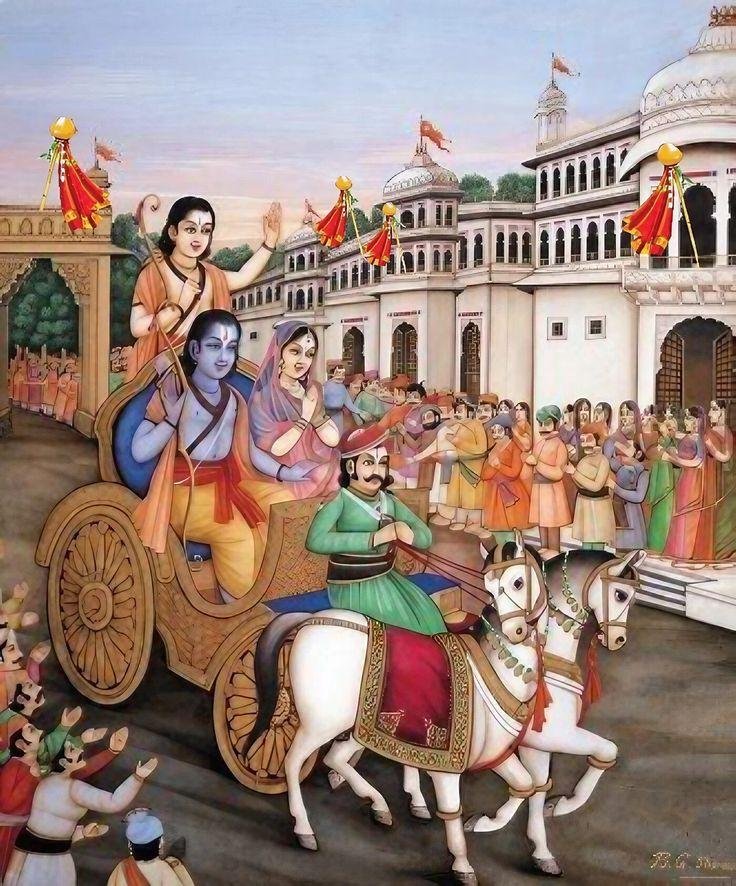
Rama, Sita and their companions return to Ayodhya.
Rama is crowned king.
The return is celebrated with great joy.
Sita becomes queen of Ayodhya.
But the story of Sita is not yet finished.
👑 Life as Queen
Rama begins his reign.
The kingdom prospers according to the traditional ideal of Rama Rajya.
However, rumours and questions about Sita’s time in Lanka eventually create a serious problem.
Rama faces a painful conflict between his personal feelings and his understanding of his responsibilities as king.
🌳 Sita Goes to Valmiki’s Ashram
In the later traditional narrative, Sita leaves Ayodhya and goes to the hermitage of Sage Valmiki.
There she gives birth to twin sons:
👦 Lava
👦 Kusha
They grow up under Valmiki’s guidance.
Sita raises them away from the royal palace.
Sita With Lava and Kusha
📖 Lava and Kusha Learn the Ramayana
Valmiki teaches Lava and Kusha the story of Rama.
They learn to recite the epic.
The boys eventually come to Rama’s attention during the Ashwamedha episode.
Rama discovers that they are his sons.
This creates an emotional reunion between father and children.
🌺 Sita’s Final Appearance
The later story reaches one of its most emotional moments.
Sita is called upon to establish her truth once again.
She appeals to Mother Earth.
According to the traditional account, the Earth opens and receives Sita.
She returns to the earth from which she is traditionally believed to have originated.
Sita’s Final Departure
🌍 Why Is Sita Important?
Sita’s story has remained powerful for generations because she experiences extraordinary circumstances while continuing to make important choices.
Her journey includes:
Mithila
➡️ Marriage
➡️ Ayodhya
➡️ Forest exile
➡️ Abduction
➡️ Lanka
➡️ Return
➡️ Life with Lava and Kusha
➡️ Final return to Mother Earth
💪 Sita as a Symbol of Strength
Sita’s strength is not always shown through physical power.
Her strength appears through:
❤️ Patience
She survives difficult circumstances.
🧠 Determination
She refuses to surrender her decisions to Ravana.
🌺 Dignity
She maintains her self-respect even in extremely difficult conditions.
👩👦 Motherhood
She raises Lava and Kusha in the forest.
🕉️ Faith
Her spiritual and moral convictions remain central to her story.
🌟 Sita’s Legacy
Sita has influenced Indian literature, art, dance, theatre and religious traditions for centuries.
Her story has also been interpreted differently by different writers and communities.
Some traditions emphasise her devotion.
Others focus on her courage.
Some highlight her suffering.
Others see her as a symbol of independence, dignity and inner strength.
This variety makes Sita one of the most discussed characters in the Ramayana tradition.
🕉️ Conclusion
Sita’s story begins in Mithila and travels through some of the most important events of the Ramayana.
She becomes Rama’s wife, chooses exile, faces Ravana in Lanka, reunites with Rama and becomes the mother of Lava and Kusha.
Her final return to Mother Earth gives her story a deeply emotional ending.
But Sita’s legacy does not end there.
🌺 Her story continues to be remembered, discussed and retold across generations.
Sita’s greatest strength was the strength of her character.
🌟 NEXT PART
Part 22: Rama vs Ravana | Why Did the Great War of Lanka Happen?
In the next article, we’ll explore the complete story of the Lanka war — how Rama’s army reached Lanka, the major warriors on both sides, Kumbhakarna, Indrajit, Vibhishana, Hanuman’s role and the final battle between Rama and Ravana
In Part 18, we explored the traditional story of Sage Valmiki and how the Ramayana came to be associated with him.
Now let us look at the complete structure of the epic.
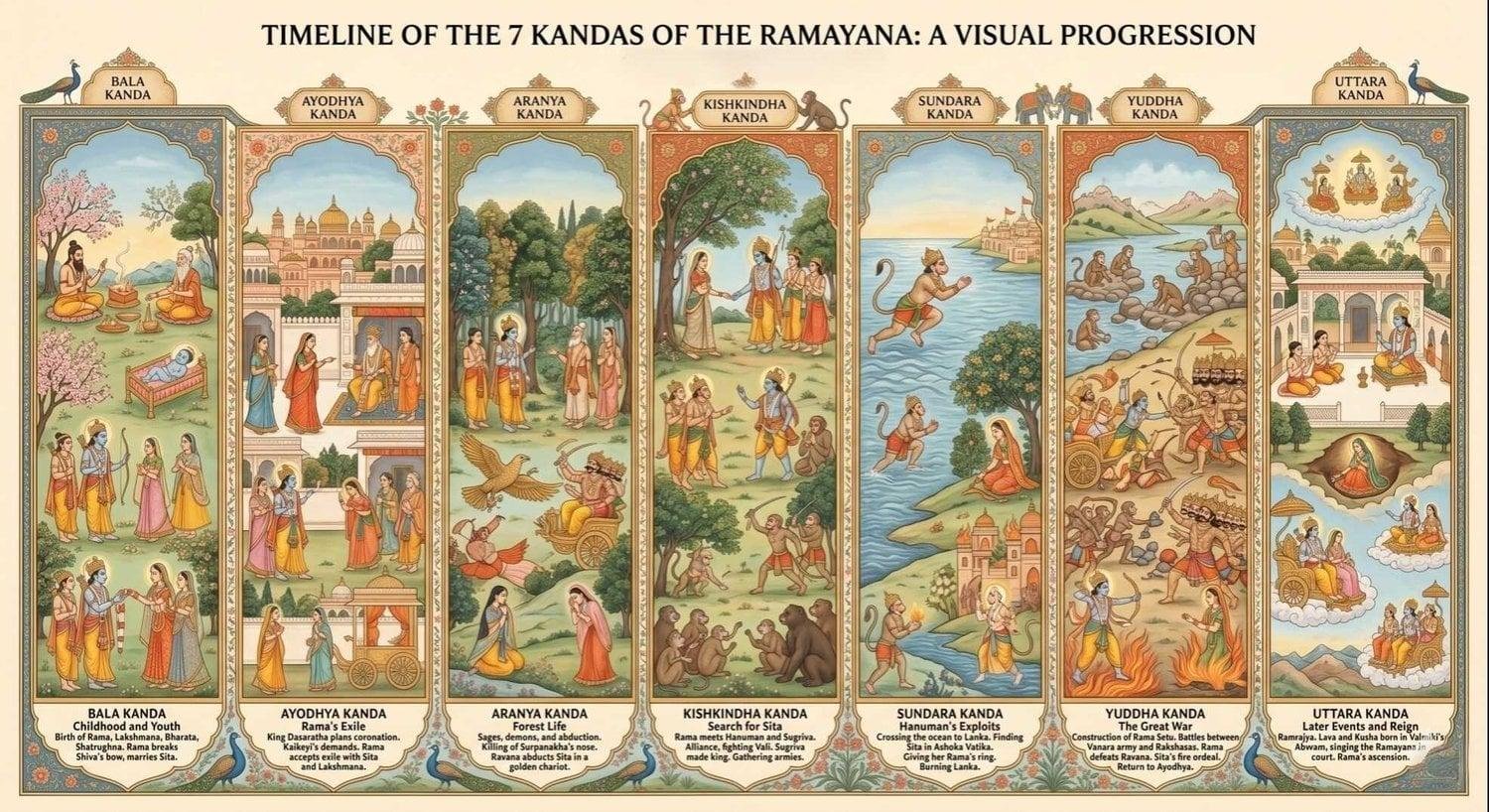
The Ramayana is traditionally divided into seven major sections, known as Kandas.
Each Kanda covers an important stage in Rama’s life — from his childhood to his final years.
📖 The Seven Kandas of the Ramayana
The traditional seven Kandas are:
Bala Kanda – Rama’s childhood and early life
Ayodhya Kanda – The exile from Ayodhya
Aranya Kanda – Life in the forest
Kishkindha Kanda – Rama meets Hanuman and Sugriva
Sundara Kanda – Hanuman’s journey to Lanka
Yuddha Kanda – The great war with Ravana
Uttara Kanda – Events after Rama’s return
Let’s explore each one.
The Seven Kandas of the Ramayana
1️⃣ Bala Kanda – The Beginning of Rama’s Story
Bala Kanda introduces us to Rama and his family.
King Dasharatha rules Ayodhya.
Although he is a powerful king, he does not have children.
He eventually performs a sacred ritual, after which his four sons are born:
👑 Rama
👑 Bharata
👑 Lakshmana
👑 Shatrughna
Rama is the eldest.
From childhood, he is shown as disciplined, courageous and responsible.
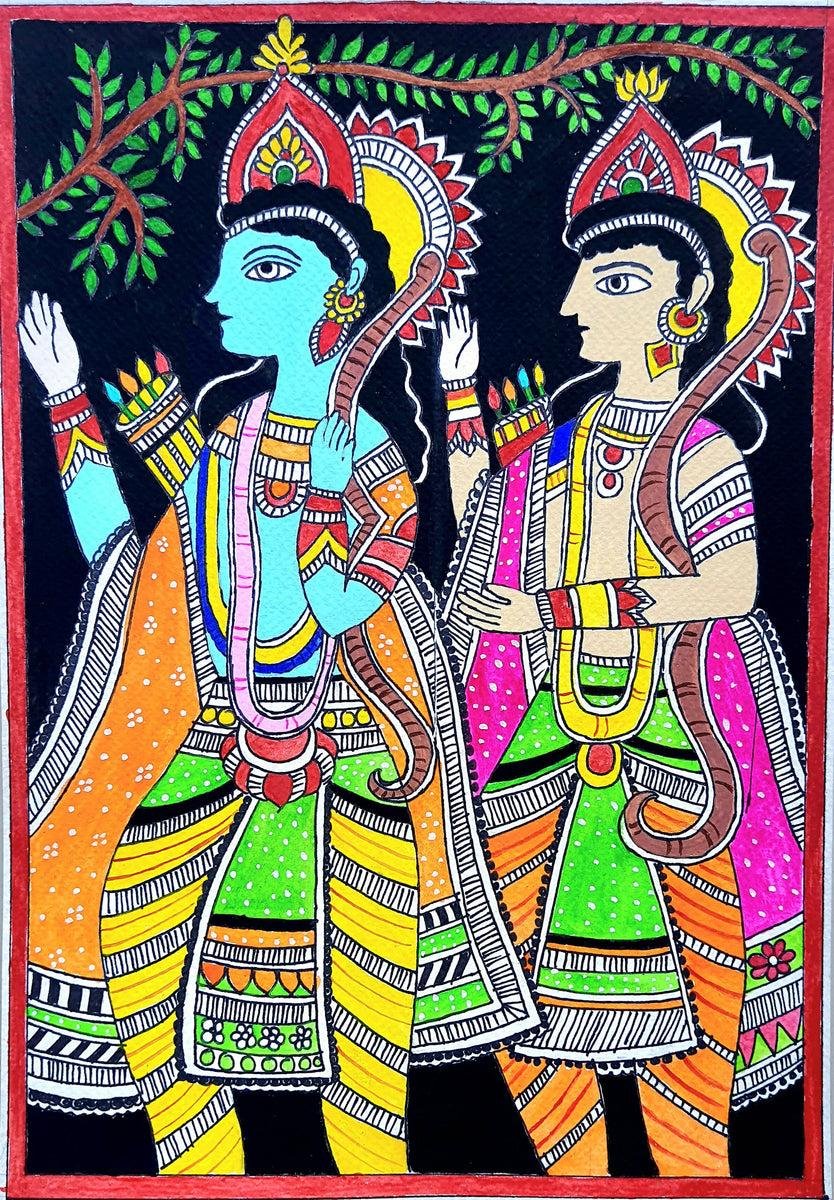
🏹 Rama Meets Sage Vishwamitra
One of the important events of Bala Kanda occurs when Sage Vishwamitra comes to Dasharatha.
He asks Rama and Lakshmana to accompany him.
The young princes protect the sage’s ritual from powerful enemies.
This becomes an important stage in Rama’s development as a warrior.
💍 Rama and Sita Meet
Rama later travels to Mithila, where King Janaka has arranged a ceremony connected with the marriage of his daughter Sita.
The famous Shiva’s bow plays a major role.
Rama is able to lift and break the bow.
Rama and Sita are then married.
Their marriage becomes one of the central relationships of the entire epic.
Rama and Sita’s Marriage
2️⃣ Ayodhya Kanda – The Great Sacrifice
The second Kanda is one of the most emotional sections.
Dasharatha decides to make Rama the crown prince.
The people of Ayodhya are delighted.
But the situation suddenly changes.
👑 Kaikeyi’s Two Boons
Queen Kaikeyi, influenced by her attendant Manthara, asks Dasharatha to fulfil two promises he had previously granted her.
She asks for:
1. Bharata to become king
2. Rama to be sent into exile for fourteen years
Dasharatha is devastated.
But Rama accepts the decision.
🌳 Rama Goes Into Exile
Rama leaves Ayodhya.
Sita chooses to accompany him.
Lakshmana also refuses to remain behind.
The three begin their forest journey together.
Dasharatha is heartbroken.
The people of Ayodhya follow Rama for some distance, unable to accept his departure.
Rama, Sita and Lakshmana Leave Ayodhya
❤️ Bharata’s Love for Rama
Bharata is away when these events occur.
When he returns and learns what happened, he is deeply upset.
He refuses to take Rama’s place as rightful king.
Instead, he goes to the forest and asks Rama to return.
Rama refuses because he has given his word to complete the exile.
Bharata then takes Rama’s padukas and places them on the throne.
He rules as Rama’s representative.
This is one of the strongest examples of brotherly loyalty in the epic.
3️⃣ Aranya Kanda – Life in the Forest
The third Kanda follows Rama, Sita and Lakshmana during their forest life.
They visit different hermitages.
They meet sages and experience many challenges.
The peaceful forest life eventually changes dramatically.
👹 Surpanakha and the Turning Point
Rama encounters Surpanakha, who becomes interested in him.
The episode leads to conflict involving Lakshmana and Surpanakha.
The events eventually bring Rama into conflict with powerful forces connected with Lanka.
Among them is Ravana.
🦌 The Golden Deer
One of the most famous episodes occurs when Sita sees a beautiful golden deer.
The deer is actually associated with the demon Maricha.
Sita asks Rama to capture it.
Rama follows the deer.
Later, Maricha imitates Rama’s voice.
Sita becomes worried and asks Lakshmana to go after Rama.
Lakshmana eventually leaves.
The Golden Deer
👑 Ravana Abducts Sita
Ravana arrives disguised as a mendicant.
He takes advantage of the situation and abducts Sita.
He carries her to Lanka.
The search for Sita begins.
This event becomes the central turning point of the Ramayana.
🐦 Jatayu Tries to Help
The great bird Jatayu sees Ravana carrying Sita away.
He attempts to stop him.
Jatayu fights bravely but is badly wounded.
Rama later finds him.
Before dying, Jatayu tells Rama what happened.
His sacrifice becomes an important symbol of courage and loyalty.
4️⃣ Kishkindha Kanda – Rama Meets Hanuman
The fourth Kanda takes us to Kishkindha.
Rama and Lakshmana meet Hanuman.
This meeting changes the entire course of the story.
Hanuman brings Rama to Sugriva.
Rama Meets Hanuman
🐒 Rama and Sugriva Become Allies
Sugriva has his own problem.
He has lost his kingdom to his brother Vali.
Rama agrees to help Sugriva regain his position.
In return, Sugriva promises to help Rama find Sita.
Their alliance becomes extremely important.
🌏 The Search for Sita
After Sugriva becomes ruler again, Vanara groups are sent in different directions to search for Sita.
One group eventually reaches the southern coast.
They learn that Sita is in Lanka.
But there is a huge obstacle:
🌊 The Ocean
Someone must cross it.
That person is Hanuman.
5️⃣ Sundara Kanda – Hanuman’s Greatest Journey
Sundara Kanda is one of the most beloved sections of the Ramayana.
It focuses mainly on Hanuman’s journey to Lanka.
Hanuman grows in confidence and prepares to cross the ocean.
Hanuman Crosses the Ocean
🏝️ Hanuman Reaches Lanka
Hanuman enters Lanka and searches for Sita.
Eventually, he finds her in the Ashoka grove.
Sita is surrounded by guards and refuses Ravana’s demands.
Hanuman approaches her carefully.
He gives her Rama’s message and shows her Rama’s ring.
Sita is relieved to know that Rama is coming.
🔥 Hanuman’s Lanka Mission
Hanuman then causes major disruption in Lanka.
He is captured by Ravana’s forces.
His tail is set on fire.
Hanuman uses the fire to set parts of Lanka ablaze.
He then escapes and returns toward Rama.
💍 Sita Gives Hanuman a Message
Before Hanuman leaves, Sita gives him a jewel as a token for Rama.
Hanuman returns with proof that he has found her.
The search has succeeded.
Now Rama knows exactly where Sita is.
6️⃣ Yuddha Kanda – The Great War
The sixth Kanda brings the story to its greatest military confrontation.
Rama’s army reaches the ocean.
A bridge is constructed toward Lanka.
The Vanara army crosses into Lanka.
Rama’s Army Reaches Lanka
⚔️ The Battle Begins
The war between Rama’s forces and Ravana’s army begins.
Many powerful warriors fight.
Among the major figures are:
Hanuman
Sugriva
Angada
Lakshmana
Vibhishana
Kumbhakarna
Indrajit
Ravana
The battle becomes increasingly intense.
💥 Kumbhakarna Falls
Ravana’s giant brother Kumbhakarna enters the battlefield.
He fights fiercely.
But Rama eventually defeats him.
Ravana suffers another major loss.
⚡ Indrajit Is Defeated
Ravana’s son Indrajit is among his most powerful warriors.
Lakshmana eventually confronts him.
After a difficult battle, Indrajit is defeated.
Ravana loses another important member of his family.
🏹 Rama vs Ravana
Finally, Rama and Ravana face each other.
Their final battle becomes the climax of the war.
Rama ultimately defeats Ravana.
The war ends.
Sita is rescued.
Rama Defeats Ravana
7️⃣ Uttara Kanda – The Later Story
The seventh and final Kanda is traditionally known as Uttara Kanda.
It deals with events associated with Rama’s life after the Lanka war and his return to Ayodhya.
This section includes important episodes involving:
Rama’s rule
Sita’s later life
Lava and Kusha
Valmiki
The Ashwamedha
Sita’s final departure
The later years of Rama
👦 Lava and Kusha
Sita lives at Valmiki’s hermitage.
Her sons Lava and Kusha grow up there.
Valmiki teaches them the Ramayana.
They eventually meet Rama.
Their story forms one of the most emotional parts of the later epic.
Lava and Kusha
🌍 Seven Kandas — One Great Journey
If we look at the entire Ramayana, the seven Kandas form one continuous journey.
Kanda
Main Theme
Bala Kanda
Rama’s childhood, Vishwamitra and Sita’s marriage
Ayodhya Kanda
Exile and Bharata’s devotion
Aranya Kanda
Forest life and Sita’s abduction
Kishkindha Kanda
Hanuman, Sugriva and the search for Sita
Sundara Kanda
Hanuman’s journey to Lanka
Yuddha Kanda
Lanka war and Ravana’s defeat
Uttara Kanda
Later life of Rama, Sita, Lava and Kusha
❤️ What Makes Each Kanda Special?
🌱 Bala Kanda
The beginning of Rama’s journey
🏠 Ayodhya Kanda
Duty and sacrifice
🌳 Aranya Kanda
Separation and struggle
🐒 Kishkindha Kanda
Friendship and alliance
🌊 Sundara Kanda
Devotion and courage
⚔️ Yuddha Kanda
The great conflict
🌺 Uttara Kanda
Family, responsibility and the later years
Together, these sections create a story that has remained culturally powerful for generations.
🕉️ Important Note About Different Ramayana Traditions
One thing every reader should remember is that not every Ramayana tradition tells every episode in exactly the same way.
The Valmiki Ramayana is the classical Sanskrit tradition most closely associated with the original epic.
Later poets and communities created many retellings.
Therefore, some popular stories may have:
Different details
Different interpretations
Different character portrayals
Different endings or additional episodes
This variety is one of the remarkable features of the Ramayana tradition.
🌟 Why the Seven Kandas Matter Today
The seven Kandas are more than chapters in an old epic.
They show the transformation of Rama from:
A young prince
➡️ A husband
➡️ An exile
➡️ A warrior
➡️ A leader
➡️ A king
➡️ A figure remembered through generations
And alongside Rama’s journey are the stories of Sita, Lakshmana, Bharata, Hanuman, Sugriva, Vibhishana, Ravana, Valmiki and many others.
🕉️ Conclusion
The Ramayana is traditionally divided into seven Kandas, each representing an important stage of the story.
From the birth of Rama in Bala Kanda to the later events of Uttara Kanda, the epic takes readers through love, exile, friendship, courage, war, sacrifice and responsibility.
That is why the Ramayana has remained one of India’s most influential epics.
📖 Seven Kandas.
👑 One extraordinary journey.
🕉️ A story remembered across generations.
🌟 NEXT PART
Part 20: Hanuman – The Complete Story | Birth, Powers, Rama Bhakti and His Greatest Adventures
In the next article, we will leave the main timeline for a moment and explore one of the most beloved characters of the Ramayana:
🐒 Lord Hanuman
His birth, childhood, powers, meeting with Rama, journey to Lanka, Sanjeevani episode and why millions of people continue to worship and admire him