In Part 15, Rama defeated Ravana after the great war of Lanka.
Sita was rescued, Vibhishana became the ruler of Lanka, and Rama began his journey back to Ayodhya.
After many years of exile, the moment everyone had been waiting for finally arrived:
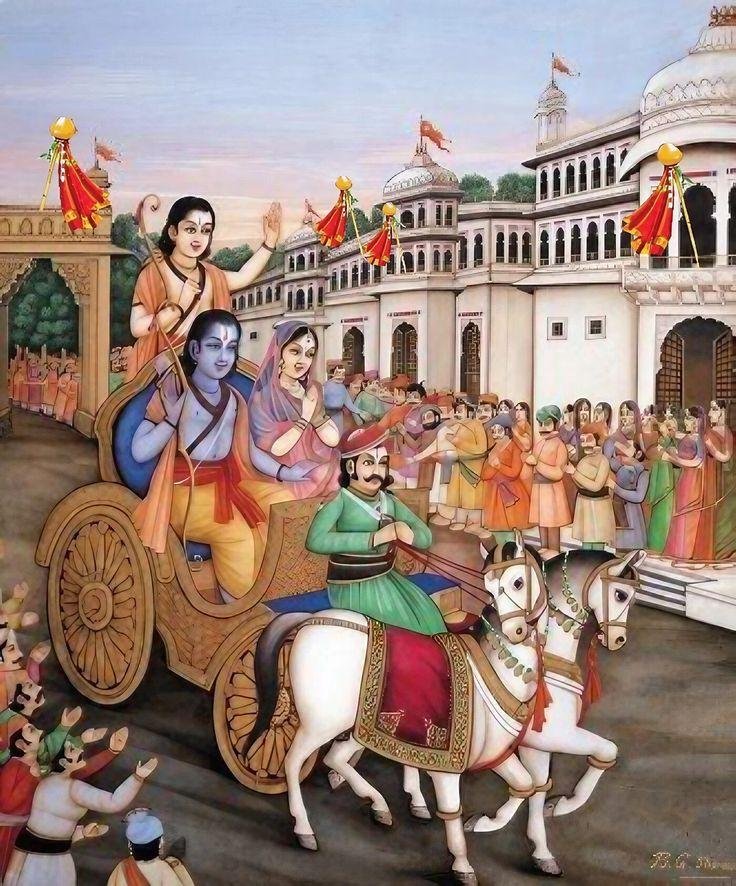
👑 Rama Returns to Ayodhya


Rama Returns to Ayodhya
Suggested image: traditional Indian artwork showing Rama, Sita and Lakshmana returning to Ayodhya.
🏠 Bharata Waits for Rama
During Rama’s long absence, Bharata remained committed to his elder brother.
He had never considered the kingdom truly his.
In the traditional story, Bharata placed Rama’s padukas (sandals) on the throne and ruled as Rama’s representative.
He waited for the day when Rama would return.
That day had finally arrived.
🛕 The People of Ayodhya Celebrate
When the people learn that Rama is returning, Ayodhya fills with happiness.
The city is decorated.
People prepare to welcome their beloved prince.
After years of uncertainty and separation, the kingdom is ready to receive Rama.


Ayodhya Welcomes Rama
🪔 Why Is Rama’s Return Associated With Diwali?
A popular Hindu tradition connects Rama’s return to Ayodhya with the celebration of Diwali.
According to this tradition, the people of Ayodhya welcomed Rama, Sita and Lakshmana by lighting rows of lamps.
The lamps symbolised the victory of light over darkness.
Today, the connection between Rama’s return and Diwali is one of the most widely known cultural traditions associated with the Ramayana.
❤️ The Meeting of Rama and Bharata
Rama and Bharata finally meet.
Their reunion is emotional.
Bharata is relieved that Rama has returned safely.
The brothers embrace after years of separation.
Lakshmana and Shatrughna are also reunited with their brothers.
The royal family is together again.


Rama and Bharata Reunite
👑 Rama’s Coronation
The time comes for Rama to take his rightful position as king.
The coronation is traditionally known as:
Rama Pattabhishekam
Rama is crowned king of Ayodhya.
Sita becomes queen.
The kingdom celebrates the beginning of a new era.
🌺 A Grand Celebration
The traditional accounts describe a magnificent coronation.
Important sages, family members, allies and citizens participate.
Those who helped Rama during his difficult journey are honoured.
Hanuman holds a special place among Rama’s closest devotees.
Sugriva, Vibhishana and the Vanara leaders are also remembered for their support.


Rama Pattabhishekam
🐒 Hanuman’s Devotion to Rama
Hanuman’s role in Rama’s story is extraordinary.
He crossed the ocean.
He found Sita.
He delivered Rama’s message.
He fought in Lanka.
He helped Rama’s army.
And he remained devoted to Rama throughout the entire journey.
The Ramayana tradition often presents Hanuman as the ideal example of selfless devotion and service.
🌟 Rama Rajya Begins
After his coronation, Rama begins ruling Ayodhya.
The traditional concept of his reign is known as:
Rama Rajya
The phrase has come to represent an ideal form of governance.
It is traditionally associated with:
- Justice
- Peace
- Good administration
- Responsibility
- Prosperity
- Welfare of the people
- Respect for dharma


Rama’s Kingdom
⚖️ Rama as a King
Rama’s role now changes.
During the exile, he was a prince travelling through forests.
During the Lanka conflict, he was a warrior.
Now he is a king responsible for an entire kingdom.
The traditional ideal of Rama’s rule focuses heavily on the responsibilities of a ruler.
A king must listen to the people and protect the kingdom.
🕉️ The Meaning of Dharma
One of the central ideas throughout the Ramayana is Dharma.
Dharma can be understood in different ways depending on context, including:
Duty
Moral responsibility
Righteous conduct
The proper order of life
Rama’s story repeatedly places him in situations where duty conflicts with personal happiness.
This is one reason the Ramayana has remained important for generations.
👨👩👦 The Story Continues
At this point, many readers may think:
“The Ramayana has ended.”
But the traditional epic contains another major section.
The Uttara Kanda tells events that occur after Rama’s return to Ayodhya.
Among the important characters introduced in the later story are:
👦 Lava
👦 Kusha
They are traditionally described as the sons of Rama and Sita.
Lava and Kusha
🌳 Sita’s Later Journey
The later part of the Ramayana becomes much more emotional.
Sita’s life takes another difficult turn.
The traditional narrative describes concerns arising in Ayodhya about Sita’s time in Lanka.
Rama faces an extremely painful conflict between his personal relationship with Sita and his perceived responsibilities as king.
This leads to Sita leaving Ayodhya.
She eventually lives in the hermitage of Sage Valmiki.
👦 Lava and Kusha Grow Up
At Valmiki’s hermitage, Sita raises her sons.
Lava and Kusha grow up learning important knowledge and skills.
According to the traditional story, they also learn the story of Rama from Valmiki.
This creates a remarkable connection:
The children eventually become singers of their father’s story.


Valmiki and Lava-Kusha
📜 Valmiki and the Ramayana
According to the traditional account, Sage Valmiki composed the Ramayana.
Lava and Kusha are traditionally said to have learned and recited the epic.
Their singing eventually brings them into contact with Rama’s court.
Rama hears the story of his own life being recited.
This creates one of the most fascinating moments in the later Ramayana.
🐎 The Ashwamedha
The later narrative also includes the Ashwamedha Yajna, an ancient royal ritual.
A specially prepared horse is allowed to travel through different territories.
Those who challenge the horse effectively challenge the authority of the king.
The story connects this ritual with the later meeting between Rama and his sons.


The Ashwamedha Episode
👦 Lava and Kusha Meet Rama
The later story reaches an emotional moment when Lava and Kusha encounter Rama.
Rama eventually learns that the two young boys are his sons.
Their identity connects the past with the future.
The children who grew up away from the royal palace are now standing before the king of Ayodhya.
🌺 Sita’s Final Departure
The later Ramayana reaches another deeply emotional moment involving Sita.
Sita is asked to establish her innocence once again.
She appeals to Mother Earth, traditionally called Bhumi Devi, to receive her if she has remained true.
The Earth is then described as opening and taking Sita back.
This is traditionally understood as Sita’s final departure from the earthly world.


Sita’s Final Departure
🕉️ The Meaning of Sita’s Story
Sita’s character has inspired countless generations.
Her story is associated with:
- Courage
- Patience
- Determination
- Loyalty
- Self-respect
- Strength during difficult circumstances
At the same time, her story has been interpreted differently by different communities, poets and scholars.
That is one reason the Ramayana continues to generate discussion even today.
🌟 Why the Ramayana Remains Important
The Ramayana is not simply one story.
It has influenced:
📚 Literature
🎭 Theatre
🎨 Art
🎵 Music
🕺 Dance
🛕 Festivals
🎬 Cinema
🗣️ Oral traditions
Different regions of India and many countries across Asia have their own Ramayana traditions and performances.


Ramayana in Indian Culture
🌏 The Ramayana Beyond India
The Ramayana also became part of the cultural traditions of several Southeast Asian countries.
Versions and adaptations have appeared in places such as:
- Thailand
- Indonesia
- Cambodia
- Laos
- Malaysia
Each tradition has developed its own artistic and cultural interpretation.
This shows how far the story travelled beyond its original cultural setting.
❤️ The Greatest Message
Perhaps the biggest reason the Ramayana has survived for thousands of years is that its characters face problems that people can still understand.
Rama faces responsibility.
Sita faces hardship.
Lakshmana shows loyalty.
Bharata shows sacrifice.
Hanuman shows devotion.
Ravana demonstrates the danger of pride.
Vibhishana chooses what he believes is right.
These characters make the epic more than a simple battle between good and evil.
🕉️ Conclusion
Rama returns to Ayodhya.
Bharata welcomes him.
The people celebrate.
Rama is crowned king.
The ideal of Rama Rajya begins.
But the later story also introduces new challenges.
Sita’s life takes another difficult turn.
Lava and Kusha are born and raised in Valmiki’s hermitage.
They eventually meet Rama.
Sita makes her final departure.
The Ramayana therefore does not end simply with Ravana’s defeat.
It continues as a story about:
Duty, family, sacrifice, leadership, devotion and the difficult choices of life.
And that is why the Ramayana remains one of the world’s most influential epics.
Leave a Reply