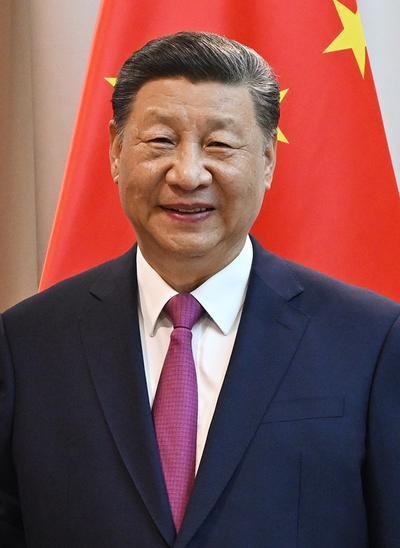


Xi Jinping is one of the most powerful political leaders in the world and the central figure in China’s modern political system. He has served as President of China, General Secretary of the Communist Party of China and Chairman of the Central Military Commission.
For India, Xi Jinping is particularly important because China is both a major economic partner and a strategic competitor. The relationship includes trade, diplomacy and cooperation, but also serious disagreements over the India–China border.
👤 Xi Jinping — Quick Facts
| Detail | Information |
|---|---|
| Name | Xi Jinping |
| Born | June 1953 |
| Birthplace | Beijing, China |
| Country | China 🇨🇳 |
| Position | President of China |
| Political Party | Communist Party of China |
| Became CPC General Secretary | 2012 |
| Became President | 2013 |
| Education | Tsinghua University |
Xi was born in June 1953 and later studied at Tsinghua University. China’s official biography says he joined the Communist Party in 1974 and held a series of political positions before rising to the national leadership.
🌱 Xi Jinping’s Early Life
Xi Jinping was born into a politically prominent Chinese family.
During his youth, he spent years in rural Shaanxi after being sent there during China’s Cultural Revolution period.
This experience became an important part of his later political biography.
He eventually returned to formal education and studied at Tsinghua University, one of China’s leading universities.
🏛️ The Rise of Xi Jinping
Xi worked through China’s political system for decades.
He held important positions in:
- Fujian
- Zhejiang
- Shanghai
- Central government
His rise was gradual.
In 2007, he became Communist Party chief of Shanghai.
In 2008, he became China’s Vice President.
Then came the major turning point.
2012 — Xi Jinping became General Secretary of the Communist Party of China.
2013 — He became President of China.
🇨🇳 Xi Jinping’s China
Under Xi, China has placed strong emphasis on:
🏭 Manufacturing
💻 Technology
🚀 Space exploration
🛡️ Military modernisation
🌏 Global influence
🌱 Green energy
🏗️ Infrastructure
💰 International trade
Xi’s government has also promoted the idea of China’s national rejuvenation and a stronger role for China in world affairs.
🇮🇳 Now Comes the Important Part — India & Xi Jinping
India and China are two of the world’s largest countries by population and two major Asian powers.
Their relationship is complicated.
It includes:
🤝 Diplomacy
💰 Trade
🌏 BRICS
🌏 Shanghai Cooperation Organisation
🏔️ Border negotiations
🛡️ Security concerns
🌐 Global politics
So the relationship cannot simply be described as friendship or rivalry.
It is both cooperation and competition.
🤝 Narendra Modi and Xi Jinping
Prime Minister Narendra Modi and Xi Jinping have met several times.
One of their most memorable meetings took place in 2019 at Mamallapuram (Mahabalipuram), Tamil Nadu.
The informal summit included cultural visits and extensive discussions between the two leaders.


The meeting demonstrated that India and China could maintain high-level dialogue even while facing difficult strategic issues.
🏔️ The India–China Border
The biggest challenge in India–China relations is the border dispute.
The two countries share a long and disputed frontier.
The eastern and western sectors of the border have been the subject of negotiations for decades.
One of the most sensitive areas is Ladakh.
The situation became particularly serious after tensions increased in 2020.
⚠️ Galwan Valley — 2020
In June 2020, Indian and Chinese troops clashed in the Galwan Valley in eastern Ladakh.
Indian soldiers were killed, and Chinese casualties were also reported.
The incident became one of the most serious military confrontations between India and China in decades.
It significantly damaged bilateral relations.
After the clash:
- Military forces were reinforced
- Diplomatic talks increased
- Border negotiations continued
- Economic relations came under greater scrutiny
🪖 Why Is the Border So Important?
The Himalayan frontier is extremely difficult terrain.
It includes:
🏔️ High mountains
❄️ Extreme weather
🏜️ High-altitude deserts
🛣️ Strategic roads
🏕️ Military posts
Both India and China have invested heavily in infrastructure near the frontier.
For India, border security is a major national-security issue.
For China, the region is also strategically important.
💰 India and China Trade
Despite political tensions, India and China have substantial economic ties.
China is an important source of:
- Electronics
- Machinery
- Chemicals
- Pharmaceutical inputs
- Industrial equipment
- Solar equipment
- Consumer products
Indian companies also sell products and services to the Chinese market.
This creates an interesting situation:
🛡️ Strategic competition
but also
💰 Significant economic interdependence.
📱 Why China Matters to Indian Consumers
Many products used by Indians are connected to Chinese manufacturing and supply chains.
China has become a major global manufacturing centre for:
📱 Smartphones
💻 Electronics
🔋 Batteries
☀️ Solar equipment
🏭 Industrial machinery
This makes completely separating the two economies difficult.
🌏 BRICS — India and China Together
India and China are both members of BRICS.
BRICS provides a platform where major emerging economies discuss:
- Economic cooperation
- Development
- Global finance
- International institutions
- Trade
- Geopolitical issues
Even when India and China disagree bilaterally, they can still cooperate in multilateral organisations.
🌏 Shanghai Cooperation Organisation
India and China are also members of the Shanghai Cooperation Organisation (SCO).
The organisation focuses on regional cooperation, security and economic relationships.
This provides another diplomatic channel between New Delhi and Beijing.
🌍 India, China and Russia
There is another interesting connection.
India, China and Russia interact through several international forums.
For India, maintaining relationships with both Russia and China is strategically important.
At the same time, India must balance these relationships with its partnerships with countries such as the United States, Japan and Australia.
This is one reason Indian foreign policy can be complicated.
🇮🇳🇺🇸 India, China and the United States
The rise of China has also influenced India’s relationship with the United States.
India and America have expanded cooperation in:
🛡️ Defence
💻 Technology
🌊 Maritime security
🌏 Indo-Pacific strategy
🚀 Space
The Quad, involving India, the United States, Japan and Australia, is another important part of the Indo-Pacific strategic environment.
China views some aspects of this growing cooperation with concern.
🛣️ China’s Belt and Road Initiative
Xi Jinping’s government launched the Belt and Road Initiative (BRI) to expand infrastructure and economic connectivity across Asia and beyond.
India has not joined the BRI.
One major reason is India’s objection to the China–Pakistan Economic Corridor (CPEC), because parts of the corridor pass through territory India claims as part of Jammu and Kashmir.
This is another major source of disagreement between New Delhi and Beijing.
🧑💼 Xi Jinping’s Leadership Style
Xi has become associated with a highly centralised style of leadership.
His government has emphasised:
- Party discipline
- National security
- Economic development
- Military modernisation
- Technological self-reliance
- Stronger central control
China’s official government sources describe Xi as holding the country’s top party, state and military positions simultaneously.
Critics outside China argue that political control and restrictions on dissent have increased under his leadership.
🚀 China Under Xi and Space Exploration
China has invested heavily in its space programme during Xi’s leadership.
China has developed:
🚀 Long March rockets
🌕 Lunar missions
🛰️ Satellites
🛸 Mars exploration
🏗️ Tiangong space station
India and China therefore compete as well as cooperate within the wider Asian technology landscape.
🤖 Technology Competition
China has become a major force in:
- Artificial intelligence
- Electric vehicles
- Batteries
- 5G
- Robotics
- Solar energy
- Semiconductor technology
India is also trying to expand its domestic technology and manufacturing capabilities.
This creates another area of long-term competition.
🕊️ Can India and China Become Friends Again?
This is one of the biggest questions.
The answer is not simple.
India and China have strong reasons to cooperate:
💰 Trade
🌏 Regional stability
🌱 Climate change
🌐 Global organisations
🏦 Economic development
But they also have serious disagreements:
🏔️ Border disputes
🛡️ Security competition
🇵🇰 China–Pakistan relations
🌏 Influence in the Indian Ocean
💻 Technology competition
Therefore, the most realistic description may be:
“Cooperate where possible, compete where necessary.”
🤯 Interesting Facts About Xi Jinping
1. 🎓 He studied at Tsinghua University
Xi completed advanced studies at one of China’s most prestigious universities.
2. 🏛️ He rose through local politics
Before reaching Beijing, Xi held important positions in several Chinese provinces.
3. 🇨🇳 He became China’s President in 2013
He was elected President and Chairman of the Central Military Commission in March 2013.
4. 🇮🇳 He has met Narendra Modi
The two leaders have held several high-level meetings.
5. 🏔️ India–China relations are heavily influenced by the Himalayan border
The border remains one of the most sensitive issues between the countries.
6. 🌏 India and China are both BRICS members
They can cooperate in multilateral forums even while disagreeing bilaterally.
7. 🚀 China has developed a major space programme
China’s space achievements have made it one of the world’s leading space powers.
🇮🇳 What Does Xi Jinping Mean for India?
For India, Xi Jinping represents something larger than one individual leader.
He represents the rise of China as a major Asian and global power.
India therefore has to manage a relationship with China that involves:
Competition + Cooperation + Caution + Diplomacy
India cannot ignore China.
China cannot ignore India.
Both countries have enormous populations, large economies, powerful militaries and important roles in Asia.
🌏 The Future of India–China Relations
The future will depend heavily on what happens along the Himalayan border.
If border tensions remain under control, India and China may have more space for economic and diplomatic cooperation.
If tensions increase, trade and political relations could again come under pressure.
The relationship will also be influenced by:
🇺🇸 United States
🇷🇺 Russia
🇵🇰 Pakistan
🇯🇵 Japan
🌏 ASEAN
🌐 Indo-Pacific politics
That makes India–China relations one of the most important geopolitical stories of the 21st century.
🏁 Final Thoughts
Xi Jinping’s rise has coincided with China’s emergence as an even more influential global power.
For India, his leadership presents both opportunities and challenges.
The two countries have ancient civilisations, enormous populations and growing economies.
But their modern relationship is complicated by the Himalayan border dispute and strategic competition.
🇮🇳🇨🇳 India and China may compete, but their relationship will remain one of the most important relationships in Asia.
Understanding Xi Jinping therefore also means understanding China’s relationship with India—and the changing balance of power in Asia.
🇮🇳 MANA BHARATHAM
Stories, Facts & Wonders From India
✍️ Written by Pasupuleti Saida Rao
🌐 Website: allpincodes.online
Know India. Explore India. Celebrate India. 🇮🇳
Leave a Reply