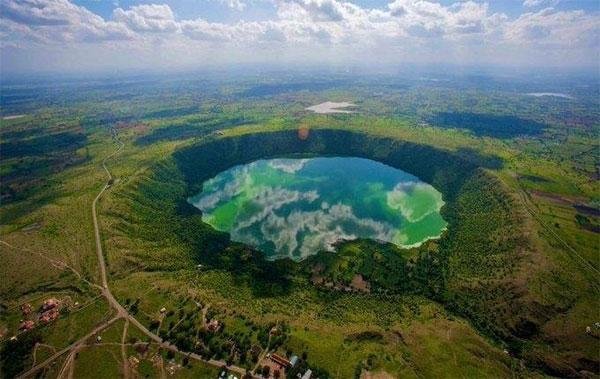
India has many beautiful lakes, but Lonar Lake in Maharashtra is unlike almost any other.
Deep inside a vast crater lies a lake that was created by an ancient meteorite impact. Surrounded by forest, temples and unusual geological formations, Lonar is a place where space, science, nature and history meet.
For centuries, the origin of the crater was a mystery. Today, scientists know that a powerful cosmic impact created this remarkable landscape, but the lake still has many fascinating features that make it worth exploring.


☄️ A Lake Created by a Meteorite
Imagine a massive object traveling through space and crashing into Earth at enormous speed.
That is essentially what happened at Lonar.
The impact created a large crater in the basalt rock of the Deccan Plateau. Over time, the depression filled with water and became what we now know as Lonar Lake.
This makes Lonar particularly interesting because it is not an ordinary volcanic or river-created lake.
It is a landscape created by an event from outer space.
🕳️ How Big Is the Crater?
The Lonar crater is roughly 1.8 kilometres across and is surrounded by raised terrain created by the impact.
From ground level, it can be difficult to understand the scale of the crater.
But when viewed from above, the circular shape becomes much more obvious.


The crater’s geological structure provides scientists with an opportunity to study the effects of high-energy impacts on basaltic rock.
🧪 A Natural Laboratory for Scientists
Lonar is more than a beautiful tourist destination.
Its unusual geology and water chemistry have attracted scientific interest for many years.
The lake’s environment is influenced by the rocks surrounding it, the climate and the way water interacts with the crater.
Because of these unusual conditions, researchers have studied Lonar in fields including geology, microbiology and planetary science.
The crater can even help scientists understand geological processes that occur on other planets and celestial bodies.
🌈 Why Has the Lake Changed Colour?
One of the most intriguing features of Lonar Lake is its changing appearance.
At different times, visitors have observed unusual colour changes in the lake.
Microorganisms living in the water can contribute to changes in colour, particularly under certain environmental conditions.
This has made photographs of Lonar especially fascinating because the lake does not always look exactly the same.


🦠 Tiny Organisms With a Big Scientific Story
Lonar’s unusual water conditions provide an environment where specialized microorganisms can survive.
Scientists have studied microbial communities in and around the lake because they can offer clues about how life adapts to unusual environments.
This is one reason Lonar has attracted interest beyond traditional geology.
A lake created by a meteorite impact has effectively become a natural laboratory for studying life and environmental adaptation.
🌳 A Forest Inside the Crater
The lake is surrounded by greenery, creating an unexpected contrast with the rocky crater walls.
From certain viewpoints, visitors can see the lake surrounded by trees and dense vegetation.
Walking through the surrounding landscape can reveal a combination of forest, rock formations and historic structures.


🛕 Ancient Temples Around Lonar
Lonar is also connected with India’s architectural and religious heritage.
Several old temples can be found around the crater.
Among the most notable is the Daitya Sudan Temple in Lonar town, known for its detailed stone carvings and historical architecture.
The presence of historic temples around a meteorite crater makes the area particularly unusual.
Here, geological history and human history exist within the same landscape.


🏛️ A Place Where Science Meets History
Few destinations combine these subjects so closely.
At Lonar, you can learn about:
☄️ Meteorite impacts
🪨 Ancient geological processes
🦠 Microbial life
🌳 Natural ecosystems
🛕 Indian temple architecture
That combination makes Lonar much more than a sightseeing location.
It is a destination where almost every part of the landscape tells a different story.
📸 Why Photographers Love Lonar
Lonar offers many different photographic perspectives.
The circular crater can be dramatic from elevated viewpoints, while the lake itself creates beautiful reflections.
The surrounding forest adds a strong green contrast to the rocky terrain.
Ancient temples provide another subject for photography, especially for people interested in architecture and history.


🚶 Exploring the Crater
Visitors can explore viewpoints around the crater and discover the surrounding natural and historic attractions.
Walking down toward the lake gives a different perspective of the enormous crater walls.
However, visitors should follow local instructions, avoid entering restricted areas and take care not to disturb the ecosystem.
🌿 Why Conservation Matters
Lonar’s unusual ecosystem is sensitive to environmental changes.
Pollution, waste and uncontrolled tourism can affect both the lake and the surrounding heritage sites.
Keeping the area clean and respecting the natural environment is important for protecting this rare geological landscape.
Visitors can contribute simply by:
- Avoiding litter
- Carrying reusable water bottles
- Not disturbing wildlife
- Respecting temple sites
- Following local guidelines
- Avoiding damage to rocks and vegetation
🤯 The Most Interesting Thing About Lonar
Perhaps the most amazing fact is that you can stand beside the lake today and look at a landscape that began with an event from outer space.
A meteorite struck Earth.
A giant crater formed.
Water accumulated inside it.
Life adapted to the unusual environment.
People later built temples around it.
And today, scientists continue to study it.
That is an incredible story for a single lake.


❓ Frequently Asked Questions
Where is Lonar Lake?
Lonar Lake is located in Buldhana district of Maharashtra, India.
How was Lonar Lake formed?
It was formed by a meteorite impact into the basaltic rock of the Deccan Plateau.
Is Lonar Lake a volcano crater?
No. Lonar is an impact crater, created by a meteorite strike.
Why is Lonar Lake scientifically important?
Its unusual geology and water environment make it valuable for research in areas such as geology, microbiology and planetary science.
Why does Lonar Lake sometimes change colour?
Changes in environmental conditions and microbial activity can influence the lake’s appearance and colour.
What else can visitors see near Lonar?
Visitors can explore the crater landscape, surrounding vegetation and historic temples, including the famous Daitya Sudan Temple.
🌟 Final Thoughts
Lonar Lake is one of India’s most extraordinary natural mysteries.
It began with a violent event from space, but over time it became a lake surrounded by forests, wildlife and centuries-old human heritage.
The combination of a meteorite crater, unusual water chemistry, microorganisms and ancient temples makes Lonar unlike most other destinations in India.
If you are interested in places where science, nature, history and mystery come together, Lonar deserves a place on your travel list.
Sometimes, you don’t need to travel into space to discover something from the universe.
You can find a piece of that story right here on Earth. 🇮🇳☄️

🇮🇳 MANA BHARATHAM
Discover the Stories Hidden Across India
From ancient monuments and mysterious natural wonders to India’s history, culture, heritage and fascinating destinations, MANA BHARATHAM brings interesting stories from across the country.
🌐 Website: allpincodes.online
📖 Blog: MANA BHARATHAM
Know India. Explore India. Celebrate India. 🇮🇳
Leave a Reply