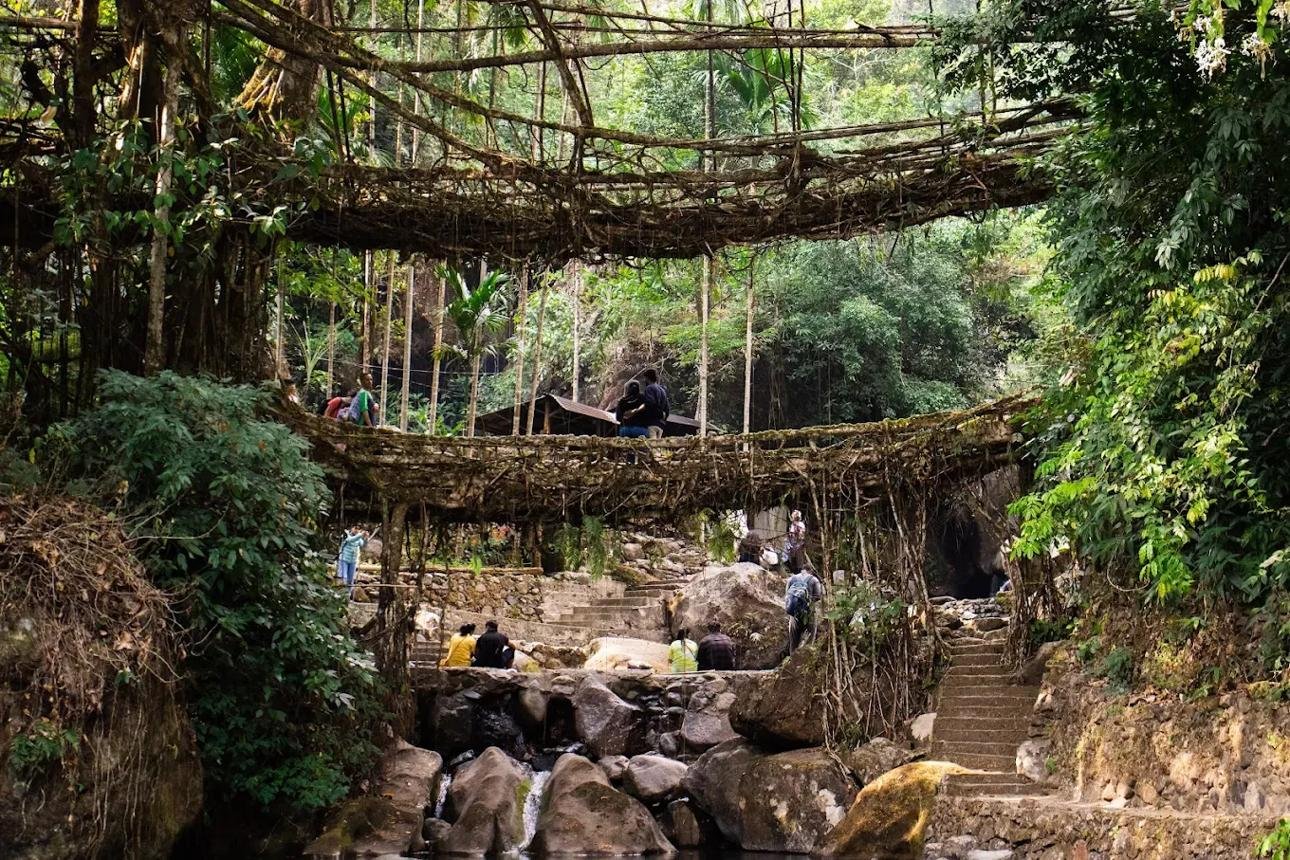


Living Root Bridges: Where Nature Becomes Architecture
Deep inside the lush green hills of Meghalaya, India, something extraordinary happens. Trees are not simply grown for their beauty—they are carefully guided and shaped to become bridges.
These remarkable structures are known as Living Root Bridges, and they are among the most fascinating examples of traditional ecological engineering in the world.
🌱 Bridges Made From Trees
Unlike ordinary bridges made from concrete, steel or wood, living root bridges are created using the aerial roots of the Ficus elastica, commonly known as the rubber fig tree.
Local communities guide the roots across streams and valleys using simple natural supports. Over many years, the roots grow stronger, intertwine and eventually form a bridge capable of carrying people.


🌧️ Built for Meghalaya’s Heavy Rain
Meghalaya receives some of the heaviest rainfall on Earth. During the monsoon, streams can become powerful and difficult to cross.
Traditional wooden bridges can decay or be washed away. Living root bridges, however, continue to grow stronger as their roots develop.
This makes them an impressive example of how local communities adapted their way of life to the environment around them.
🌳 A Bridge That Gets Stronger With Age
One of the most amazing things about a living root bridge is that it is not truly “finished.”
As the tree continues growing, its roots become thicker and stronger. Some bridges have been used by generations of local people.
Instead of fighting nature, the builders work with nature.
🥾 The Famous Double-Decker Root Bridge
One of Meghalaya’s best-known examples is the Double-Decker Living Root Bridge near Nongriat.
As its name suggests, it has two levels of living roots, creating a spectacular natural structure in the middle of the rainforest.
Reaching it requires a challenging trek involving hundreds of steps, but the journey through Meghalaya’s forests makes the experience even more memorable.


🌍 What the Bridges Teach Us
Living root bridges offer an important lesson for the modern world.
They show that engineering does not always have to mean cutting down forests or replacing nature with concrete. Sometimes, the environment itself can become part of the solution.
These bridges combine tradition, patience, sustainability and natural engineering in a way that is rarely seen elsewhere.
📍 A Living Heritage of Meghalaya
For the communities of Meghalaya, these bridges are much more than tourist attractions. They are part of local knowledge and a connection between people and their environment.
Visitors who walk across one are not simply crossing a stream—they are experiencing a tradition that has been shaped by generations of people.
🌿 Nature’s Own Bridges
The living root bridges of Meghalaya remind us that some of the world’s most impressive engineering can be created without machines, factories or modern materials.
With patience and knowledge, people can guide nature to create something useful, beautiful and remarkably durable.
Meghalaya’s living root bridges are proof that sometimes the best way to build a bridge is to let nature build it with you.
Leave a Reply