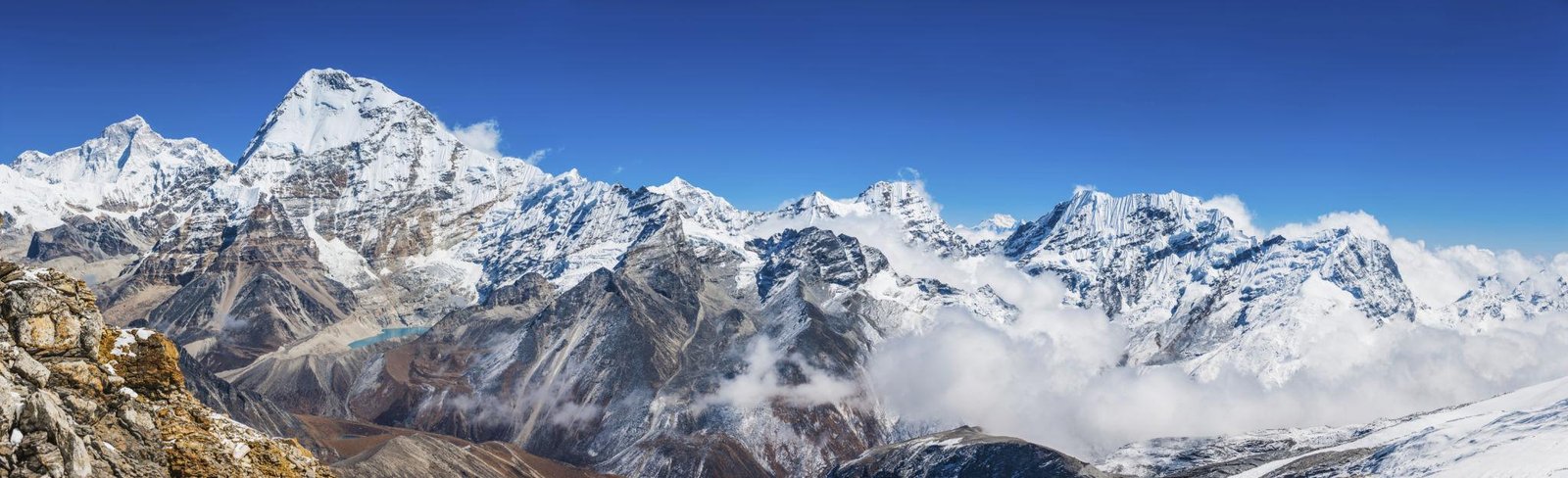
What would it feel like to stand on top of a mountain so high that the world below looks incredibly small?
Some mountains rise so far above sea level that their peaks reach into the thin, freezing air near the edge of the atmosphere. For centuries, these enormous mountains have attracted explorers, climbers and adventurers from around the world.
But these mountains are more than just tall peaks.
They are shaped by the movement of Earth’s tectonic plates, covered by glaciers and snow, and connected to rivers, wildlife and communities that depend on the mountains around them.
Let’s explore some of the highest mountains on Earth and discover what makes them extraordinary.


🏔️ 1. Mount Everest – The Highest Peak on Earth
When people hear the words “highest mountain in the world,” one name immediately comes to mind: Mount Everest.
Everest rises to approximately 8,849 metres (29,032 feet) above sea level and is located in the Himalayas on the border between Nepal and the Tibet Autonomous Region of China.
Its extreme altitude creates freezing temperatures, powerful winds and very low oxygen levels near the summit.


🤯 An Incredible Fact
At Everest’s summit, the amount of oxygen available is only a fraction of what exists at sea level.
That means simply breathing becomes a serious challenge.
Climbers often need supplemental oxygen when attempting the highest parts of the mountain.
🏔️ 2. K2 – The Savage Mountain
K2 is the second-highest mountain in the world, reaching about 8,611 metres (28,251 feet).
It lies in the Karakoram range on the Pakistan–China border.
K2 is famous among mountaineers for its steep terrain, unpredictable weather and technically difficult climbing routes.


Because of its difficulty, K2 has earned the nickname “Savage Mountain.”
Its enormous walls and extreme weather make it one of the world’s most challenging major peaks.
🏔️ 3. Kangchenjunga – A Giant of the Himalayas
Kangchenjunga reaches approximately 8,586 metres (28,169 feet).
It lies along the border between Nepal and India.
The mountain has enormous cultural and spiritual importance to communities in the surrounding region.
Its huge snow-covered peaks create one of the most dramatic mountain landscapes in the Himalayas.
🏔️ 4. Lhotse – Everest’s Giant Neighbor
Lhotse rises to approximately 8,516 metres (27,940 feet).
It is located very close to Mount Everest and is connected to the Everest massif.


Because of its proximity to Everest, climbers in the region may see both enormous peaks during their journey.
Lhotse’s steep mountain face is particularly famous among experienced climbers.
🏔️ 5. Makalu – The Pyramid-Shaped Mountain
Makalu stands approximately 8,485 metres (27,838 feet) high.
It is located in the Himalayas of Nepal, close to the border with China.
One of Makalu’s most recognizable features is its striking pyramid-like shape.


Its steep slopes and exposed ridges make climbing it a major challenge.
🏔️ 6. Cho Oyu – One of the Eight-Thousanders
Cho Oyu is approximately 8,188 metres (26,864 feet) high.
It lies in the Himalayas near the Nepal–China border.
It is one of the fourteen mountains in the world that rise above 8,000 metres.


These fourteen peaks are often called the eight-thousanders.
Reaching even one of them is considered a major mountaineering achievement.
🏔️ 7. Dhaulagiri I – The White Mountain
Dhaulagiri I reaches approximately 8,167 metres (26,795 feet).
It is located entirely within Nepal.
The name is associated with the idea of a “White Mountain,” reflecting its snow-covered appearance.


Its massive slopes and surrounding glaciers create an impressive Himalayan landscape.
🏔️ 8. Manaslu – The Mountain of the Spirit
Manaslu rises to approximately 8,163 metres (26,781 feet).
It is located in Nepal’s Himalayas.
The name is connected with the Sanskrit concept of “manas,” associated with the mind or spirit.


The surrounding region is known for spectacular mountain scenery and traditional Himalayan communities.
🏔️ 9. Nanga Parbat – The Killer Mountain
Nanga Parbat reaches approximately 8,126 metres (26,660 feet).
It is located in Pakistan’s Himalayas.
The mountain is famous for its enormous vertical relief and challenging climbing conditions.


It is sometimes called the “Killer Mountain” because of the dangers faced by climbers attempting its difficult routes.
🏔️ 10. Annapurna I – Beauty and Danger
Annapurna I reaches approximately 8,091 metres (26,545 feet).
It is located in Nepal.
The Annapurna region is famous for spectacular mountain scenery and popular trekking routes.


Annapurna I is also known for the serious risks associated with climbing its high-altitude terrain.
🌍 Why Are So Many of the World’s Highest Mountains in Asia?
Here is where the story gets really interesting.
The Himalayas and neighboring mountain ranges were created largely by the collision of the Indian and Eurasian tectonic plates.
The Indian Plate continues to move northward and interact with the Eurasian Plate.
This enormous geological process has helped push the Himalayas upward over millions of years.


So the world’s highest mountains are not simply giant rocks sitting on Earth’s surface.
They are part of a living geological process.
🧊 What Happens at Extreme Altitude?
As altitude increases, conditions become increasingly difficult.
At very high elevations:
- Oxygen levels are much lower.
- Temperatures can fall dramatically.
- Strong winds can occur.
- Snow and ice can create dangerous conditions.
- The human body struggles to function normally.
This is why climbing the world’s highest peaks requires careful preparation, specialized equipment and experienced guides.
🏔️ The 14 Eight-Thousanders
There are 14 mountains on Earth higher than 8,000 metres.
They are:
| Mountain | Approximate Height |
|---|---|
| Mount Everest | 8,849 m |
| K2 | 8,611 m |
| Kangchenjunga | 8,586 m |
| Lhotse | 8,516 m |
| Makalu | 8,485 m |
| Cho Oyu | 8,188 m |
| Dhaulagiri I | 8,167 m |
| Manaslu | 8,163 m |
| Nanga Parbat | 8,126 m |
| Annapurna I | 8,091 m |
| Gasherbrum I | 8,080 m |
| Broad Peak | 8,051 m |
| Gasherbrum II | 8,035 m |
| Shishapangma | 8,027 m |
Most of these extraordinary mountains are located in the Himalayas and Karakoram ranges of Asia.
🤯 One Mountain Can Influence an Entire Region
Mountains are not just obstacles for climbers.
They can influence rainfall, river systems, agriculture and human settlements.
Snow and glaciers in high mountain regions feed rivers that provide water to communities far beyond the mountains themselves.
This means a mountain peak can have an influence far beyond what we see from the ground.


🌟 Amazing Mountain Facts
🏔️ Mount Everest is the highest mountain above sea level.
🏔️ K2 is the second-highest.
🧊 Many of the world’s highest peaks remain covered in snow and ice.
🌏 Most of the world’s eight-thousanders are in Asia.
🌋 The Himalayas were formed through enormous tectonic forces.
💨 At extreme altitude, thin air makes physical activity much harder.
💧 Mountain snow and glaciers contribute to important river systems.
🌎 Final Thoughts
The world’s highest mountains are more than numbers on a list.
They represent some of the most dramatic interactions between Earth’s geology, climate and life.
For millions of years, tectonic forces have continued shaping these mountains.
Today, they stand as enormous natural monuments—beautiful, dangerous and still changing.
And perhaps the most fascinating thought is this:
The mountains we see today are not exactly the mountains that future generations will see.
Earth is still moving.
Earth is still changing.
And the giants of the world are still being shaped.
❓ Frequently Asked Questions
What is the highest mountain in the world?
Mount Everest is the highest mountain above sea level, at approximately 8,849 metres.
Where are most of the highest mountains located?
Most of the world’s highest mountains are located in Asia, particularly in the Himalayas and Karakoram ranges.
How many mountains are higher than 8,000 metres?
There are 14 commonly recognized eight-thousanders.
Why are the Himalayas so high?
The Himalayas were formed primarily through the ongoing collision and interaction of the Indian and Eurasian tectonic plates.
Is K2 higher than Mount Everest?
No. K2 is the second-highest mountain above sea level, after Mount Everest.
Why is climbing very high mountains dangerous?
Extreme altitude, low oxygen, freezing temperatures, strong winds, steep terrain, snow and ice can all create serious hazards
Leave a Reply