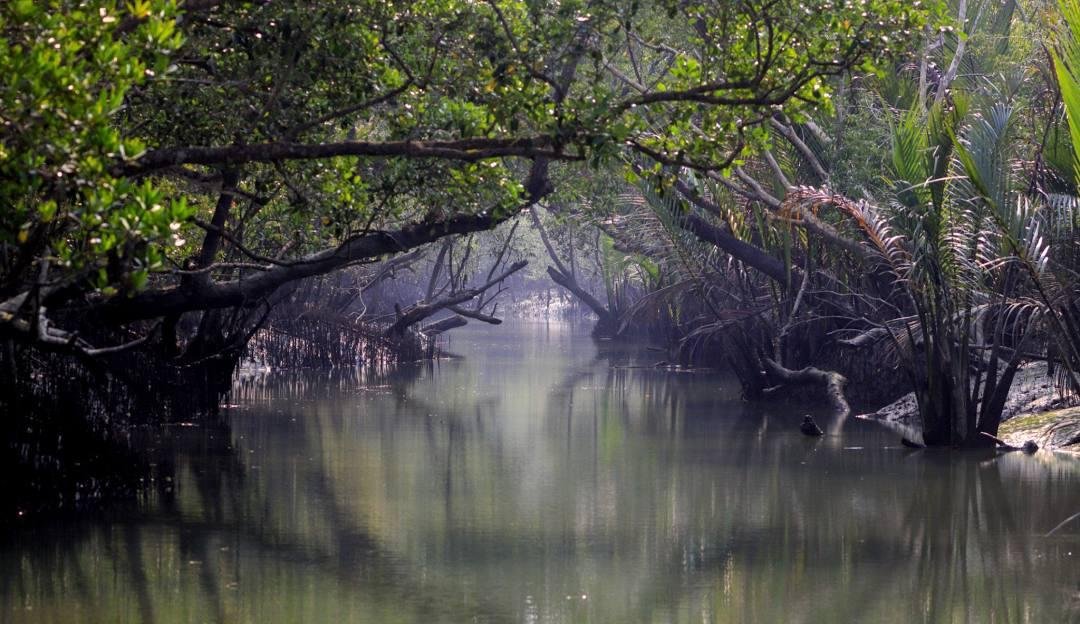
Imagine a forest where the land and water are constantly changing.
There are no ordinary roads running through much of it. Instead, rivers, creeks and narrow waterways form natural pathways between dense mangrove trees.
Somewhere in this vast wilderness, the Royal Bengal Tiger moves silently through the forest.
This is the Sundarbans — one of the most extraordinary forest ecosystems in India and one of the world’s largest mangrove regions.


🌿 What Makes the Sundarbans Different?
Most forests are dominated by land.
The Sundarbans are different.
Here, forest, river and sea are deeply connected.
The landscape is made up of islands, tidal waterways, mudflats and dense mangrove vegetation.
Twice each day, tides can dramatically change the appearance of the waterways.
An area that looks like exposed mud at one time can later be covered by water.
This constant movement of water makes the Sundarbans a truly dynamic ecosystem.
🌊 Where Is the Sundarbans?
The Sundarbans stretches across the Ganges-Brahmaputra-Meghna delta.
The larger Sundarbans region extends across both India and Bangladesh.
The Indian portion is primarily in West Bengal.
The region is strongly influenced by freshwater rivers flowing from the Himalayas and saltwater entering from the Bay of Bengal.


🌱 What Is a Mangrove Forest?
Mangroves are trees and shrubs that can survive in coastal environments where freshwater and saltwater mix.
They have special adaptations that allow them to live in muddy, waterlogged conditions.
Some mangrove plants develop unusual root systems that help them obtain oxygen from the soil.
These roots also help stabilize the shoreline.
In the Sundarbans, mangrove forests create an intricate natural network of roots, mud and waterways.
🐅 Home of the Royal Bengal Tiger
The Sundarbans is famous around the world for its Royal Bengal Tigers.
Unlike tigers living in many other Indian forests, Sundarbans tigers have adapted to an unusual environment of mangrove islands, tidal creeks and wetlands.


Seeing a tiger in this environment is difficult.
Dense vegetation, muddy terrain and waterways make the forest challenging to explore.
That difficulty is part of what makes the Sundarbans such a fascinating wildlife landscape.
🐊 More Than Tigers
The Sundarbans is not just a tiger habitat.
The ecosystem supports many different species, including:
- 🐊 Estuarine crocodiles
- 🦌 Spotted deer
- 🐒 Rhesus macaques
- 🐍 Various snakes
- 🐟 Fish and aquatic species
- 🐦 Numerous bird species
Each species plays a role in the complex food web of the mangrove ecosystem.


🦀 A Forest Full of Life
Look closely at the muddy edges of the waterways and you may notice another world.
Crabs, mudskippers, fish and other small creatures live around the tidal zones.
Mangrove roots provide shelter and breeding areas for many aquatic organisms.
This makes the forest important not only for large animals but also for countless smaller species.
🌊 Nature’s Protection Against Storms
Mangrove forests provide an important natural barrier along vulnerable coastlines.
Their dense root systems can help reduce wave energy and trap sediment.
In a region exposed to tropical storms and cyclones, healthy mangroves can provide valuable protection to coastal landscapes and communities.
This makes conservation of the Sundarbans important not just for wildlife, but also for people.


🏘️ Life Around the Forest
Many communities live around the Sundarbans and depend on the surrounding environment.
Fishing, agriculture and other traditional livelihoods are closely connected with the region.
For people living near the forest, the Sundarbans is not simply a wildlife destination.
It is part of everyday life.
This relationship can be challenging because the same environment that provides resources can also bring dangers such as storms, flooding and encounters with wildlife.
🐝 Honey Collection in the Sundarbans
One traditional activity associated with the region is the collection of wild honey.
Honey collectors enter parts of the forest during designated periods and search for wild bee colonies.
It is a demanding activity because collectors work in an environment where encounters with dangerous wildlife are possible.
The practice demonstrates the complicated relationship between people and the forest.


🚤 Exploring the Sundarbans by Boat
One of the most interesting things about visiting the Sundarbans is that water becomes the road.
Boats travel through permitted waterways while visitors observe the surrounding mangroves.
Instead of walking through a conventional forest trail, you experience the wilderness from the water.
Sometimes the forest appears completely silent.
Then a bird suddenly flies across the water or a crocodile may be spotted near a muddy bank.
The unpredictability is part of the experience.
🛶 Why Boats Are So Important
The Sundarbans contains countless waterways.
Boats are therefore essential for transportation, tourism and many local activities.
The waterways also influence where communities can live and how people move between islands.


🌧️ A Forest Under Constant Environmental Pressure
The Sundarbans faces several environmental challenges.
Climate change, rising sea levels, coastal erosion, cyclones and changes in freshwater flow can affect this fragile ecosystem.
Some islands have experienced significant erosion and changes in their coastline.
Because the Sundarbans is built around a constantly changing delta, even small environmental changes can have major consequences.
🌍 Why Protecting the Sundarbans Matters
The Sundarbans is important on several levels.
It protects biodiversity.
It supports local communities.
It stores carbon.
It helps protect coastlines.
And it preserves one of the world’s most unusual ecosystems.
Protecting the forest therefore means protecting both nature and people.


🌅 The Beauty of a Sundarbans Sunset
Despite its wild reputation, the Sundarbans can also be incredibly peaceful.
As the sun begins to disappear, the waterways reflect the changing sky.
Mangrove silhouettes appear against the horizon.
Boats slowly move through the channels.
For a few moments, the enormous forest seems completely still.


🤯 Fascinating Facts About the Sundarbans
🌳 It is a mangrove ecosystem
The Sundarbans is dominated by mangrove vegetation adapted to tidal and saline conditions.
🐅 It is famous for wild tigers
The Indian Sundarbans is an important habitat for Royal Bengal Tigers.
🌊 Tides shape the landscape
Water levels change dramatically with the tidal cycle, constantly reshaping parts of the ecosystem.
🐊 Crocodiles live here too
Estuarine crocodiles are among the reptiles found in the Sundarbans.
🚤 Waterways are essential
Boats are an important means of transportation for both tourism and local communities.
🌏 It crosses an international border
The wider Sundarbans ecosystem extends across India and Bangladesh.
❓ Frequently Asked Questions
Where is the Sundarbans located?
The Sundarbans lies in the Ganges-Brahmaputra-Meghna delta, with the Indian part primarily located in West Bengal.
Why is the Sundarbans famous?
It is famous for its vast mangrove ecosystem, Royal Bengal Tigers, tidal waterways and unique biodiversity.
Can tourists visit the Sundarbans?
Yes. Tourism is possible through designated routes and permitted areas, generally using boats.
Are there tigers in the Sundarbans?
Yes. The Indian Sundarbans is an important habitat for Royal Bengal Tigers.
Why are mangroves important?
Mangroves provide habitat for wildlife, help stabilize coastlines and can reduce the impact of waves and storms.
Is the Sundarbans dangerous?
It is a genuine wilderness environment. Wildlife, tides, storms and remote terrain can create risks, so visitors should always follow local authorities and trained guides.
🌟 Final Thoughts
The Sundarbans is not an ordinary forest.
It is a place where land becomes water, freshwater meets the sea, and forests grow in salty mud.
It is home to one of India’s most iconic wild animals and thousands of other creatures.
But perhaps its greatest lesson is about balance.
The forest protects people.
People depend on the forest.
And the survival of both is connected to the health of the ecosystem.
The Sundarbans reminds us that some of India’s greatest natural treasures are not monuments built by humans.
They are living landscapes that have been shaped by nature for thousands of years. 🌿🐅🌊🇮🇳


🇮🇳 MANA BHARATHAM
Discover the Stories Hidden Across India
From India’s forests and wildlife to hidden destinations, history, culture, heritage and fascinating natural wonders, MANA BHARATHAM brings interesting stories from across the country.
🌐 Website: allpincodes.online
📖 Blog: MANA BHARATHAM
Know India. Explore India. Celebrate India. 🇮🇳
Leave a Reply