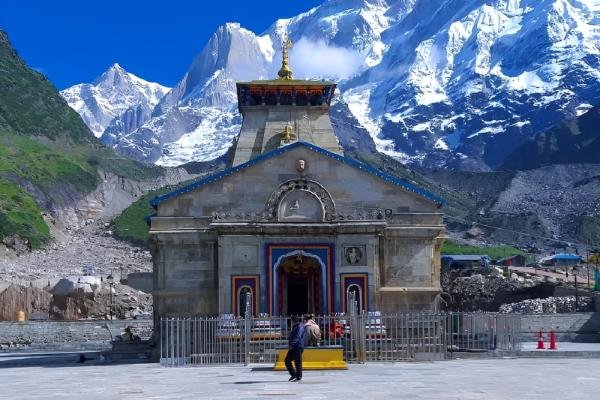
India is a land of ancient temples, sacred traditions and fascinating legends. Among the many holy places in the Himalayas, Kedarnath Temple holds a very special place.
Situated in the magnificent Garhwal Himalayas of Uttarakhand, Kedarnath is dedicated to Lord Shiva and is one of the twelve Jyotirlingas. The temple stands at an altitude of around 3,580 metres and is surrounded by spectacular mountain peaks.


📍 Where Is Kedarnath Temple Located?
Kedarnath Temple is located in Rudraprayag district of Uttarakhand, near the source region of the Mandakini River.
The temple is surrounded by the majestic Garhwal Himalayan mountains, creating one of the most dramatic natural settings of any major Indian pilgrimage site.
The journey to Kedarnath has traditionally been an important part of the pilgrimage itself.
🛕 Why Is Kedarnath Temple So Famous?
Kedarnath is famous for several reasons.
It is:
- 🙏 One of the 12 Jyotirlingas of Lord Shiva
- 🏔️ One of the important sites of the Chota Char Dham
- 🛕 One of the important temples of the Panch Kedar
- 📜 Associated with traditions connected to the Mahabharata
- 🏛️ Famous for its ancient stone architecture
- 🌄 Located in the spectacular Himalayan landscape
The official temple committee identifies Kedarnath as the eleventh of the twelve Jyotirlingas.


📜 History of Kedarnath Temple
Kedarnath is considered an ancient temple with a history extending back many centuries.
The Shri Badrinath-Kedarnath Temple Committee states that the present temple is associated with Adi Shankaracharya and an even earlier shrine connected by tradition with the Pandavas.
The temple’s massive stone construction has survived for centuries in a challenging Himalayan environment.
Its history combines documented heritage with religious traditions and legends that have been passed down through generations.
🙏 Kedarnath and the Mahabharata Story
One of the most famous traditions associated with Kedarnath comes from the Mahabharata.
According to the traditional story, after the Kurukshetra war, the Pandavas wanted to seek forgiveness from Lord Shiva for the destruction caused by the war.
Lord Shiva did not immediately reveal himself to them. According to the legend, he took the form of a buffalo and attempted to avoid the Pandavas.
Bhima eventually recognized him.
When Shiva disappeared into the ground, different parts of the divine form were believed to have appeared at different locations in the Himalayas.
According to the Panch Kedar tradition, the hump of Shiva appeared at Kedarnath.


🐂 The Shiva Form at Kedarnath
Inside the sanctum of Kedarnath Temple is a conical rock formation worshipped as Lord Shiva in his Sadashiva form.
According to the traditional belief associated with the Panch Kedar story, this represents the hump of Shiva.
This distinctive form makes Kedarnath different from many other Shiva temples.
🧘 Adi Shankaracharya and Kedarnath
Adi Shankaracharya is strongly associated with the revival and development of Kedarnath as an important pilgrimage centre.
The temple committee attributes the present shrine to the 8th century period of Adi Shankaracharya, while Incredible India notes that he revitalised the shrine during that period.
A samadhi associated with Adi Shankaracharya is located near the temple.


🏛️ Architecture of Kedarnath Temple
The architecture of Kedarnath Temple is simple, powerful and impressive.
Unlike temples decorated with extremely elaborate towers, Kedarnath is known for its massive grey stone slabs, strong walls and mountain-style construction.
The temple has:
- Garbha Griha – inner sanctum
- Mandap – assembly hall
- Large stone steps
- Stone walls
- Sculptural details
- Sacred images inside the temple
The official temple committee notes that the building was constructed using extremely large, evenly cut grey stone slabs.


🐂 Nandi Outside the Temple
A large statue of Nandi, the sacred bull associated with Lord Shiva, stands outside the temple.
Nandi is traditionally regarded as Lord Shiva’s vehicle and devotee.
The statue faces the temple and forms an important part of the temple’s visual identity.


🏔️ Kedarnath and the Himalayan Mountains
One of the most extraordinary features of Kedarnath is its natural surroundings.
The temple stands against the backdrop of the Kedarnath mountain range, surrounded by high Himalayan peaks and the Mandakini river valley.
This combination of ancient stone architecture and snow-covered mountains makes Kedarnath one of India’s most visually remarkable pilgrimage destinations.


🚶 The Journey to Kedarnath
The pilgrimage to Kedarnath traditionally involves travelling through the Himalayan region and completing an uphill trek from Gaurikund.
The exact trekking distance can vary with route changes and current arrangements. Uttarakhand government information currently describes the trek from Gaurikund as roughly 19 km, while another government district page lists an older 14 km figure.
The difficult journey is considered by many pilgrims to be an important part of the spiritual experience.
🕉️ Kedarnath as One of the Jyotirlingas
Hindu tradition recognizes twelve Jyotirlingas, sacred manifestations of Lord Shiva.
Kedarnath is one of these twelve holy sites and is considered the highest among them.
For devotees of Lord Shiva, visiting Kedarnath is therefore considered a deeply meaningful pilgrimage.


🛕 Kedarnath and Panch Kedar
Kedarnath is also the most prominent of the Panch Kedar temples.
The five traditionally associated Shiva shrines are:
- Kedarnath
- Madhyamaheshwar
- Tungnath
- Rudranath
- Kalpeshwar
According to the traditional story, different parts of Shiva’s buffalo form appeared at these five Himalayan locations.
🌸 Kedarnath After the 2013 Disaster
Kedarnath also became widely known around the world after the devastating 2013 Uttarakhand floods.
The surrounding region suffered enormous destruction, while the main temple structure survived.
The disaster became an important chapter in the modern history of Kedarnath and led to major changes in pilgrimage infrastructure and disaster-management planning in the region.


💡 Interesting Facts About Kedarnath Temple
- 🛕 Kedarnath is dedicated to Lord Shiva.
- 🕉️ It is one of the 12 Jyotirlingas.
- 🏔️ The temple is located at roughly 3,580 metres above sea level.
- 📍 It is located in Rudraprayag district, Uttarakhand.
- 🐂 The traditional Mahabharata story connects the shrine with the hump of Shiva in buffalo form.
- 🧘 Adi Shankaracharya is strongly associated with the shrine’s revival.
- 🏛️ The temple is built from massive grey stone slabs.
- 🐂 A Nandi statue stands outside the temple.
- 🛕 Kedarnath is one of the Panch Kedar.
- 🌄 The temple is surrounded by the spectacular Garhwal Himalayas.
🇮🇳 Why Is Kedarnath Important to India?
Kedarnath represents a unique combination of faith, mythology, history, architecture and Himalayan geography.
The temple’s ancient stone structure stands in an extremely challenging natural environment, while centuries-old traditions continue to attract pilgrims.
For many visitors, the journey to Kedarnath is not simply a trip to a temple. It is a journey through the mountains and a deeply spiritual experience.
🌸 Conclusion
The Kedarnath Temple is one of India’s most remarkable spiritual and cultural landmarks.
Its connection with Lord Shiva, the Jyotirlinga tradition, the Mahabharata legends, Adi Shankaracharya, ancient stone architecture and magnificent Himalayan surroundings make it truly unique.
Standing among the mountains of Uttarakhand, Kedarnath continues to represent the enduring spiritual traditions of India.
Kedarnath is not just a temple in the Himalayas — it is a symbol of faith, devotion, history and India’s timeless spiritual heritage. 🇮🇳🙏


🇮🇳 MANA BHARATHAM
This article is published by MANA BHARATHAM on ALL INDIA PIN CODE SEARCH.
For more interesting stories about Indian history, temples, ancient monuments, culture and traditions, stay connected with MANA BHARATHAM.
Know India. Explore India. Celebrate India. 🇮🇳
Leave a Reply