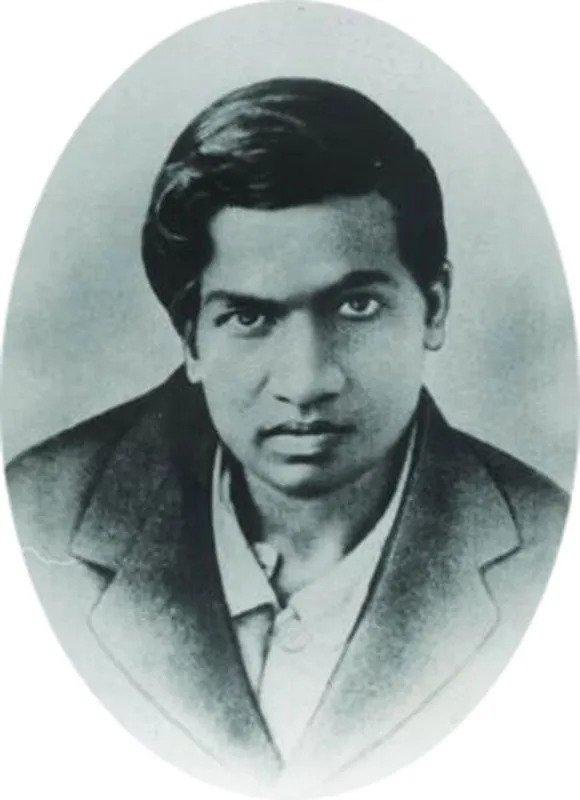
Some people solve problems.
Some people create new ideas.
And then there are rare people whose minds seem to work in a completely different way.
One such person was Srinivasa Ramanujan, a self-taught mathematical genius from India whose discoveries continue to influence mathematics more than a century later.
His story is not only about numbers.
It is about talent, poverty, determination, intuition and the power of believing in your own ability.


🇮🇳 A Boy Obsessed With Numbers
Srinivasa Ramanujan was born in 1887 in Erode, Tamil Nadu, and grew up in Kumbakonam.
From a young age, mathematics fascinated him.
While other students were studying many subjects, Ramanujan became deeply absorbed in mathematical problems.
His interest eventually became so intense that mathematics dominated his life.
📖 He Was Mostly Self-Taught
One of the most remarkable parts of Ramanujan’s story is that he did not follow the traditional path expected of a great mathematician.
He studied mathematics largely on his own.
A book titled A Synopsis of Elementary Results in Pure and Applied Mathematics, written by G. S. Carr, became particularly important to him.


He worked through mathematical ideas and developed his own results.
His notebooks eventually became filled with formulas, identities and mathematical discoveries.
✍️ His Notebooks Became Famous
Ramanujan wrote many of his results in notebooks.
These notebooks contained thousands of mathematical statements.
What makes them extraordinary is that many results were written without the detailed proofs that modern mathematicians normally expect.
He often seemed to know that a formula was correct before providing a conventional derivation.
This unusual style became one of the defining features of his mathematical work.
🇬🇧 The Letter That Changed His Life
Ramanujan’s life changed when he wrote to the British mathematician G. H. Hardy at Cambridge.
He included some of his mathematical results.
At first, such a letter might have been easy to dismiss.
But Hardy quickly recognized that the mathematics was extraordinary.


Hardy later worked with Ramanujan and helped bring him to Cambridge.
This was a turning point.
A young mathematician from India who had been working largely outside the academic system suddenly entered one of the world’s great mathematical institutions.
🧮 The Number 1729
One of the most famous stories connected with Ramanujan involves the number:
1729
Hardy visited Ramanujan while he was ill and mentioned that he had travelled in a taxi numbered 1729.
Hardy reportedly considered it an uninteresting number.
Ramanujan immediately pointed out that 1729 was actually special.
It is the smallest positive integer that can be expressed as the sum of two positive cubes in two different ways:
1729 = 1³ + 12³
and
1729 = 9³ + 10³
This number is now popularly known as the Hardy–Ramanujan number.


🤯 Why Was Ramanujan So Different?
Ramanujan had an extraordinary mathematical intuition.
He could see relationships between numbers that were difficult for other mathematicians to discover.
But intuition alone wasn’t enough.
His ideas eventually became the subject of rigorous mathematical study.
Modern mathematicians have continued investigating his formulas and notebooks.
📚 His Work Was Far Ahead of Its Time
Ramanujan contributed to several areas of mathematics, including:
- Number theory
- Infinite series
- Continued fractions
- Mathematical analysis
- Partition theory
- Special functions
His work on partitions became particularly important.
A partition asks how many different ways a positive integer can be written as a sum of positive integers.
For example:
4
can be written as:
4
3 + 1
2 + 2
2 + 1 + 1
1 + 1 + 1 + 1
So 4 has 5 partitions.
For larger numbers, the problem becomes dramatically more complicated.
Ramanujan discovered deep patterns in partition numbers.
🔢 The Mystery of Partitions
Ramanujan and Hardy discovered remarkable congruences involving partition numbers.
For example, certain partition values obey surprising patterns based on the number being considered.
These discoveries became foundational results in number theory.
Even today, Ramanujan’s ideas continue to influence mathematical research.
🌌 His Ideas Reached Modern Mathematics
Perhaps the most surprising part of Ramanujan’s story is that his work did not simply belong to the mathematics of his own time.
Some of his ideas have found connections with modern areas of mathematics and theoretical physics.
Researchers continue studying objects known as mock theta functions, which Ramanujan introduced near the end of his life.


His notebooks have therefore remained valuable long after his death.
🏛️ Life at Cambridge
Ramanujan travelled to England in 1914.
At Cambridge, he worked closely with Hardy and other mathematicians.
His mathematical achievements were recognized internationally.
He was elected a Fellow of the Royal Society in 1918, becoming one of the youngest people to receive that honour at the time.
❤️ A Brilliant Life Cut Short
Ramanujan’s health deteriorated badly during his years in England.
He returned to India in 1919.
Sadly, he died in 1920, at only 32 years old.
His life had been incredibly short.
But the mathematical legacy he left behind was enormous.


🇮🇳 Why Ramanujan’s Story Still Matters
Ramanujan’s story is especially inspiring because he did not begin with wealth, prestigious institutions or extensive formal training.
He had something else:
An extraordinary curiosity.
He kept asking questions.
He kept experimenting with numbers.
He kept writing down ideas.
And eventually, the world noticed.
His story reminds students that talent can emerge from unexpected places.
🎓 A Message for Students
Ramanujan’s life does not mean formal education is unnecessary.
Quite the opposite.
His story shows what can happen when intense curiosity meets opportunity and mentorship.
If you love mathematics, science, art, writing or technology, don’t be afraid to explore beyond your textbook.
Ask questions.
Try difficult problems.
Make mistakes.
Read.
Experiment.
And keep learning.
🤯 One More Amazing Thing
Ramanujan produced an enormous amount of mathematics during a very short life.
Many of his notebooks contained results that later mathematicians spent years proving, interpreting and extending.
In other words:
Ramanujan left behind questions and ideas that continued working long after he was gone.
That is an extraordinary legacy.
❓ Frequently Asked Questions
Who was Srinivasa Ramanujan?
He was an Indian mathematician whose groundbreaking work in number theory and related areas made him one of the most famous mathematicians of the 20th century.
Where was Ramanujan born?
He was born in Erode, Tamil Nadu, in 1887.
Why is 1729 famous?
It is the smallest number that can be expressed as the sum of two positive cubes in two different ways.
Who was G. H. Hardy?
G. H. Hardy was a leading British mathematician who recognized Ramanujan’s extraordinary talent and collaborated with him at Cambridge.
How old was Ramanujan when he died?
He died in 1920 at the age of 32.
Why is Ramanujan important today?
His work continues to influence number theory and other areas of modern mathematics, and mathematicians continue to study results from his notebooks.
🌟 Final Thoughts
Ramanujan’s story is one of the most remarkable scientific stories to come out of India.
He did not have a long career.
He did not have an easy life.
But his mathematical imagination was extraordinary.
From a young man filling notebooks with equations to a mathematician whose work reached Cambridge and the Royal Society, his journey shows how powerful human curiosity can be.
Some people leave behind money.
Some leave behind buildings.
Ramanujan left behind ideas.
And more than a century later, mathematicians are still discovering how deep those ideas really were.
A brilliant mind may disappear—but great ideas can live forever. 🧠🔢🇮🇳

🇮🇳 MANA BHARATHAM
Stories, Facts & Wonders From India
🌐 Website: allpincodes.online
📖 Blog: MANA BHARATHAM
Know India. Explore India. Celebrate India. 🇮🇳
Leave a Reply