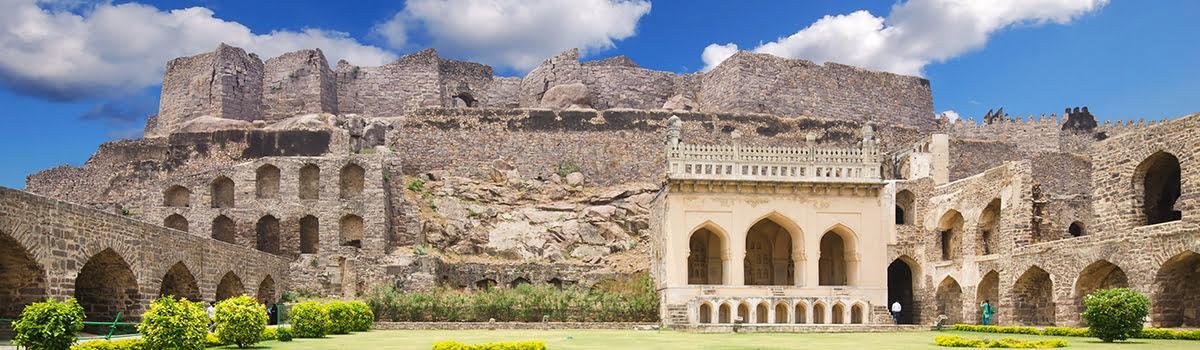
Imagine standing on a massive stone fort overlooking Hyderabad, surrounded by enormous walls, ancient gateways and ruins that once belonged to a powerful kingdom.
But Golconda is not just another old fort.
It was a military stronghold, royal centre, diamond-trading hub and architectural wonder.
Today, its ruins tell the story of one of the most fascinating chapters in the history of southern India.


🏰 A Fort With Centuries of History
Golconda Fort is located near Hyderabad, Telangana.
The fort developed over several centuries and became particularly important under the Qutb Shahi dynasty, which ruled the region from the 16th to the 17th century.
Its strategic location and impressive defensive architecture helped make Golconda a major political centre.
🪨 Built for Defence
Golconda wasn’t designed simply to look beautiful.
Its walls, gates, bastions and elevated position were created to make the fort difficult to attack.


The fort’s complex layout meant that an invading army could not easily move straight toward the centre.
Defensive structures were positioned strategically across the rocky terrain.
👏 The Famous Acoustic Secret
One of Golconda’s most fascinating features is its acoustic design.
At the entrance area, a clap can reportedly be heard at a considerable distance in certain parts of the fort.


This was not simply entertainment.
Acoustic communication could have helped people inside the fort know when someone had arrived at the entrance.
The phenomenon demonstrates how architecture and practical engineering could work together.
💎 The Fort and the Diamond Trade
Golconda became famous around the world for its connection with the diamond trade.
The broader region was historically associated with important diamond mines and trading networks.
Several famous diamonds are traditionally connected with the Golconda diamond trade, including the Koh-i-Noor and other historically significant stones.


However, it’s important to distinguish between a diamond being associated with the Golconda region/trade and being physically mined inside Golconda Fort itself.
The fort was a major centre of the region, not a diamond mine.
👑 The Qutb Shahi Dynasty
The Qutb Shahi rulers played a major role in developing Hyderabad and the surrounding region.
They supported architecture, literature, culture and commerce.
Golconda served as an important centre before the capital shifted to Hyderabad.


🕌 Mosques, Palaces and Royal Buildings
Inside the fort complex are remains of various structures, including:
- 🕌 Mosques
- 👑 Royal residences
- 🏛️ Audience halls
- 🌊 Water systems
- 🛡️ Defensive structures
- 🏰 Gateways
- ⚔️ Bastions
Although many buildings are now ruins, they reveal the scale of the former settlement.
💧 How Did People Get Water?
One of the most impressive aspects of old forts is their ability to support large populations.
Golconda had systems for managing and supplying water.
Rainwater harvesting, reservoirs and channels helped support the fort’s residents.


In a region where water availability could be challenging, these systems were essential.
🌇 From Golconda to Hyderabad
As the Qutb Shahi rulers developed the city of Hyderabad, the political importance of Golconda gradually changed.
Hyderabad became the major urban centre.
Yet Golconda remained an important symbol of the region’s history.
Today, the two places together help tell the story of the Qutb Shahi period.
⚔️ The Mughal Conquest
Golconda eventually came under Mughal control in the late 17th century.
In 1687, Mughal emperor Aurangzeb’s forces captured Golconda after a long siege.
The fall of the fort marked the end of the Qutb Shahi dynasty.

🌅 Golconda at Sunset
Today, one of the most beautiful times to visit the fort is around sunset.
The stone walls catch the changing light.
Hyderabad’s skyline appears in the distance.
The rocky landscape becomes golden.


The same walls that once guarded a powerful kingdom now attract visitors interested in history and architecture.
🎭 The Sound and Light Show
Golconda is also known for its evening sound and light show, which presents the fort’s history through narration, lighting and storytelling.
For visitors who want to understand the historical background while seeing the monument illuminated, it can be an interesting experience.
Current show timings should be checked before visiting.
📸 A Photographer’s Paradise
Golconda provides countless photography opportunities:
- 🏰 Fort walls
- 🛡️ Bastions
- 🚪 Historic gateways
- 🌇 Hyderabad skyline
- 🌅 Sunset
- 🪨 Rocky hills
- 🕌 Islamic architecture
- 🌿 Surrounding landscapes


🤯 The Most Interesting Question
Perhaps the most fascinating thing about Golconda is this:
How did people build such a massive fort without modern machines?
Huge stones had to be transported.
Walls had to be constructed.
Water had to be managed.
Food had to be stored.
Soldiers had to be housed.
Communication systems had to work.
And the entire complex had to function as a self-sufficient defensive settlement.
The technology may have been different from ours—but the engineering was remarkable.
🧠 What Golconda Teaches Us
Golconda is a reminder that India’s history is not just about kings and battles.
It is also about:
Engineering.
Architecture.
Trade.
Water management.
Culture.
Urban development.
Military strategy.
A fort can therefore tell us much more than who won a war.
It can tell us how an entire society lived.
❓ Frequently Asked Questions
Where is Golconda Fort?
Golconda Fort is located in Hyderabad, Telangana.
Who built Golconda Fort?
The fort has earlier origins, but it was significantly expanded and developed under the Qutb Shahi rulers.
Why is Golconda famous?
It is famous for its massive fortifications, acoustic features, Qutb Shahi history and connection with the historic Golconda diamond trade.
Was the Koh-i-Noor mined inside Golconda Fort?
No. The fort itself was not a diamond mine. The Koh-i-Noor is historically associated with the broader Golconda diamond region/trade.
Who captured Golconda?
Mughal emperor Aurangzeb’s forces captured Golconda in 1687.
Is Golconda Fort worth visiting?
Yes, especially if you enjoy Indian history, architecture, photography and heritage sites.
🌟 Final Thoughts
Today, Golconda is quiet.
But centuries ago, it was full of soldiers, merchants, craftsmen, rulers and ordinary families.
Its walls witnessed political struggles.
Its markets were connected to international trade.
Its architecture solved practical problems.
And its name became associated with some of the world’s most famous diamonds.
Walking through the ruins today, it is easy to see only stones.
But behind those stones is the story of a powerful kingdom that once shaped the history of southern India.
**Golconda is not just a fort.
It is a piece of India’s history carved into stone. 🏰💎🇮🇳**

🇮🇳 MANA BHARATHAM
Stories, Facts & Wonders From India
🌐 Website: allpincodes.online
📖 Blog: MANA BHARATHAM
Know India. Explore India. Celebrate India. 🇮🇳
Leave a Reply