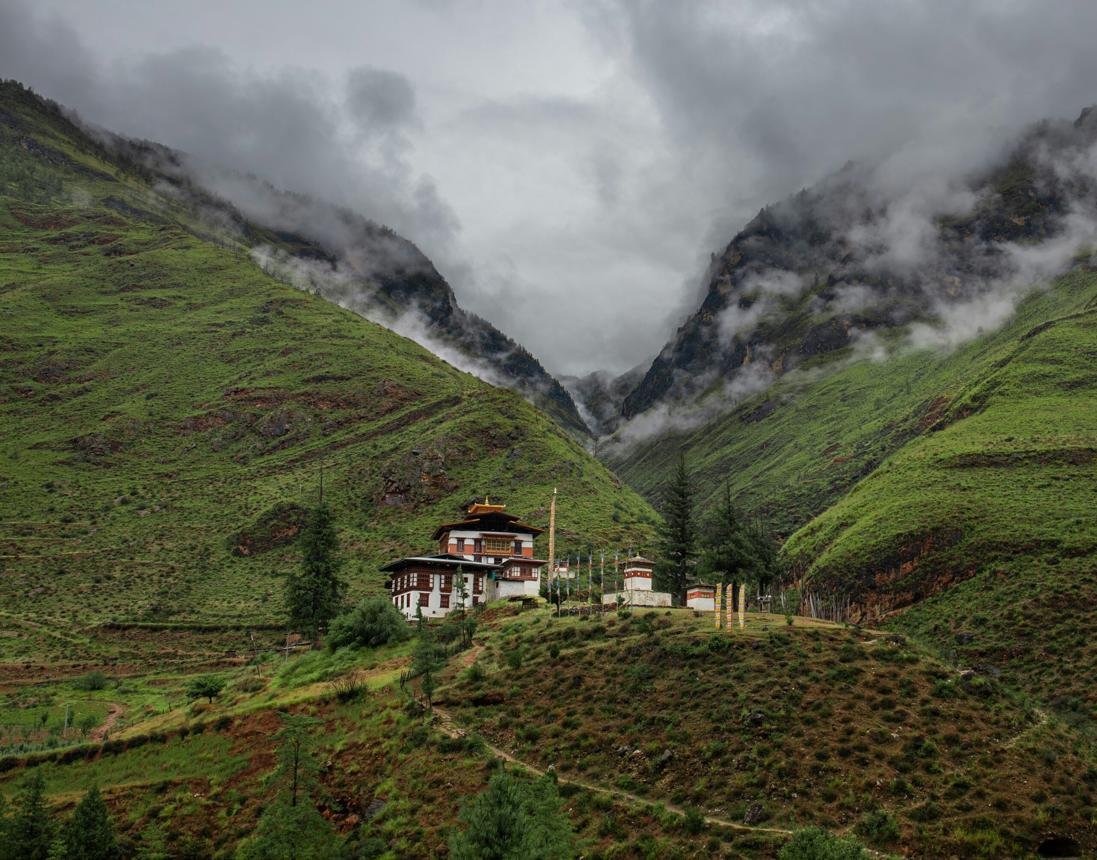
A Fascinating Look at Gross National Happiness, Forest Protection and a Unique Way of Development
When people think about the progress of a country, they usually think about GDP, income, industries, roads, technology and economic growth.
But there is a small Himalayan country that became famous for asking a different question:
“Is economic growth enough to make a country truly successful?”
That country is Bhutan.
Nestled between India and China in the eastern Himalayas, Bhutan is known for its mountains, monasteries, forests and distinctive cultural traditions. But one of its most remarkable features is its approach to national development.
Instead of treating economic growth as the only measure of progress, Bhutan developed the philosophy of Gross National Happiness (GNH).
And the story behind it is far more interesting than the name suggests.


🏔️ Where Is Bhutan?
Bhutan is a landlocked Himalayan kingdom located between India and China.
Its landscape is dominated by:
- High mountains
- Deep valleys
- Forests
- Rivers
- Traditional Buddhist architecture
- Small towns and settlements
The country’s geography has played an important role in shaping its culture and development.
Its mountainous terrain also means that protecting forests, water resources and biodiversity is especially important.
Bhutan’s government has therefore made environmental conservation a central part of its national development philosophy.
😊 What Is Gross National Happiness?
The most famous idea associated with Bhutan is:
Gross National Happiness — GNH
The concept was developed under the leadership of King Jigme Singye Wangchuck, Bhutan’s Fourth King, in the 1970s.
The basic idea is that economic development should improve people’s overall quality of life, rather than focusing only on increasing national income.
Bhutan’s official description of GNH presents it as a holistic development approach involving people’s well-being, culture, environment and good governance.
This does not mean that Bhutan ignores money or economic development.
Instead, the philosophy attempts to balance economic development with other aspects of life.
🌱 The Four Pillars of Gross National Happiness
Bhutan’s GNH philosophy is traditionally organised around four major pillars.
1. Sustainable and Equitable Socio-Economic Development
Economic development matters, but the emphasis is on making development sustainable and beneficial to society.
2. Environmental Conservation
Bhutan gives extraordinary importance to forests, biodiversity and ecological protection.
3. Preservation and Promotion of Culture
Traditional culture, heritage and identity are considered important parts of national well-being.
4. Good Governance
The quality of government and institutions is also considered part of people’s overall well-being.
These four pillars are further developed into areas including health, education, psychological well-being, living standards, community vitality, culture, governance, ecological integration and balanced use of time.


📊 Does Bhutan Actually Measure Happiness?
This is where the story becomes particularly interesting.
GNH is not simply a slogan saying:
“Bhutanese people are happy.”
Bhutan developed a framework containing multiple indicators to examine different dimensions of people’s lives.
The official GNH framework has included nine domains, 38 sub-indexes, 72 indicators and 151 variables.
These areas cover subjects such as:
- Psychological well-being
- Living standards
- Health
- Education
- Time use
- Cultural diversity
- Community vitality
- Good governance
- Ecological conditions
So the idea is much broader than asking someone a simple question such as:
“Are you happy?”
🌳 Bhutan’s Extraordinary Forest Commitment
Bhutan has another remarkable feature that makes it stand out internationally.
Its Constitution requires the country to maintain at least 60% of its total land area under forest cover for all time.
This is not merely an environmental target written in a government plan.
It is a constitutional requirement.
Bhutan’s Department of Forests and Park Services currently reports forest cover of about 70.45%, with an additional 10.43% under shrubs, while 51.34% of the country’s total area is under protected-area management.
That makes Bhutan’s environmental policy one of the country’s most distinctive characteristics.
🌍 A Country That Wants to Remain Carbon Negative
Bhutan has also made strong climate commitments.
Its forests absorb significant amounts of carbon dioxide, and Bhutan has repeatedly committed itself to remaining carbon neutral.
Government environmental documents describe Bhutan as a net carbon sink, meaning its ecosystems absorb more carbon than the country emits overall.
This is especially remarkable because Bhutan is a small developing country with a relatively modest industrial base.
Its environmental strategy demonstrates that economic development and environmental protection do not necessarily have to be treated as complete opposites.


🐯 Why Are Bhutan’s Forests So Important?
Bhutan’s forests are not valuable only because they look beautiful.
They provide:
- Wildlife habitat
- Clean water
- Protection against soil erosion
- Carbon storage
- Biodiversity
- Natural resources
- Ecosystem services for communities
The country’s protected-area network includes national parks, wildlife sanctuaries, nature reserves and biological corridors.
This approach has helped Bhutan maintain important habitats across its mountainous landscape.
🛕 Culture Is Another Part of Development
Bhutan has carefully preserved many aspects of its traditional identity.
Visitors often notice:
- Dzongs
- Buddhist monasteries
- Traditional buildings
- Religious festivals
- Traditional clothing
- Local crafts
- Himalayan customs
Bhutan’s approach is unusual because cultural preservation is not treated merely as a tourism product.
It is considered part of national identity and well-being.
That is why modern development in Bhutan often exists alongside centuries-old cultural traditions.
⚡ Bhutan’s Economy Is Not Based Only on Happiness
It is important not to misunderstand the GNH philosophy.
Bhutan still needs:
Jobs + Income + Infrastructure + Education + Healthcare + Investment + Economic Growth
One of the country’s economically important sectors has historically been hydropower.
Bhutan’s mountainous terrain gives it significant hydropower potential, and electricity has become an important part of its economic relationship with neighbouring India.
Bhutan’s government also identifies hydropower as a major component of its development strategy.
🇮🇳 Bhutan and India: A Special Relationship
Bhutan shares a long border with India and has strong economic, cultural and diplomatic connections with its larger neighbour.
India has been an important partner in areas including:
- Hydropower
- Infrastructure
- Trade
- Education
- Development cooperation
- Connectivity
For Bhutan, cooperation with India is particularly significant because of its geography and landlocked position.
🚀 Bhutan Is Also Changing
It would be wrong to imagine Bhutan as a country frozen in the past.
The country is developing modern infrastructure, expanding digital services and looking for new economic opportunities.
One of the major current initiatives is Gelephu Mindfulness City, which the Bhutanese government describes as a transformative development initiative.
The 2026 State of the Nation report highlighted Gelephu Mindfulness City alongside initiatives such as the 21st Century Economic Roadmap.
This shows that Bhutan is attempting to combine:
Tradition + Technology + Economic Development + Well-being
rather than choosing only one of them.
🏙️ Can Other Countries Copy Bhutan’s Happiness Model?
This is a difficult question.
Bhutan’s approach was developed within a particular:
- Cultural environment
- Geographic setting
- Political history
- Economic structure
- Religious tradition
- Population size
Therefore, another country cannot simply copy Bhutan’s model and expect exactly the same results.
But the underlying question is universal:
Should a country’s success be measured only by how much money it produces?
That is the question Bhutan has encouraged the world to discuss.
🤔 Is Bhutan Really the “Happiest Country in the World”?
This is one of the biggest misconceptions about Bhutan.
You may see headlines saying:
“Bhutan is the world’s happiest country.”
But that statement is too simplistic.
Gross National Happiness is Bhutan’s development philosophy.
It is not the same thing as saying that Bhutan ranks first in every international happiness survey.
A country can use GNH as a policy framework without automatically being No. 1 in every global happiness ranking.
This distinction is important for accurate reporting.
🌟 Why Is Bhutan So Interesting?
Bhutan is fascinating because it challenges some assumptions about what development should look like.
A country can ask:
How much did our economy grow?
But Bhutan also asks:
How are our people living?
Is our environment healthy?
Are we preserving our culture?
Is development sustainable?
Is government serving society effectively?
These questions make Bhutan’s development philosophy unusual in the modern world.
📌 10 Fascinating Facts About Bhutan
1️⃣ Bhutan is a Himalayan kingdom between India and China.
2️⃣ It developed the philosophy of Gross National Happiness.
3️⃣ GNH considers more than economic output.
4️⃣ Bhutan’s Constitution requires at least 60% forest cover to be maintained permanently.
5️⃣ The country’s current forest cover is reported at about 70.45% by Bhutan’s forestry authorities.
6️⃣ More than half of Bhutan’s territory is under protected-area management, according to its forestry authorities.
7️⃣ Hydropower is an important part of the country’s economy.
8️⃣ Bhutan places strong emphasis on preserving its cultural heritage.
9️⃣ Bhutan has committed to maintaining carbon neutrality.
🔟 The country is now pursuing new economic and urban-development initiatives while retaining its GNH philosophy.
🇧🇹 The Real Lesson From Bhutan
Bhutan’s greatest uniqueness may not be its mountains, monasteries or forests.
It may be the question it asks about development.
For decades, the world has often measured national success through:
GDP + Income + Production + Economic Growth
Bhutan added another dimension:
Well-being + Culture + Environment + Good Governance
It does not mean economic growth is unimportant.
Instead, Bhutan’s philosophy argues that economic development should serve human well-being rather than becoming the only definition of progress.
That idea is what made this small Himalayan country famous far beyond its borders.
🌏 Bhutan may be small on the world map, but its question is enormous:
“What does it really mean for a country to develop?”
And that is precisely why Bhutan deserves a special place in any World Information collection.
Leave a Reply