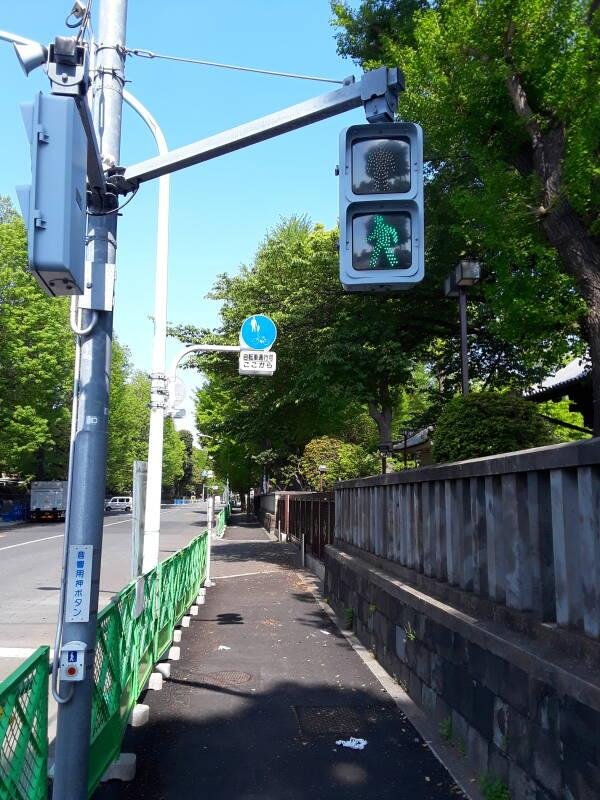
If you look at a traffic signal in Japan, you may notice something surprising.
The light that most of the world calls green is commonly referred to in Japanese as “ao” (青) — a word usually translated as blue.
So, does Japan really have blue traffic lights?
The answer is much more interesting than a simple yes or no.


🚦 A Green Light That Is Called “Blue”
In English, traffic signals are normally described as:
Red → Yellow → Green
But in Japan, the green signal is traditionally called:
青信号 (Ao-shingō)
Here, ao means blue, while shingō means signal.
So, literally, ao-shingō means “blue signal.”
For someone visiting Japan for the first time, this can sound strange. After all, the signal looks green to most people.
But the explanation goes back much further than modern traffic lights.
It is connected to the history of the Japanese language and the way colour words developed over centuries.
🎨 The Japanese Words “Ao” and “Midori”
Modern Japanese has a commonly used word for green:
Midori (緑)
It is used for many things we would clearly describe as green, including vegetation and other green objects.
There is also:
Ao (青)
which is normally associated with blue.
However, historically, ao covered a broader range of colours than the modern English word “blue.”
It could be used for colours that were blue, blue-green or vividly green in particular contexts.
This is why some traditional Japanese expressions can sound unusual when translated directly into English.
For example, Japanese still has familiar words and expressions containing ao that refer to things that appear green to English speakers.


📜 The Story Goes Back Centuries
The unusual use of ao is not something that was invented for traffic signals.
The word has a very long history in Japanese.
Historically, Japanese colour terminology did not always divide the visible colour spectrum into exactly the same categories used in modern English.
Over time, midori became strongly associated with green, especially natural greenery.
But ao continued to survive in older expressions and everyday language.
That history eventually became connected to one of the world’s most recognisable road signals.
🚥 When Did Japan Get Traffic Lights?
Japan’s first electric traffic light was installed in Hibiya, Tokyo, in 1930.
It was imported from the United States and used the familiar three-colour system.
Interestingly, the original Japanese legislation referred to the “go” colour as midori, meaning green.
But ordinary people continued to call the signal ao.
The popular terminology eventually became so established that in 1947, ao-shingō was adopted in Japanese law as the official name for the “go” signal.
That means the strange-sounding expression has a genuine historical and legal background.
💚 So, Is Japan’s Traffic Light Actually Blue?
Not exactly.
Japanese traffic signals generally serve the same three basic functions as traffic signals elsewhere:
🔴 Red — Stop
🟡 Yellow — Caution
🟢 Green — Go
The “blue” mystery is mainly about the name, not about Japan changing the basic meaning of the signal.
However, there is another interesting detail.
Some Japanese green traffic signals can appear somewhat blue-green or cyan rather than the deeper green many people expect.
This helps explain why the traditional terminology does not always feel completely disconnected from what people see.
But the main reason remains language and history, not a completely different traffic-light system.


💡 Why Do Some Japanese Signals Look Blue-Green?
Modern LED technology has made traffic signals brighter and more precisely controlled.
Japan has also played an important role in LED technology. Japanese researchers Akasaki Isamu, Amano Hiroshi and Nakamura Shuji were awarded the 2014 Nobel Prize in Physics for work related to efficient blue LEDs. Blue LEDs later became important in displays, lighting and traffic signals.
But it would be incorrect to say that Japan uses blue traffic lights simply because of blue-LED technology.
The name “ao-shingō” existed long before modern LED traffic signals.
The language came first; the technology came later.
🗣️ Why Didn’t Japan Simply Change the Name to “Midori”?
This is where language becomes fascinating.
Once a word becomes deeply established in everyday speech, changing it can be surprisingly difficult.
Millions of people already understood ao-shingō to mean the signal that tells traffic it can proceed.
Changing the name would create little practical benefit while breaking a familiar linguistic tradition.
In 1947, the term was officially incorporated into Japanese law, helping preserve the expression.
So today, Japanese speakers can understand:
Ao = traditionally blue, but also used in certain green-related expressions
and
Midori = modern word strongly associated with green
without seeing this as the contradiction it may appear to be to an English speaker.
🌿 This Is Not the Only Japanese “Blue-Green” Mystery
The relationship between ao and green appears in other Japanese vocabulary too.
For example, expressions involving fresh foliage and green vegetables can use ao.
One famous example is:
Aoba (青葉)
which refers to fresh green leaves.
Another is:
Aomame (青豆)
used for green soybeans.
These expressions show that the historical meaning of ao was broader than the modern English definition of “blue.”
🗻 Even “Aomori” Has an Interesting Connection
Japan’s Aomori Prefecture provides another interesting example of the old association.
The name Aomori is commonly explained as referring historically to green vegetation or trees associated with the area.
The exact historical interpretation of place names can be complex, but it provides another illustration of how ao has long been connected with the natural world and greenery in Japanese language and culture.


🌏 What Does This Teach Us About Language?
The Japanese traffic-light story demonstrates something important:
Colours are not understood through exactly the same linguistic categories in every culture.
We often assume that colours have universal names.
Red is red.
Blue is blue.
Green is green.
But languages divide and describe colours differently.
A word that traditionally covers a wider range of shades in one language may have a much narrower translation in another.
That is why translating ao = blue and stopping there can create a misleading impression.
Language is not simply a dictionary of one-to-one replacements.
It carries history, culture and everyday habits.
🤯 Why Does This Fact Surprise Tourists?
Imagine learning Japanese and memorising:
Midori = Green
Ao = Blue
Then you arrive in Tokyo and see a green traffic signal.
Someone tells you:
“Ao-shingō.”
You might immediately think:
“Wait… isn’t that green?”
That moment is exactly what makes this one of Japan’s most fascinating everyday cultural facts.
It looks like a simple traffic signal.
But behind it are:
Language + History + Culture + Technology
🇯🇵 Japan’s Traffic Lights Are a Lesson in Cultural Differences
Japan is known for its advanced technology, extremely organised transport systems and attention to detail.
Yet this particular curiosity has nothing to do with Japan being technologically different.
Instead, it shows how an old linguistic tradition can survive inside a modern technological system.
A traffic light introduced in the early twentieth century became part of a language tradition that was already centuries old.
That combination makes the Japanese ao-shingō story particularly fascinating.
🔍 Quick Facts About Japan’s “Blue” Traffic Light
| Question | Answer |
|---|---|
| What does ao usually mean? | Blue, but historically it can cover blue-green/green shades |
| What does midori mean? | Green |
| What is a Japanese green traffic signal called? | Ao-shingō (青信号) |
| When was Japan’s first electric traffic light installed? | 1930 |
| Where? | Hibiya, Tokyo |
| When was ao-shingō adopted in law? | 1947 |
| Does “blue signal” mean the light is literally blue? | No |
| Why is it called blue? | Historical Japanese colour terminology and established usage |
The historical details above are documented in research on Japanese colour terminology and the history of the traffic signal term.
🌟 The Fascinating Conclusion
Japan’s so-called “blue traffic lights” are not really a story about a country using a completely different traffic system.
They are a story about how language survives through time.
A colour word that once covered a wider range of shades remained part of everyday Japanese vocabulary. When traffic lights arrived, people used the familiar word ao for the green “go” signal. Eventually, ao-shingō became officially established.
So the next time you see a Japanese traffic signal described as blue, remember:
💙 It is not simply a mistake in translation.
💚 It is a piece of Japanese linguistic history.
And that is what makes an ordinary traffic light one of the most interesting little cultural mysteries in Japan.
Leave a Reply