In Part 18, we explored the traditional story of Sage Valmiki and how the Ramayana came to be associated with him.
Now let us look at the complete structure of the epic.
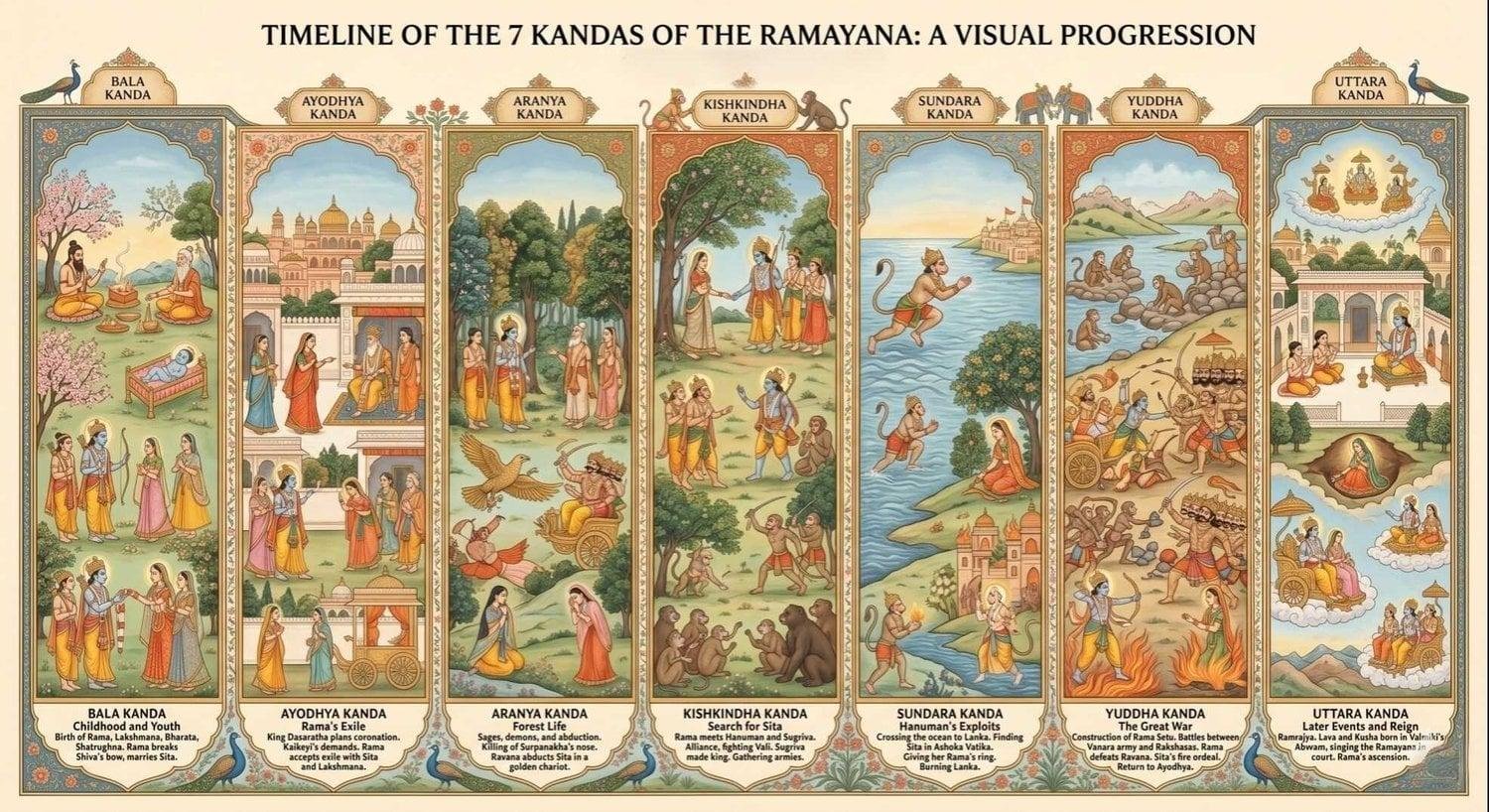
The Ramayana is traditionally divided into seven major sections, known as Kandas.
Each Kanda covers an important stage in Rama’s life — from his childhood to his final years.
📖 The Seven Kandas of the Ramayana
The traditional seven Kandas are:
- Bala Kanda – Rama’s childhood and early life
- Ayodhya Kanda – The exile from Ayodhya
- Aranya Kanda – Life in the forest
- Kishkindha Kanda – Rama meets Hanuman and Sugriva
- Sundara Kanda – Hanuman’s journey to Lanka
- Yuddha Kanda – The great war with Ravana
- Uttara Kanda – Events after Rama’s return
Let’s explore each one.


The Seven Kandas of the Ramayana
1️⃣ Bala Kanda – The Beginning of Rama’s Story
Bala Kanda introduces us to Rama and his family.
King Dasharatha rules Ayodhya.
Although he is a powerful king, he does not have children.
He eventually performs a sacred ritual, after which his four sons are born:
👑 Rama
👑 Bharata
👑 Lakshmana
👑 Shatrughna
Rama is the eldest.
From childhood, he is shown as disciplined, courageous and responsible.
🏹 Rama Meets Sage Vishwamitra
One of the important events of Bala Kanda occurs when Sage Vishwamitra comes to Dasharatha.
He asks Rama and Lakshmana to accompany him.
The young princes protect the sage’s ritual from powerful enemies.
This becomes an important stage in Rama’s development as a warrior.
💍 Rama and Sita Meet
Rama later travels to Mithila, where King Janaka has arranged a ceremony connected with the marriage of his daughter Sita.
The famous Shiva’s bow plays a major role.
Rama is able to lift and break the bow.
Rama and Sita are then married.
Their marriage becomes one of the central relationships of the entire epic.


Rama and Sita’s Marriage
2️⃣ Ayodhya Kanda – The Great Sacrifice
The second Kanda is one of the most emotional sections.
Dasharatha decides to make Rama the crown prince.
The people of Ayodhya are delighted.
But the situation suddenly changes.
👑 Kaikeyi’s Two Boons
Queen Kaikeyi, influenced by her attendant Manthara, asks Dasharatha to fulfil two promises he had previously granted her.
She asks for:
1. Bharata to become king
2. Rama to be sent into exile for fourteen years
Dasharatha is devastated.
But Rama accepts the decision.
🌳 Rama Goes Into Exile
Rama leaves Ayodhya.
Sita chooses to accompany him.
Lakshmana also refuses to remain behind.
The three begin their forest journey together.
Dasharatha is heartbroken.
The people of Ayodhya follow Rama for some distance, unable to accept his departure.


Rama, Sita and Lakshmana Leave Ayodhya
❤️ Bharata’s Love for Rama
Bharata is away when these events occur.
When he returns and learns what happened, he is deeply upset.
He refuses to take Rama’s place as rightful king.
Instead, he goes to the forest and asks Rama to return.
Rama refuses because he has given his word to complete the exile.
Bharata then takes Rama’s padukas and places them on the throne.
He rules as Rama’s representative.
This is one of the strongest examples of brotherly loyalty in the epic.
3️⃣ Aranya Kanda – Life in the Forest
The third Kanda follows Rama, Sita and Lakshmana during their forest life.
They visit different hermitages.
They meet sages and experience many challenges.
The peaceful forest life eventually changes dramatically.
👹 Surpanakha and the Turning Point
Rama encounters Surpanakha, who becomes interested in him.
The episode leads to conflict involving Lakshmana and Surpanakha.
The events eventually bring Rama into conflict with powerful forces connected with Lanka.
Among them is Ravana.
🦌 The Golden Deer
One of the most famous episodes occurs when Sita sees a beautiful golden deer.
The deer is actually associated with the demon Maricha.
Sita asks Rama to capture it.
Rama follows the deer.
Later, Maricha imitates Rama’s voice.
Sita becomes worried and asks Lakshmana to go after Rama.
Lakshmana eventually leaves.


The Golden Deer
👑 Ravana Abducts Sita
Ravana arrives disguised as a mendicant.
He takes advantage of the situation and abducts Sita.
He carries her to Lanka.
The search for Sita begins.
This event becomes the central turning point of the Ramayana.
🐦 Jatayu Tries to Help
The great bird Jatayu sees Ravana carrying Sita away.
He attempts to stop him.
Jatayu fights bravely but is badly wounded.
Rama later finds him.
Before dying, Jatayu tells Rama what happened.
His sacrifice becomes an important symbol of courage and loyalty.
4️⃣ Kishkindha Kanda – Rama Meets Hanuman
The fourth Kanda takes us to Kishkindha.
Rama and Lakshmana meet Hanuman.
This meeting changes the entire course of the story.
Hanuman brings Rama to Sugriva.


Rama Meets Hanuman
🐒 Rama and Sugriva Become Allies
Sugriva has his own problem.
He has lost his kingdom to his brother Vali.
Rama agrees to help Sugriva regain his position.
In return, Sugriva promises to help Rama find Sita.
Their alliance becomes extremely important.
🌏 The Search for Sita
After Sugriva becomes ruler again, Vanara groups are sent in different directions to search for Sita.
One group eventually reaches the southern coast.
They learn that Sita is in Lanka.
But there is a huge obstacle:
🌊 The Ocean
Someone must cross it.
That person is Hanuman.
5️⃣ Sundara Kanda – Hanuman’s Greatest Journey
Sundara Kanda is one of the most beloved sections of the Ramayana.
It focuses mainly on Hanuman’s journey to Lanka.
Hanuman grows in confidence and prepares to cross the ocean.


Hanuman Crosses the Ocean
🏝️ Hanuman Reaches Lanka
Hanuman enters Lanka and searches for Sita.
Eventually, he finds her in the Ashoka grove.
Sita is surrounded by guards and refuses Ravana’s demands.
Hanuman approaches her carefully.
He gives her Rama’s message and shows her Rama’s ring.
Sita is relieved to know that Rama is coming.
🔥 Hanuman’s Lanka Mission
Hanuman then causes major disruption in Lanka.
He is captured by Ravana’s forces.
His tail is set on fire.
Hanuman uses the fire to set parts of Lanka ablaze.
He then escapes and returns toward Rama.
💍 Sita Gives Hanuman a Message
Before Hanuman leaves, Sita gives him a jewel as a token for Rama.
Hanuman returns with proof that he has found her.
The search has succeeded.
Now Rama knows exactly where Sita is.
6️⃣ Yuddha Kanda – The Great War
The sixth Kanda brings the story to its greatest military confrontation.
Rama’s army reaches the ocean.
A bridge is constructed toward Lanka.
The Vanara army crosses into Lanka.


Rama’s Army Reaches Lanka
⚔️ The Battle Begins
The war between Rama’s forces and Ravana’s army begins.
Many powerful warriors fight.
Among the major figures are:
Hanuman
Sugriva
Angada
Lakshmana
Vibhishana
Kumbhakarna
Indrajit
Ravana
The battle becomes increasingly intense.
💥 Kumbhakarna Falls
Ravana’s giant brother Kumbhakarna enters the battlefield.
He fights fiercely.
But Rama eventually defeats him.
Ravana suffers another major loss.
⚡ Indrajit Is Defeated
Ravana’s son Indrajit is among his most powerful warriors.
Lakshmana eventually confronts him.
After a difficult battle, Indrajit is defeated.
Ravana loses another important member of his family.
🏹 Rama vs Ravana
Finally, Rama and Ravana face each other.
Their final battle becomes the climax of the war.
Rama ultimately defeats Ravana.
The war ends.
Sita is rescued.


Rama Defeats Ravana
7️⃣ Uttara Kanda – The Later Story
The seventh and final Kanda is traditionally known as Uttara Kanda.
It deals with events associated with Rama’s life after the Lanka war and his return to Ayodhya.
This section includes important episodes involving:
- Rama’s rule
- Sita’s later life
- Lava and Kusha
- Valmiki
- The Ashwamedha
- Sita’s final departure
- The later years of Rama
👦 Lava and Kusha
Sita lives at Valmiki’s hermitage.
Her sons Lava and Kusha grow up there.
Valmiki teaches them the Ramayana.
They eventually meet Rama.
Their story forms one of the most emotional parts of the later epic.


Lava and Kusha
🌍 Seven Kandas — One Great Journey
If we look at the entire Ramayana, the seven Kandas form one continuous journey.
| Kanda | Main Theme |
|---|---|
| Bala Kanda | Rama’s childhood, Vishwamitra and Sita’s marriage |
| Ayodhya Kanda | Exile and Bharata’s devotion |
| Aranya Kanda | Forest life and Sita’s abduction |
| Kishkindha Kanda | Hanuman, Sugriva and the search for Sita |
| Sundara Kanda | Hanuman’s journey to Lanka |
| Yuddha Kanda | Lanka war and Ravana’s defeat |
| Uttara Kanda | Later life of Rama, Sita, Lava and Kusha |
❤️ What Makes Each Kanda Special?
🌱 Bala Kanda
The beginning of Rama’s journey
🏠 Ayodhya Kanda
Duty and sacrifice
🌳 Aranya Kanda
Separation and struggle
🐒 Kishkindha Kanda
Friendship and alliance
🌊 Sundara Kanda
Devotion and courage
⚔️ Yuddha Kanda
The great conflict
🌺 Uttara Kanda
Family, responsibility and the later years
Together, these sections create a story that has remained culturally powerful for generations.
🕉️ Important Note About Different Ramayana Traditions
One thing every reader should remember is that not every Ramayana tradition tells every episode in exactly the same way.
The Valmiki Ramayana is the classical Sanskrit tradition most closely associated with the original epic.
Later poets and communities created many retellings.
Therefore, some popular stories may have:
- Different details
- Different interpretations
- Different character portrayals
- Different endings or additional episodes
This variety is one of the remarkable features of the Ramayana tradition.
🌟 Why the Seven Kandas Matter Today
The seven Kandas are more than chapters in an old epic.
They show the transformation of Rama from:
A young prince
➡️ A husband
➡️ An exile
➡️ A warrior
➡️ A leader
➡️ A king
➡️ A figure remembered through generations
And alongside Rama’s journey are the stories of Sita, Lakshmana, Bharata, Hanuman, Sugriva, Vibhishana, Ravana, Valmiki and many others.
🕉️ Conclusion
The Ramayana is traditionally divided into seven Kandas, each representing an important stage of the story.
From the birth of Rama in Bala Kanda to the later events of Uttara Kanda, the epic takes readers through love, exile, friendship, courage, war, sacrifice and responsibility.
That is why the Ramayana has remained one of India’s most influential epics.
📖 Seven Kandas.
👑 One extraordinary journey.
🕉️ A story remembered across generations.
🌟 NEXT PART
Part 20: Hanuman – The Complete Story | Birth, Powers, Rama Bhakti and His Greatest Adventures
In the next article, we will leave the main timeline for a moment and explore one of the most beloved characters of the Ramayana:
🐒 Lord Hanuman
His birth, childhood, powers, meeting with Rama, journey to Lanka, Sanjeevani episode and why millions of people continue to worship and admire him
Leave a Reply