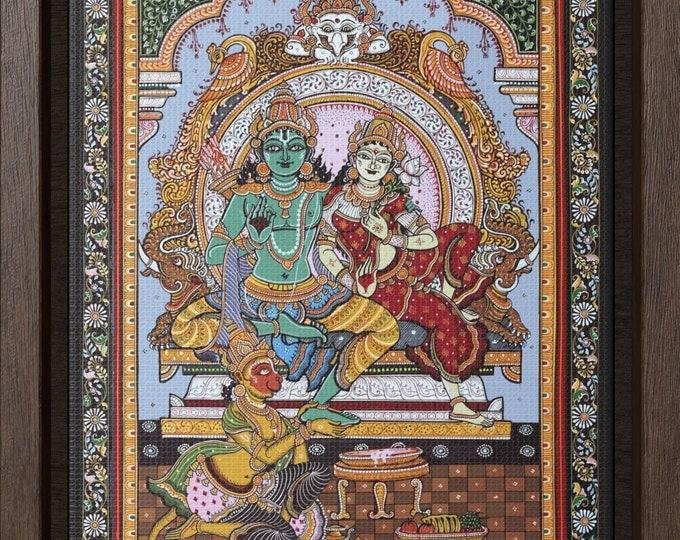
In the next article, we’ll explore how the Ramayana became part of Tamil, Kannada and Malayalam culture, the famous regional literary traditions, temple celebrations, storytelling and performance forms, and how South India gave the epic its own distinctive voices.


One Epic, Many South Indian Traditions
The Ramayana has a particularly rich presence in South India.
Across Tamil Nadu, Karnataka and Kerala, the story has been preserved through:
📖 Literature
🎵 Devotional music
🎭 Theatre
💃 Dance
🛕 Temple traditions
🗣️ Storytelling
Although the central story remains familiar, each region developed its own way of understanding and presenting Rama’s journey.
The Ramayana in Tamil Tradition
Tamil literature has one of India’s most celebrated Ramayana retellings:
Kamba Ramayanam
Composed by Kambar, this magnificent Tamil work transformed the Ramayana into a major Tamil literary tradition.
Kambar did more than translate the Sanskrit epic.
He used the richness of Tamil poetry to express:
❤️ Love
🙏 Devotion
⚔️ Heroism
😢 Sorrow
👑 Kingship
His work remains one of the great achievements of Tamil literature.


Kambar’s Rama
Kambar’s portrayal of Rama is deeply connected with devotion.
Rama is presented not only as a heroic prince but also as a figure of divine significance.
The poet uses powerful descriptions of nature, emotions and battles to make the story vivid.
This helped the Ramayana become deeply connected with Tamil literary and devotional culture.
Ramayana in Tamil Temple Culture
Rama and related characters appear in many Tamil temples.
Temple traditions may include:
🛕 Rama and Sita shrines
🙏 Hanuman worship
🎵 Religious recitations
🎭 Festival performances
🪔 Special celebrations
The temple therefore becomes another place where the Ramayana remains part of living culture.
The Ramayana in Kannada
Karnataka also developed a rich Ramayana literary tradition.
Among the notable works is the Torave Ramayana, traditionally associated with Kumara Valmiki.
Kannada writers and performers adapted Rama’s story for their own literary and cultural environment.
The epic also entered Karnataka’s theatre and storytelling traditions.


Yakshagana and the Ramayana
One of Karnataka’s most spectacular performance traditions is Yakshagana.
It combines:
🎭 Drama
🎵 Music
🥁 Percussion
💃 Movement
👑 Elaborate costumes
Ramayana stories have been performed through Yakshagana for generations.
The dramatic costumes and energetic performances make characters such as Rama, Ravana and Hanuman especially memorable.


The Ramayana in Kerala
Kerala has its own strong Ramayana tradition.
One of the most important Malayalam works is:
Adhyatma Ramayanam Kilippattu
Associated with Thunchaththu Ezhuthachan, this work became deeply influential in Malayalam literary and devotional culture.
For many Malayalam-speaking families, the month of Karkidakam is traditionally associated with reading or listening to the Ramayana.
Karkidakam and Ramayana Reading
Karkidakam is sometimes popularly associated with the Ramayana month in Kerala.
Families may read or listen to the Adhyatma Ramayanam during this period.
This creates a special connection between:
🌧️ The monsoon season
📖 Ramayana reading
🙏 Devotion
👨👩👧👦 Family tradition
The practice demonstrates how literature can become part of the rhythm of everyday life.


Kathakali and the Ramayana
Kerala’s famous classical theatre tradition, Kathakali, has also presented stories from the Ramayana.
Its distinctive visual language includes:
🎨 Elaborate makeup
👑 Large costumes
👀 Expressive eyes
🤲 Hand gestures
🥁 Percussion
The audience can recognize characters through their dramatic appearance even before they speak.
Rama and Ravana in Kathakali
Kathakali allows performers to explore the personalities of the Ramayana characters through highly stylized acting.
Rama can represent dignity and righteousness.
Ravana can represent power, pride and dramatic intensity.
The confrontation between these characters becomes a visual and emotional experience.


South Indian Dance and the Ramayana
The Ramayana is also deeply connected with South Indian classical dance.
In Bharatanatyam, performers can portray episodes through:
👋 Mudras
👀 Facial expressions
💃 Movement
🎵 Music
A dancer may portray Sita’s emotions, Rama’s journey or Hanuman’s devotion without requiring a large stage set.
The audience follows the story through the performer’s expression and gestures.
Temple Festivals and Rama
Across South India, Rama temples continue to celebrate important occasions.
Sri Rama Navami is especially significant.
Celebrations can include:
🛕 Temple rituals
🎵 Devotional music
🙏 Special prayers
📖 Ramayana recitation
💍 Sita Rama Kalyanam
Local customs vary considerably from one temple to another.


Different Languages, Shared Story
Tamil, Kannada and Malayalam traditions demonstrate how a single epic can develop many artistic identities.
Tamil
Kamba Ramayanam and Tamil devotional traditions.
Kannada
Torave Ramayana and Yakshagana.
Malayalam
Adhyatma Ramayanam Kilippattu and Kathakali.
Each region contributes something different.
Yet Rama, Sita, Lakshmana, Hanuman and Ravana remain recognizable throughout.
The Role of Local Artists
Regional artists played an enormous role in keeping these traditions alive.
Poets created literature.
Singers created devotional compositions.
Actors performed epic scenes.
Dancers expressed emotions.
Storytellers passed episodes to new audiences.
Together, they transformed the Ramayana into a living cultural tradition.
Why Regional Versions Matter
Regional Ramayana traditions are important because they show that Indian culture is not a single uniform tradition.
It contains many voices.
The Ramayana became a bridge between these cultures.
The same story could be expressed through different languages while remaining part of a larger shared tradition.
The Ramayana Today
These traditions have not disappeared.
They continue through:
📚 Books
🛕 Temples
🎭 Theatre
💃 Dance
🎵 Music
📺 Television
🎬 Cinema
📱 Digital media
Modern technology has created new ways for audiences to discover traditions that once depended mainly on live performance and oral storytelling.


Conclusion
South India has given the Ramayana some of its most influential literary and artistic expressions.
From Kambar’s Kamba Ramayanam in Tamil to the Torave Ramayana in Kannada and Adhyatma Ramayanam Kilippattu in Malayalam, the epic has developed remarkable regional identities.
Through Yakshagana, Kathakali, Bharatanatyam, temple festivals and devotional traditions, the story continues to reach new generations.
🕉️ The Ramayana may have travelled across languages, regions and centuries, but every generation found its own way to give the ancient story a new voice.
In the next part, we will explore the Ramayana’s influence on Indian art and painting — from ancient temple sculptures and murals to miniature paintings and modern artistic representations of Rama, Sita and Hanuman.
Leave a Reply