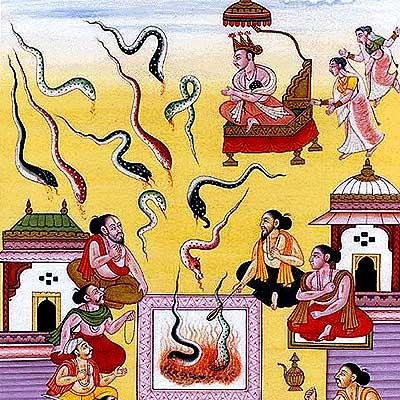
Janamejaya’s Serpent Sacrifice – The Story of the Mahabharata
After the death of Parikshit, his son Janamejaya became king.
But Janamejaya could not forget how his father had died.
He blamed the serpent king Takshaka and decided to take revenge.
His decision would lead to one of the most important gatherings in the history of the Mahabharata.


1. Janamejaya Wants Revenge
Janamejaya was deeply angry about the death of his father Parikshit.
He wanted Takshaka to be punished.
His anger gradually became a desire to destroy all serpents.
He decided to perform a huge ritual known as the Sarpa Satra, or serpent sacrifice.


2. The Great Sacrifice Begins
Janamejaya invited many learned sages and priests to the ritual.
A massive sacrificial fire was prepared.
The priests began performing powerful rituals.
Through the power of the sacrifice, serpents were being drawn toward the fire.
Janamejaya believed that Takshaka would soon be brought before him.


3. Takshaka Seeks Protection
Takshaka became frightened.
He sought protection from Indra, the king of the gods.
Takshaka hoped that Indra’s protection would prevent him from being pulled into the sacrificial fire.
But Janamejaya’s sacrifice continued with great power.
4. The Priests Call Takshaka
The priests intensified the ritual.
Takshaka was eventually drawn toward the sacrificial fire.
But he was still protected by Indra.
Janamejaya demanded that Takshaka be brought into the fire.
The situation became increasingly dangerous.


5. Astika Appears
At this critical moment, a young and wise sage named Astika arrived.
Astika was connected to both the human and serpent lineages.
He understood that Janamejaya’s anger had gone too far.
He wanted to stop the destruction.


6. Janamejaya Is Impressed by Astika
Astika praised Janamejaya and spoke respectfully to him.
The king was impressed by Astika’s wisdom.
Janamejaya offered him a boon.
Astika then asked for the serpent sacrifice to be stopped.
Janamejaya was surprised.
But he had given his word.
7. The Sacrifice Is Stopped
Janamejaya honored his promise.
The serpent sacrifice was stopped.
Takshaka was saved.
The destruction of the serpents came to an end.
Astika had prevented Janamejaya’s anger from causing even greater destruction.
8. Janamejaya Learns a Lesson
Janamejaya understood that revenge could create endless suffering.
His father had died because of Takshaka.
But destroying every serpent would not bring Parikshit back.
Astika’s wisdom helped him understand the importance of restraint and compassion.
The king accepted the lesson.


9. The Great Gathering of Sages
The serpent sacrifice had brought together many great sages.
Among them was Vaishampayana, a disciple of Vyasa.
Janamejaya wanted to hear the history of his ancestors.
He asked for the story of the Kuru dynasty.
This created the setting for the great narration of the Mahabharata.


10. The Story of the Kuru Dynasty
Vaishampayana began narrating the history of the Kuru family.
He told the stories of:
- Shantanu
- Bhishma
- Pandu
- Dhritarashtra
- Kunti
- Pandavas
- Kauravas
- Krishna
- Kurukshetra War
The history of several generations was brought together into one great narrative.


11. From One Generation to Another
The Mahabharata had passed through many generations.
From the elders of the Kuru dynasty to the Pandavas, and from the Pandavas to Parikshit and Janamejaya, the story continued.
Every generation carried the lessons and consequences of the previous one.
This is one of the reasons the Mahabharata became more than just a story about a war.
It became a vast exploration of dharma, duty, relationships, power and human choices.


12. The Importance of Astika
Astika’s intervention saved countless lives.
He showed that wisdom can stop anger from becoming destruction.
Janamejaya had the power to continue the sacrifice.
But keeping his promise and listening to Astika changed the outcome.
The story teaches an important lesson:
Revenge may continue a cycle of suffering, while wisdom can bring it to an end.
13. The Mahabharata Becomes a Legacy
The stories narrated to Janamejaya preserved the memory of the Kuru dynasty.
The struggles of the Pandavas and Kauravas were passed from one generation to another.
The lessons of Krishna’s teachings, the decisions of Yudhishthira, the courage of Arjuna and the sacrifices of countless warriors became part of a great cultural tradition.


14. The Story Lives On
The Mahabharata does not end simply with the death of its heroes.
Its greatest strength is in the questions it leaves behind:
What is dharma?
What happens when anger controls us?
Can victory truly compensate for loss?
How should a person choose between duty and emotion?
These questions continue to make the Mahabharata meaningful even today.


MAHA BHARATHAM – THE GREAT STORY
We have now reached the end of the main chronological story of the Pandavas, Kauravas and the Kuru dynasty.
But there are still many important stories, teachings and characters that deserve separate articles.
We can continue with Maha Bharatham Part 30 – Important Characters, Stories and Lessons from Mahabharata, and cover the most important episodes one by one.
Frequently Asked Questions
Why did Janamejaya perform the Sarpa Satra?
He wanted revenge for the death of his father, Parikshit, who died after being bitten by Takshaka.
Who stopped the serpent sacrifice?
Astika stopped the sacrifice.
Who was Astika?
Astika was a wise sage connected with both the human and serpent lineages.
Who narrated the Mahabharata to Janamejaya?
The traditional account describes Vaishampayana, disciple of Vyasa, narrating the great story to Janamejaya.
What is the main lesson of the serpent sacrifice?
The episode highlights the danger of uncontrolled revenge and the importance of wisdom, restraint and compassion
Leave a Reply