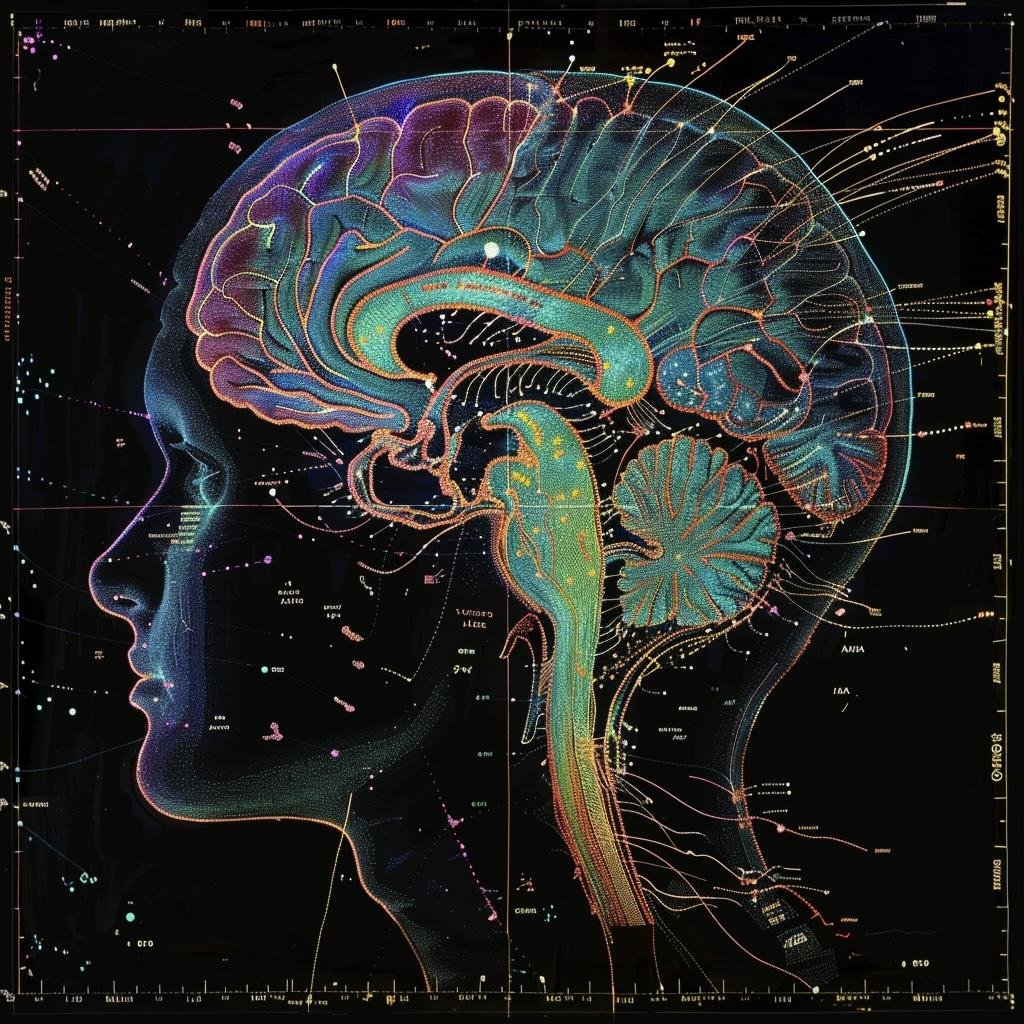
Your brain weighs only around 1.3–1.4 kilograms.
Yet this small organ controls your thoughts, memories, emotions, movements, language and even the automatic processes that keep you alive.
Every second, your brain is processing enormous amounts of information.
But here is the really interesting part:
You still don’t fully understand everything your own brain is capable of doing.
Let’s explore some fascinating brain facts that can make you look at yourself—and the human mind—in a completely different way.


🤯 1. Your Brain Is Always Working
Even when you’re sleeping, your brain doesn’t simply “switch off.”
During sleep, the brain remains active and carries out important processes related to memory, learning and the regulation of the body.


That’s why you can wake up after several hours of sleep and immediately know where you are and who you are.
Your brain was never truly offline.
⚡ 2. Your Brain Communicates Using Electrical Signals
Your brain contains billions of nerve cells called neurons.
Neurons communicate with one another using electrical and chemical signals.


These signals allow information to travel through networks inside your nervous system.
Every time you move your hand, recognize a face, read a sentence or remember something, complex networks of neurons are involved.
👀 3. Your Brain Helps You See—Not Your Eyes Alone
Your eyes collect light.
But your brain interprets that information and turns it into what you experience as vision.


The brain has to process shapes, colors, movement, depth and countless other details.
In other words:
Your eyes collect information. Your brain makes sense of it.
🧠 4. Your Brain Can Change
For a long time, scientists thought the adult brain was relatively fixed.
Modern neuroscience has shown that the brain can change its connections and organization in response to learning, experience and other factors.
This ability is called neuroplasticity.


Learning a new language, practising an instrument or developing a new skill can involve changes in neural networks.
🌟 That’s Good News
Your brain isn’t simply a machine that stays exactly the same.
Experience can shape it.
🎵 5. Music Can Activate Many Brain Systems
Why can one song make you happy while another reminds you of an old memory?
Music can involve multiple brain systems related to hearing, emotion, movement, attention and memory.


That’s one reason a familiar song can suddenly bring back memories you haven’t thought about for years.
🧩 6. Memories Are Not Like Computer Files
A common misconception is that memories are stored in the brain like individual files on a hard drive.
Human memory is much more complicated.


Memories involve networks of brain activity.
And remembering something isn’t necessarily like playing back an exact recording.
Each time you remember an event, the brain can reconstruct aspects of that memory.
That is one reason human memories can sometimes change over time.
😴 7. Dreams Can Feel Completely Real
During certain stages of sleep, especially REM sleep, brain activity can be highly active.


Dreams can include people, places, emotions and stories that seem incredibly realistic while you’re experiencing them.
Scientists still study why we dream and exactly how different aspects of dreaming arise.
👃 8. Smell Is Closely Connected With Memory
Have you ever smelled a particular perfume, food or place and suddenly remembered something from years ago?
There is a reason this can happen.


The brain systems involved in smell have strong connections with areas involved in emotion and memory.
That’s why a smell can sometimes trigger a surprisingly powerful memory.
❤️ 9. Your Brain Helps Control Your Heartbeat
You don’t have to consciously tell your heart to beat.
The nervous system helps regulate automatic functions such as:
- ❤️ Heart rate
- 🫁 Breathing
- 🌡️ Body temperature
- 💧 Fluid balance
- 🍽️ Digestion


Your brain and nervous system are constantly coordinating these processes, even when you’re not thinking about them.
🔄 10. Your Brain Predicts What Happens Next
Your brain isn’t simply reacting to everything after it happens.
It also uses previous experience to make predictions about what is likely to happen next.


For example, when you read a sentence, your brain is already anticipating what kinds of words might come next.
When you recognize a familiar object, your brain can identify it incredibly quickly.
This predictive ability helps us navigate the world efficiently.
🗣️ 11. Your Brain Can Process Language Extremely Quickly
Reading a simple sentence seems easy.
But behind that simple action are many processes.
Your brain must recognize letters or sounds, identify words, understand grammar and connect the information with meaning.


All of this happens remarkably quickly.
🧠 12. The Brain Uses a Lot of Energy
Although the brain represents only a small fraction of total body weight, it consumes a significant share of the body’s energy at rest.


This energy is needed to maintain electrical activity, communication between neurons and many other cellular processes.
So even when you’re sitting quietly doing nothing physical, your brain is still an energy-hungry organ.
🎯 13. Multitasking Isn’t Always What You Think
You may feel like you’re doing several things at exactly the same time.
But for many demanding tasks, the brain is actually switching attention rapidly between activities.


That switching can make tasks less efficient and increase the chance of mistakes.
This is one reason focusing on one demanding task at a time can often be more effective.
🧘 14. Your Brain Can Influence How You Experience Pain
Pain is real, but the experience of pain isn’t determined only by physical signals from the body.
The brain also processes context, attention, emotion and expectations.


This is why two people can sometimes experience similar physical injuries very differently.
The nervous system and brain play major roles in how pain is perceived.
🧠 15. Your Brain Is Still Full of Mysteries
Despite decades of neuroscience research, scientists still don’t have complete answers to some of the biggest questions about consciousness, memory, dreams and subjective experience.


We know an enormous amount about the brain.
But compared with everything there is to discover, there is still much more to learn.
And that’s what makes neuroscience so fascinating.
🤯 Bonus: Your Brain Can Fool You
Your brain is incredibly powerful—but it isn’t a perfect recording device.
Optical illusions demonstrate that perception can sometimes differ from physical reality.


Your brain constantly interprets incomplete information and tries to construct the most useful explanation.
Sometimes, that interpretation can be wrong.
👀 The Strange Part
You can look directly at something and still perceive it incorrectly.
That’s not necessarily a failure.
It’s a reminder that what you experience is the brain’s interpretation of information—not a perfect copy of the outside world.
🌟 Why Is the Human Brain So Fascinating?
Think about what your brain allows you to do.
You can:
📖 Read a story.
🎵 Remember a song.
❤️ Feel love.
😂 Laugh at a joke.
🧠 Learn something completely new.
🌍 Imagine a place you’ve never visited.
🚀 Invent something that has never existed.
🎨 Create art.
🔬 Discover new scientific ideas.
The brain isn’t simply controlling your body.
It allows you to build an internal model of the world and imagine possibilities beyond what you can currently see.
🤯 Amazing Brain Facts at a Glance
🧠 The brain contains billions of neurons.
⚡ Neurons communicate through electrical and chemical signals.
😴 The brain remains active during sleep.
👀 Vision depends on both the eyes and the brain.
🎵 Music can involve several brain systems at once.
🧩 Memory is a complex reconstruction process.
🧠 The brain can change through neuroplasticity.
👃 Smell has strong connections with memory and emotion.
❤️ The nervous system helps regulate automatic body functions.
🎯 The brain uses predictions to help interpret the world.
🌟 Final Thoughts
The most fascinating thing about the human brain isn’t its size.
It’s what it can do.
A small organ inside your skull can allow you to remember your childhood, understand a new language, recognize someone’s face, solve a difficult problem and imagine a future that doesn’t exist yet.
Scientists have learned an incredible amount about the brain.
But some of its biggest mysteries remain open.
The human brain is studying the universe while also trying to understand itself.
And perhaps that is one of the greatest mysteries in the world.
❓ Frequently Asked Questions
How many neurons are in the human brain?
The human brain contains roughly 86 billion neurons, based on widely cited estimates.
Does the brain work while we sleep?
Yes. The brain remains active during sleep and carries out important processes involving memory, regulation and other functions.
Can the brain change?
Yes. Neuroplasticity allows the brain to change its connections and organization in response to experience, learning and other factors.
Why do smells trigger memories?
Brain pathways involved in smell have strong connections with regions associated with memory and emotion.
Does the brain control the heartbeat?
The brain and autonomic nervous system help regulate heart rate and many other involuntary body functions.
Why do we dream?
Scientists have several theories about dreaming, but there is no single complete explanation for why humans dream.
Leave a Reply