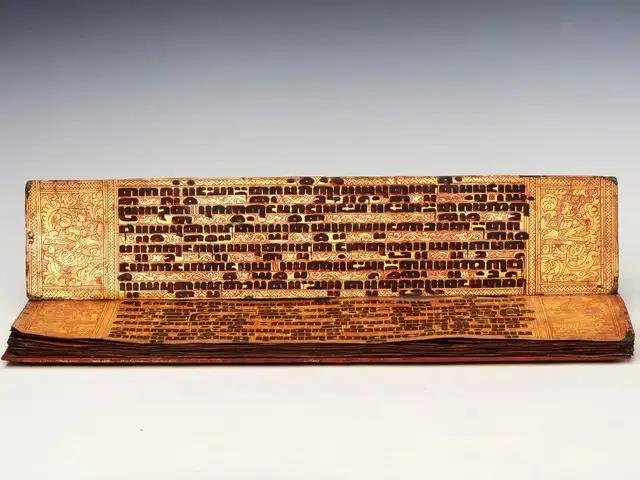
The Vishnu Purana is traditionally counted among the 18 Mahapuranas and is the third Purana in our series.
It is one of the important texts of the Vaishnava tradition, with Lord Vishnu as a central divine figure. The Purana discusses creation, cosmic cycles, genealogies, dharma, devotion, the avatars of Vishnu, and the stories of important kings and sages.


Image ALT: Ancient Sanskrit manuscript representing the Vishnu Purana and Vaishnava literary tradition
What Is the Vishnu Purana?
The Vishnu Purana is an ancient Sanskrit Purana traditionally associated with Lord Vishnu.
It presents a broad account of the universe and human life through stories and teachings. Its subjects include:
- Creation of the universe
- Destruction and recreation
- Genealogies
- Manvantaras
- Stories of kings
- Stories of sages
- Vishnu’s avatars
- Dharma
- Bhakti
- Krishna
- Cosmic time
- The Kali Yuga


Image ALT: Lord Vishnu with traditional attributes representing the Vishnu Purana
The Purana presents Vishnu as a supreme divine principle and describes the universe through a distinctly Vaishnava theological perspective.
Who Narrates the Vishnu Purana?
The Vishnu Purana is presented through a traditional chain of teaching.
A famous framework involves the sage Maitreya asking questions and Parashara providing the teachings.
This question-and-answer format is common in Puranic literature.


Image ALT: Ancient Indian sage teaching disciples representing the traditional narration of the Vishnu Purana
Through their conversation, the Purana explores the nature of creation, divine manifestations, dharma and spiritual knowledge.
The Six Parts of the Vishnu Purana
The Vishnu Purana is traditionally divided into six Amshas, or parts.
They are:
- First Amsha
- Second Amsha
- Third Amsha
- Fourth Amsha
- Fifth Amsha
- Sixth Amsha
Each part covers different aspects of cosmology, mythology, genealogy, religious practice and spiritual teachings.
First Amsha – Creation and Cosmic Order
The first part begins with discussions concerning creation.
It describes the origins of the universe and the manifestation of different beings.


Image ALT: Lord Vishnu representing cosmic creation and preservation in traditional Indian art
The Purana describes creation as part of a larger cosmic cycle rather than as an isolated event.
It also introduces important divine and ancestral figures.
Prakriti and the Universe
The Vishnu Purana discusses Prakriti, the primordial material principle, and the development of the universe.
It describes the emergence of different elements and cosmic principles.
The Purana therefore combines mythology with a traditional philosophical explanation of how the universe comes into existence.


Image ALT: Traditional Hindu cosmological representation of the universe described in Puranic literature
The Avatars of Lord Vishnu
One of the most famous features of the Vishnu Purana is its discussion of Vishnu’s avatars.
The avatar concept describes the manifestation of the divine in different forms for the protection of dharma and the restoration of cosmic order.
Some famous avatars include:
- Matsya
- Kurma
- Varaha
- Narasimha
- Vamana
- Parashurama
- Rama
- Krishna


Image ALT: Traditional Indian depiction of the Dashavatara, the avatars of Lord Vishnu
The Vishnu Purana contains narratives concerning several of these divine manifestations.
Varaha Avatar
The Varaha, or boar incarnation, is one of the important stories in Puranic literature.
According to the traditional narrative, Vishnu takes the form of Varaha and rescues the Earth from the cosmic waters.


Image ALT: Varaha avatar of Lord Vishnu lifting Goddess Earth in traditional Indian art
The story represents the restoration of cosmic order and balance.
Narasimha Avatar
The Narasimha avatar is another famous Vishnu narrative.
Narasimha appears as a being who is part human and part lion.
The story is closely connected with Prahlada, a devoted follower of Vishnu, and the powerful king Hiranyakashipu.


Image ALT: Lord Narasimha protecting Prahlada in traditional Indian art
The story is traditionally understood as demonstrating the power of devotion and divine protection.
Vamana Avatar
The Vamana story centres on the generous king Mahabali.
Vishnu appears as Vamana, a dwarf Brahmin, and asks Mahabali for as much land as can be covered in three steps.


Image ALT: Vamana avatar of Lord Vishnu and King Mahabali in traditional Indian art
The story is one of the famous narratives associated with Vishnu’s avatars.
Lord Rama in the Vishnu Purana
The Vishnu Purana also connects Lord Rama with Vishnu’s avatar tradition.
Rama’s story represents ideals such as:
- Dharma
- Truth
- Courage
- Responsibility
- Loyalty
- Sacrifice


Image ALT: Lord Rama with Sita, Lakshmana and Hanuman representing the Rama avatar tradition
The Rama tradition became one of the most influential stories in Indian culture.
Krishna in the Vishnu Purana
The Fifth Amsha is particularly important because it contains an extensive account of Lord Krishna.
It describes Krishna’s birth, childhood, family, battles and divine activities.


Image ALT: Lord Krishna as a child representing the Krishna narratives of the Vishnu Purana
Stories include Krishna’s childhood in Gokula and Vrindavana, his interactions with the cowherd community and his eventual role in major events.
Krishna and Kamsa
One of the important Krishna stories is the conflict between Krishna and Kamsa, the ruler of Mathura.
Kamsa fears Krishna because of a prophecy concerning his death.
Krishna eventually confronts Kamsa and defeats him.


Image ALT: Lord Krishna defeating Kamsa in traditional Indian art
The story is often understood as a victory of dharma over tyranny.
Krishna’s Childhood Stories
The Vishnu Purana contains several stories from Krishna’s childhood.
These include narratives involving:
- Gokula
- Vrindavana
- Yashoda
- Nanda
- Balarama
- Kamsa
- Krishna’s divine activities


Image ALT: Young Krishna with Mother Yashoda representing the childhood stories of the Vishnu Purana
These stories became deeply influential in later Indian devotional traditions.
Balarama
The Vishnu Purana also describes Balarama, Krishna’s elder brother.
Balarama plays an important role in the Vrishni and Yadava traditions.


Image ALT: Krishna and Balarama representing the Yadava tradition in the Vishnu Purana
Balarama is traditionally associated with strength and agricultural symbolism.
The Yadava Dynasty
The Vishnu Purana contains extensive genealogical material.
It discusses the Yadava dynasty, the family lineage associated with Krishna.


Image ALT: Traditional depiction of the Yadava dynasty associated with Lord Krishna
Genealogies are an important part of Puranic literature because they connect divine stories with legendary and royal lineages.
Dhruva – The Devoted Child
One of the most inspiring stories associated with the Vishnu Purana is the story of Dhruva.
Dhruva is a young prince who experiences rejection and hardship.
He undertakes intense devotion and meditation and eventually receives the blessing of Vishnu.


Image ALT: Young Dhruva meditating upon Lord Vishnu in traditional Indian art
Dhruva’s story is remembered as an example of determination, devotion and spiritual achievement.
Prahlada – The Power of Devotion
Another famous devotee is Prahlada.
Prahlada remains devoted to Vishnu despite opposition from his father, Hiranyakashipu.


Image ALT: Devotee Prahlada praying to Lord Vishnu in traditional Indian art
His story emphasizes the idea that sincere devotion can remain strong even during difficult circumstances.
The Story of Prithu
The Vishnu Purana also contains the story of King Prithu.
Prithu is described as an important ruler and is associated with the prosperity and proper administration of the Earth.


Image ALT: King Prithu and the Earth represented in traditional Indian Puranic art
The story presents the king as someone responsible for the welfare of his people.
Cosmic Time in the Vishnu Purana
The Vishnu Purana gives considerable attention to time and cosmic cycles.
It describes:
- Yugas
- Mahayugas
- Manvantaras
- Kalpas
- Cycles of creation and dissolution


Image ALT: Traditional Indian representation of cosmic cycles and the Yugas described in the Vishnu Purana
This cyclical understanding of time is an important feature of traditional Hindu cosmology.
The Four Yugas
The Vishnu Purana describes the four Yugas:
Satya Yuga
The age associated with righteousness and virtue.
Treta Yuga
The second age in the traditional cycle.
Dvapara Yuga
The third age, associated with the decline of dharma compared with earlier ages.
Kali Yuga
The fourth and final age of the cycle, traditionally associated with further decline of dharma.

Image ALT: Four Yugas representing the cyclical concept of time in the Vishnu Purana
The Kali Yuga
The Vishnu Purana contains a description of the Kali Yuga and the changes expected during this age.
It describes a decline in traditional social and moral values and discusses the characteristics associated with the final age of the cycle.

Image ALT: Traditional Indian artistic representation of Kali Yuga and the decline of dharma
These descriptions form part of the Purana’s larger teaching about cyclical time and cosmic change.
The End of the Yuga Cycle
The Vishnu Purana describes the eventual transformation of the world at the end of the Kali Yuga.
The cycle then moves toward a new age of righteousness.
This reflects the broader Puranic concept that creation is cyclical rather than permanently linear.
Dharma in the Vishnu Purana
Dharma is an important theme throughout the Vishnu Purana.
The text presents ideas concerning:
- Righteous conduct
- Duties
- Charity
- Truth
- Devotion
- Self-control
- Responsibilities of rulers
- Spiritual discipline


Image ALT: Ancient Indian sage teaching spiritual and dharmic principles
The teachings are often presented through stories so that moral principles become easier to understand and remember.
Vishnu Purana and Bhakti
The Purana places strong emphasis on devotion to Vishnu.
Bhakti is presented as a powerful path through which a person can develop a relationship with the divine.


Image ALT: Devotee praying to Lord Vishnu representing Bhakti in the Vishnu Purana
Stories of Dhruva, Prahlada and other devotees demonstrate different forms of devotion.
Vishnu Purana and Sacred Knowledge
The Purana is not only a collection of mythology.
It also preserves traditional discussions of:
- Cosmology
- Genealogy
- Geography
- Dharma
- Philosophy
- Ritual
- Spiritual practice
This makes the Vishnu Purana useful for understanding several aspects of traditional Indian thought.
Why Is the Vishnu Purana Important?
1. Vishnu Tradition
It is one of the major texts associated with Vaishnava traditions.
2. Krishna Stories
It preserves important narratives concerning Krishna.
3. Avatar Tradition
It discusses several manifestations of Vishnu.
4. Cosmic Time
It provides descriptions of Yugas and larger cosmic cycles.
5. Genealogy
It preserves traditions concerning ancient dynasties and lineages.
6. Dharma and Bhakti
It communicates spiritual and ethical teachings through stories.
Vishnu Purana – Quick Facts
Series: 18 Mahapuranas – Part 3
Name: Vishnu Purana
Traditional Association: Lord Vishnu
Language: Sanskrit
Major Themes: Creation, cosmology, genealogy, avatars, dharma, bhakti and sacred traditions
Important Figures: Vishnu, Krishna, Rama, Dhruva, Prahlada, Prithu and many sages and kings
Important Section: Fifth Amsha – Krishna narratives
Major Tradition: Vaishnavism
What Can We Learn From the Vishnu Purana?
The Vishnu Purana teaches several important ideas through its stories.
Devotion
Dhruva and Prahlada demonstrate unwavering devotion.
Dharma
Kings and ordinary people are repeatedly reminded of their responsibilities.
Courage
Many divine stories describe the struggle against injustice.
Discipline
Spiritual growth is connected with self-control and dedication.
Cosmic Perspective
The Yuga cycle encourages a view of history within a much larger cosmic framework.
Frequently Asked Questions
What is the Vishnu Purana?
The Vishnu Purana is one of the traditional 18 Mahapuranas and an important text of the Vaishnava tradition.
Who is the main deity of the Vishnu Purana?
Lord Vishnu is the central divine figure.
Who narrates the Vishnu Purana?
The text is traditionally presented through the dialogue between Sage Maitreya and Sage Parashara.
Does the Vishnu Purana contain Krishna stories?
Yes. The Fifth Amsha contains extensive narratives concerning Krishna.
Does it discuss Vishnu’s avatars?
Yes. The Purana contains narratives concerning several avatars of Vishnu.
Who is Dhruva?
Dhruva is a young devotee whose intense devotion to Vishnu becomes one of the famous stories of Puranic literature.
Who is Prahlada?
Prahlada is a famous devotee of Vishnu associated with the Narasimha story.
What are the four Yugas?
They are Satya, Treta, Dvapara and Kali Yuga.
Why is the Vishnu Purana important?
It preserves important traditions concerning Vishnu, Krishna, avatars, cosmology, dharma, genealogy and bhakti.
Conclusion
The Vishnu Purana – Part 3 takes us deeper into one of the most important texts of the Mahapurana tradition.
From the creation of the universe to the great cycles of cosmic time, from the avatars of Vishnu to the stories of Dhruva and Prahlada, and from the childhood of Krishna to the traditions of the Yadava dynasty, the Purana contains a vast collection of stories and teachings.
Its central message repeatedly returns to the importance of dharma, devotion and the preservation of cosmic order.
The Vishnu Purana also shows how mythology, genealogy, cosmology and spiritual teaching were brought together into a single literary tradition.
For anyone interested in Vishnu, Krishna, Hindu mythology, ancient Indian literature and Puranic traditions, the Vishnu Purana is an important text to explore.
This is Part 3 of our 18 Mahapuranas series.
Leave a Reply