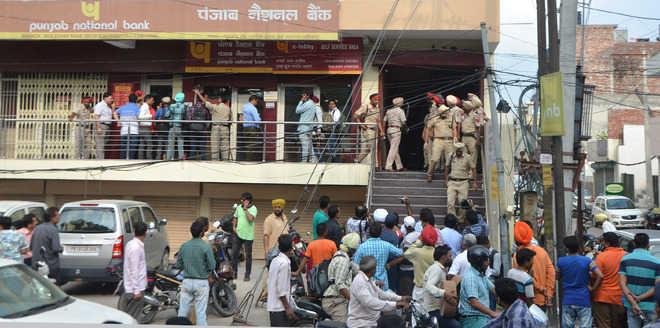

India has witnessed some extraordinary robberies over the decades—from criminals digging tunnels beneath bank buildings to gangs posing as police officers and stealing crores of rupees.
Some of these crimes were carefully planned for months. Others depended on deception, insider knowledge or simply exploiting weaknesses in security.
The amounts involved have changed dramatically with time. A few lakh rupees once represented an enormous fortune, while modern heists have involved crores of rupees worth of cash or gold.
Here are some of the most remarkable and widely reported major robberies in India’s history.
1. The 1987 Ludhiana PNB Robbery
One of India’s Most Famous Bank Heists
One of the most notorious bank robberies in Indian history took place in Ludhiana, Punjab, in February 1987.
A group of armed men entered a Punjab National Bank branch and reportedly posed as police officers. The deception allowed them to gain access to the premises and overpower security personnel.
According to contemporary reports, the gang escaped with approximately ₹5.7 crore. At the time, the amount was extraordinary, and the robbery was widely described as the biggest bank robbery in India. Contemporary international reports put the value at around US$4.5 million.
The robbery was later associated with the Khalistan militant movement, and the stolen money was alleged to have been used to finance militant activities.
The case continued for decades. In 2017, the Supreme Court acquitted nine people who had previously been convicted under TADA, holding that the prosecution had failed to establish that ₹60 lakh recovered from the accused was part of the stolen money.


2. The ₹100-Crore PNB Locker Heist in Haryana
A Tunnel Leads Directly Into the Bank
Another extraordinary case occurred in Sonipat, Haryana, in 2014.
This robbery became famous because of an underground tunnel.
According to reports, the criminals began digging a tunnel from an abandoned house near the Punjab National Bank branch.
The tunnel reportedly extended for approximately 125 feet and eventually reached the bank’s strong-room area.
The robbers targeted lockers inside the bank. Reports said that the bank contained hundreds of lockers and that the gang broke open or accessed dozens of them.
The estimated value of valuables taken from the lockers was reported at around ₹100 crore, making it one of the largest locker robberies reported in India.
Unlike a conventional armed robbery, this crime relied heavily on planning, patience and secrecy.
The criminals did not simply walk into the bank.
They attempted to reach the valuables from underneath the building.


3. The 1968–69 Kolkata Robbery Series
When Robberies Were Called “Revolutionary” Acts
One of the most unusual robbery stories comes from Kolkata in the late 1960s.
Beginning in July 1968, a group carried out a series of robberies targeting financial institutions.
The first major incident involved the Park Street Post Office, where approximately ₹3.97 lakh was reportedly taken.
Over the following months, other targets included National & Grindlays Bank branches and the Park Street branch of the State Bank of India.
The total amount taken in the series was reported to be approximately ₹12 lakh.
What made the case particularly unusual was the way the robbers described themselves. According to later reporting, they told victims that they were not ordinary criminals but revolutionaries.
The police investigation became one of Kolkata’s famous unsolved crime stories for decades.


5
4. The ₹8.49-Crore Ludhiana Cash Management Robbery
A Modern Cash-Centre Heist
In 2023, Ludhiana again became the scene of a major robbery.
This time, the target was not a traditional bank branch but the office of a cash-management company.
According to the FIR reported by the Indian Express, a group of robbers entered the company’s office in Ludhiana and escaped with at least ₹8.49 crore. Police investigated the possibility of insider involvement as part of the case.
The incident demonstrated how modern financial crimes can target not only banks but also companies responsible for handling and transporting large amounts of cash.


5. The ₹13-Crore Gold Robbery in Karnataka
A Bank Heist Inspired by Crime Fiction
In October 2024, a major gold robbery took place at an SBI branch in Nyamati, Davanagere district, Karnataka.
According to police investigations reported in 2025, approximately 17 kg of gold, valued at around ₹13 crore, was stolen.
The investigation later led to arrests, and police reported recovering most of the stolen gold.
One particularly unusual detail emerged during the investigation: police said the main accused had been influenced by crime videos and the television series Money Heist while planning the crime.
Unlike some older cases that remained unresolved for years, this case was eventually cracked by investigators.


4
6. The 2025 Karnataka Gold Heist
Nearly 59 Kilograms of Gold
Another extraordinary robbery was reported in Karnataka in May 2025.
According to India Today, unidentified robbers targeted a Canara Bank branch in Managuli, Vijayapura district.
The reported haul was approximately 59 kg of pledged gold jewellery, along with around ₹5.2 lakh in cash.
Investigators said the robbers had disabled the alarm system and used a fake key to access a particular locker. A strange object resembling a black-magic doll was reportedly left behind, apparently intended to mislead investigators.
The enormous quantity of gold made this one of the most striking recent bank robberies reported in India.


Why Were These Robberies So Successful?
Although every case was different, several common factors can be seen.
Careful Planning
Large robberies rarely happen completely spontaneously.
The criminals involved in major cases often appear to have studied the target, its security arrangements and the movement of money or valuables beforehand.
Deception
The 1987 Ludhiana robbery demonstrated how powerful deception could be.
The robbers reportedly presented themselves as police officers, exploiting the trust normally associated with law-enforcement personnel.
Knowledge of the Target
In some cases, criminals appeared to know exactly where valuables were stored.
The Haryana tunnel case, for example, involved a tunnel reaching the strong-room area of a bank.
Weak Security
Every successful robbery exposes weaknesses.
Modern banks and financial institutions therefore continuously upgrade alarms, surveillance systems, access controls and cash-handling procedures.
A 1987 parliamentary response regarding bank robberies noted that public-sector banks were reviewing security arrangements and issuing additional guidelines where necessary.
The Difference Between a Robbery, Theft and Heist
These words are often used interchangeably, but there are differences.
Robbery generally involves taking property through force or threat.
Theft involves taking property without the victim’s consent, usually without direct confrontation.
Heist is a popular term for a carefully planned major theft or robbery, particularly one involving money, valuables or a high-value target.
The cases discussed in this article include different types of crimes, so calling all of them simply “bank robberies” can sometimes be misleading.
What Happened to the Stolen Money?
One of the biggest questions in major robberies is what happens to the loot afterward.
Large quantities of cash and gold are difficult to hide permanently.
Police investigations often focus on:
- Where the stolen property was taken
- Who helped move it
- Whether insiders were involved
- Where money or gold was sold
- Financial transactions after the crime
- Vehicles and communication records
- CCTV and forensic evidence
In the 2024 Karnataka gold robbery, for example, investigators eventually recovered much of the stolen gold and arrested suspects.
The Biggest Robberies Were Not Always the Most Clever
A huge amount of stolen money does not necessarily mean a perfect crime.
Some robberies involved elaborate planning but were eventually solved.
Others remained mysteries for years.
The Kolkata robbery series of the late 1960s, for example, remained a famous unsolved case for decades before later developments shed more light on what happened.
Meanwhile, some modern cases have been solved relatively quickly because of better CCTV networks, digital evidence, forensic techniques and financial tracking.
How Banking Security Has Changed
The world of banking has changed dramatically.
Decades ago, security depended heavily on physical guards, locks and basic alarm systems.
Today, financial institutions can use:
- CCTV surveillance
- Electronic access controls
- Alarm systems
- Strong-room security
- GPS tracking
- Digital transaction monitoring
- Forensic technology
- Improved police coordination
Technology has therefore made some forms of traditional robbery more difficult.
At the same time, criminals continually search for new weaknesses.
Conclusion
India’s history of major robberies is filled with stories that sound almost unbelievable.
There was the 1987 Ludhiana bank robbery, in which criminals reportedly escaped with ₹5.7 crore.
There was the Haryana tunnel robbery, where criminals reportedly dug their way into a bank’s strong-room area.
There were the unusual Kolkata robberies of 1968–69, which remained famous for decades.
And in recent years, massive gold and cash heists have shown that large-scale financial crime has not disappeared.
But behind every spectacular robbery is a serious reality: victims, financial losses and years of investigation.
These cases are interesting from a historical and investigative perspective, but they also demonstrate why strong security systems, responsible banking practices and effective law enforcement are essential.
The most fascinating part of these stories is not the money itself.
It is how investigators eventually try to answer one question:
Leave a Reply