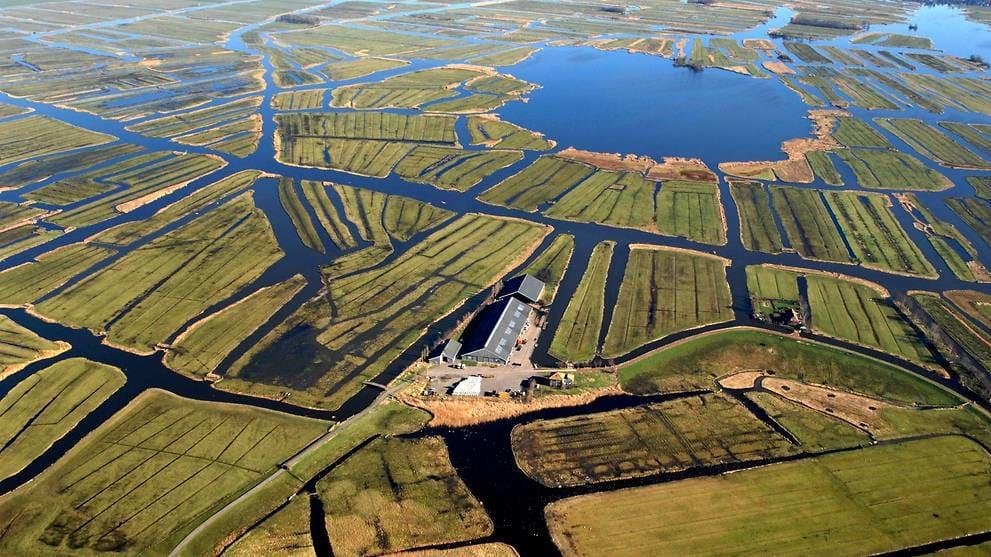
Imagine looking at a map and discovering that some of the land beneath your feet was once covered by the sea.
It sounds impossible.
But in the Netherlands, this is part of everyday reality.
For centuries, the Dutch people have fought a continuous battle against water by building dikes, dams, canals, pumping systems and reclaimed land.
The result is one of the world’s most remarkable examples of how humans can reshape their environment.
The Netherlands is not simply a country surrounded by water.
It is a country that learned how to live with water — and, in some places, how to push it back.


🌊 Why Does the Netherlands Have So Much Water?
The Netherlands is located in northwestern Europe, along the North Sea.
A significant part of the country is extremely low-lying.
Some areas are even below sea level.
Several major European rivers, including the Rhine, Meuse and Scheldt, flow through the Netherlands before reaching the North Sea.
This geography gives the country enormous advantages for trade and agriculture.
But it also creates a serious problem:
Water can become a threat.
Flooding has been one of the major dangers in Dutch history.
So the Dutch developed increasingly sophisticated ways to manage it.
🏞️ What Is a Polder?
One of the most fascinating Dutch inventions is the:
Polder
A polder is land that has been artificially drained and protected from surrounding water.
The basic process can involve:
Water → Dike → Pumping → Drainage → Usable Land
Once water is removed from an enclosed area, the land can potentially be used for:
- Farming
- Housing
- Roads
- Industry
- Nature reserves
This is one of the reasons the Netherlands looks so different from many other countries.


🚜 How Can Land Below Sea Level Be Safe?
This is perhaps the most surprising question.
If land is below sea level, why doesn’t seawater simply cover it?
The answer is a complex system of dikes, drainage channels, pumps and water-management infrastructure.
Water is continuously managed.
It may be:
- Diverted
- Stored
- Pumped
- Drained
- Released through controlled systems
The system has to be maintained constantly.
So living below sea level doesn’t mean water has disappeared.
It means humans are continuously managing where the water is allowed to go.
🌬️ The Famous Dutch Windmills Had a Practical Purpose
When people hear the word Netherlands, they often imagine traditional windmills.
Many people associate them with beautiful scenery and tourism.
But historically, windmills had a much more practical role.
Some were used to pump water out of low-lying areas.
Wind-powered pumping systems helped drain land and maintain polders.
This means the famous Dutch windmill is not just a cultural symbol.
It is also part of the history of Dutch water engineering.
⚙️ From Windmills to Modern Pumps
Technology has changed dramatically.
Modern Dutch water management relies on advanced infrastructure rather than depending mainly on traditional windmills.
Today, the country uses:
- Large pumping stations
- Dikes
- Storm-surge barriers
- Canals
- Sluices
- Reservoirs
- Digital monitoring systems
The principle, however, remains similar:
Keep water under control without destroying the natural environment.


🏗️ The Delta Works: One of the World’s Greatest Water Projects
One of the most impressive examples of Dutch engineering is the:
Delta Works
The Delta Works is a huge network of dams, barriers, dikes, sluices and other structures designed to protect the southwestern Netherlands from flooding.
It was developed after a catastrophic flood in 1953.
That disaster demonstrated how vulnerable parts of the Netherlands could be to extreme coastal flooding.
The country responded with one of the largest water-engineering programmes in its history.
🌊 The 1953 North Sea Flood
In the early hours of 1 February 1953, a severe North Sea storm caused catastrophic flooding across parts of the Netherlands.
Thousands of people lost their lives in the Netherlands, and the disaster caused enormous damage.
The event became a turning point in Dutch water-management policy.
Instead of simply repairing damaged infrastructure, the country began developing a much larger long-term strategy for flood protection.
The disaster changed the way the Netherlands thought about water.
🚪 The Maeslantkering: A Giant Door for the Sea
One of the most extraordinary structures in the Netherlands is the:
Maeslantkering
It is a massive movable storm-surge barrier near Rotterdam.
When ordinary conditions exist, the barrier remains open so ships can pass through.
But when a severe storm threatens, the giant gates can close to protect the surrounding region.
This is an incredible combination of:
Engineering + Automation + Water Management
🚢 Why Rotterdam Needs This Protection
Rotterdam is one of Europe’s most important ports.
The city’s location is closely connected to the North Sea and major rivers.
Its position provides enormous economic advantages.
Ships can travel inland through waterways, connecting the port with markets across Europe.
But the same geography creates flood risks.
That is why water protection is not simply an environmental issue.
It is also an economic necessity.


🌷 How Did the Netherlands Turn Water Into Farmland?
Some reclaimed areas are now used for agriculture.
This has helped the Netherlands become a major agricultural producer despite its relatively small size.
Dutch agriculture is particularly known for:
- Flowers
- Vegetables
- Dairy
- Greenhouse farming
- Seeds
- Agricultural technology
The famous Dutch flower industry is closely connected with this highly productive agricultural system.
🌷 The Netherlands and the World’s Flowers
When people think about the Netherlands, tulips often come to mind.
Tulips are deeply associated with Dutch culture and tourism.
Every spring, large areas of the country can become covered with colourful flower fields.
The combination of:
Reclaimed land + sophisticated agriculture + greenhouse technology
has helped make the Netherlands internationally famous for horticulture.


🧠 The Dutch Secret: Don’t Always Fight Water — Work With It
This may be the most important lesson from the Netherlands.
Modern Dutch water management is not simply about building higher and higher walls.
Increasingly, the philosophy also involves giving water space.
This can mean:
- Restoring wetlands
- Creating flood storage areas
- Moving dikes where appropriate
- Designing cities to handle heavy rainfall
- Creating waterways and retention areas
The idea is:
Instead of asking only “How do we stop the water?” ask “Where can the water safely go?”
This approach is becoming increasingly important as climate change affects sea levels and extreme rainfall.
🏙️ How Dutch Cities Are Preparing for the Future
Cities in the Netherlands have been experimenting with ways to manage heavy rainfall.
Urban areas can use:
- Water plazas
- Green roofs
- Rain gardens
- Permeable surfaces
- Temporary water-storage areas
These approaches allow cities to temporarily store excess rainwater instead of allowing drainage systems to become overwhelmed.
It is an example of how urban design can become part of climate adaptation.
🌍 Why Is the Netherlands Important for the Future?
Climate change is increasing concerns about:
- Rising sea levels
- Extreme rainfall
- Coastal flooding
- River flooding
The Netherlands has centuries of experience dealing with water.
That makes Dutch engineering and water-management expertise valuable internationally.
Dutch experts have worked with communities around the world on issues involving:
- Coastal protection
- Flood management
- Urban water systems
- River management
- Climate adaptation
🤯 10 Amazing Facts About the Netherlands
1️⃣ Parts of the Netherlands are below sea level.
2️⃣ The country has built extensive systems of dikes and barriers to manage flood risk.
3️⃣ Polders are areas of land reclaimed and maintained through water management.
4️⃣ Traditional Dutch windmills were sometimes used to pump water.
5️⃣ The Delta Works is one of the country’s most famous engineering achievements.
6️⃣ The devastating 1953 North Sea Flood transformed Dutch flood-protection policy.
7️⃣ The Maeslantkering is a giant movable storm-surge barrier near Rotterdam.
8️⃣ Water management is deeply connected with the Dutch economy and agriculture.
9️⃣ The Netherlands is internationally famous for flowers, especially tulips.
🔟 Dutch water-management techniques are increasingly relevant to a world facing climate-related risks.
🇳🇱 The Netherlands Is More Than Tulips and Windmills
Tourists may visit the Netherlands for:
🌷 Tulips
🚲 Bicycles
🌬️ Windmills
🏠 Beautiful canals
🎨 Museums
🏙️ Amsterdam
But beneath all of that lies a much more extraordinary story.
For centuries, Dutch society has had to answer one fundamental question:
How do you build a successful country when water is always nearby?
Their answer was not one invention.
It was generations of engineering, planning, maintenance and adaptation.
🌊 The Incredible Lesson of the Netherlands
The Netherlands teaches us something that goes far beyond geography.
Nature cannot always be controlled.
But humans can learn to understand natural forces and design societies that live with them.
The Dutch transformed wetlands into farmland, built cities below sea level, protected major ports and developed some of the world’s most sophisticated flood-management systems.
Yet their greatest achievement may not be keeping water out.
It may be learning when to keep water out — and when to give water room.
That is what makes the Netherlands one of the most fascinating countries in the world.
Leave a Reply