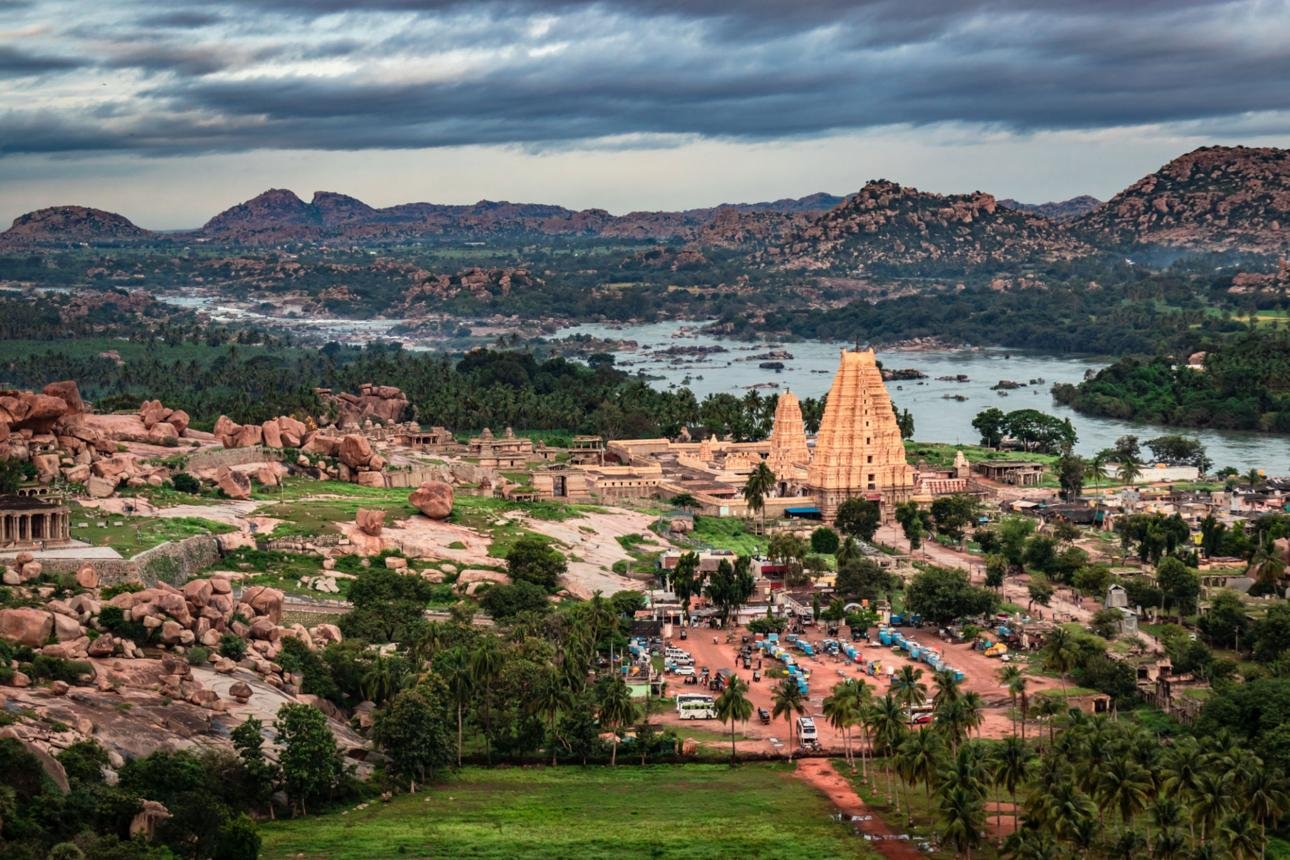
Imagine walking through a landscape filled with giant boulders, ancient temples, massive gateways and ruined palaces.
At first, it may look like a strange natural landscape.
Then you notice the carvings.
Huge stone pillars.
Old markets.
Temple towers.
And suddenly you realize—you are standing inside the remains of one of the greatest cities of medieval India.
This is Hampi, in Karnataka.


👑 The City of the Vijayanagara Empire
Hampi was the capital of the Vijayanagara Empire, one of the most powerful kingdoms of southern India.
At its height, Vijayanagara was a major political, commercial and cultural centre.
Merchants, travellers, soldiers, artists and pilgrims passed through the city.
What remains today gives us an idea of how enormous and sophisticated this settlement once was.
🪨 A City Built Among Giant Rocks
One of the first things visitors notice about Hampi is its unusual landscape.
Huge granite boulders cover the surrounding hills.
Ancient builders used this natural environment while developing the city.
Temples and other structures appear between rocks and hills, creating a landscape unlike almost anywhere else in India.


It is almost as though nature and architecture were designed together.
🛕 Virupaksha Temple
One of Hampi’s most famous landmarks is the Virupaksha Temple.
The temple is dedicated to Lord Shiva and remains an important place of worship.
Its enormous gateway tower rises above the surrounding landscape and has become one of the most recognizable images of Hampi.


Unlike many ruins in Hampi, the temple continues to have religious significance today.
That makes the site more than an archaeological monument.
It is also a living heritage site.
🛍️ The Ancient Market Streets
Hampi once had large market areas associated with temples and major roads.
Some surviving structures reveal rows of stone platforms that were once associated with commercial activity.
Imagine these streets centuries ago.
Merchants displaying goods.
Travellers arriving from distant regions.
Animals carrying cargo.
Pilgrims moving toward temples.
The city must have been incredibly busy.


💎 A Centre of Trade
Historical accounts describe Vijayanagara as a wealthy and commercially active city.
Trade brought valuable goods from different parts of India and beyond.
Markets were an important part of urban life.
The wealth generated through agriculture, commerce and political power helped support magnificent temples and public buildings.
🏰 The Royal Enclosure
Hampi was not only a religious centre.
It was also the heart of an enormous empire.
The Royal Enclosure contains remains associated with the political and administrative centre of the city.


Although many structures were destroyed over time, surviving foundations and monuments provide clues about the scale of the former capital.
🐘 Elephant Stables
One of Hampi’s most visually impressive surviving structures is the Elephant Stables.
The long building contains a series of large chambers with distinctive domes and architectural details.


The building demonstrates the importance of elephants in the royal and military world of the Vijayanagara period.
🌸 Lotus Mahal
Another famous structure is the Lotus Mahal.
Its elegant form is very different from the massive temple structures surrounding it.
The building’s name comes from its lotus-like architectural appearance.


It is one of the most photographed monuments in Hampi.
🛕 Vittala Temple and the Stone Chariot
The Vittala Temple is perhaps one of Hampi’s most famous monuments.
Its complex is known for elaborate architecture and the iconic Stone Chariot.


The stone chariot has become one of the symbols of Karnataka’s heritage.
The temple complex also contains intricately carved pillars and halls.
🎵 The Famous Musical Pillars
The Vittala Temple is particularly famous for its carved pillars traditionally associated with musical sounds.
These pillars have attracted generations of visitors and have become an important part of Hampi’s architectural story.
However, visitors should not strike or hit the pillars.
The structures are ancient heritage and need to be protected from damage.
🌊 The Tungabhadra River
The Tungabhadra River flows beside Hampi.
The river was extremely important to the development of the city.
Water supported agriculture, settlements and everyday life.


Even today, the river adds a peaceful contrast to the dramatic ruins.
⚔️ How Did Hampi Become Ruins?
The decline of Hampi is closely connected to the Battle of Talikota in 1565.
The Vijayanagara forces were defeated by a coalition of Deccan Sultanates.
The capital was subsequently devastated, and its political importance declined dramatically.
Over time, the once-great city became a landscape of ruins.
Yet its monuments survived.
🌅 Hampi Today
Today, Hampi is one of India’s most important heritage destinations.
The ruins attract travellers, photographers, history enthusiasts and architecture lovers from around the world.
The entire landscape feels like an open-air museum.
But unlike a conventional museum, Hampi has no roof.
Its galleries are hills.
Its walls are temples.
Its pathways are ancient streets.


📸 Why Photographers Love Hampi
Hampi offers an incredible variety of subjects:
- 🛕 Ancient temples
- 🪨 Giant boulders
- 🌅 Sunrise and sunset
- 🌊 Tungabhadra River
- 🏛️ Ruined palaces
- 🐘 Elephant Stables
- 🛕 Stone Chariot
- 🌴 Palm trees and landscapes
The warm light around sunrise and sunset can transform the stone structures completely.
🤯 Hampi’s Biggest Mystery
Perhaps the most fascinating question is not what remains.
It is:
What did Hampi look like when it was alive?
Today we see ruins.
But centuries ago, the same landscape contained busy streets, functioning temples, royal ceremonies, markets, homes and enormous crowds.
The ruins give us only fragments of that world.
Our imagination has to fill in the rest.
❓ Frequently Asked Questions
Where is Hampi?
Hampi is located in Vijayanagara district of Karnataka, beside the Tungabhadra River.
Why is Hampi famous?
It is famous for the ruins of the Vijayanagara Empire, magnificent temples, the Stone Chariot, giant boulder landscape and historical significance.
Who built Hampi?
Hampi developed as the capital of the Vijayanagara Empire, which was founded in the 14th century.
What happened to Hampi?
The city suffered major destruction after the Vijayanagara defeat at the Battle of Talikota in 1565.
Is Hampi a UNESCO World Heritage Site?
Yes. The Group of Monuments at Hampi is recognized as a UNESCO World Heritage Site.
Is Hampi still a living place?
Yes. Hampi is not simply an abandoned archaeological site. The Virupaksha Temple continues to function as a place of worship, and local communities live around the heritage landscape.
🌟 Final Thoughts
Hampi is one of those places where history feels unusually close.
You can stand beside a temple pillar and imagine the people who carved it.
Walk through an ancient market and imagine merchants selling goods centuries ago.
Look across the boulders and wonder how a massive city once filled this landscape.
Today, Hampi may be a collection of ruins.
But those ruins tell an enormous story.
A story of empire.
A story of art.
A story of faith.
A story of trade.
And ultimately, a story of how even powerful cities can disappear—but their legacy can survive for centuries. 🇮🇳


🇮🇳 MANA BHARATHAM
Stories, Facts & Wonders From India
🌐 Website: allpincodes.online
📖 Blog: MANA BHARATHAM
Know India. Explore India. Celebrate India. 🇮🇳
Leave a Reply